Serf Life
Been here much more than a while
- Location
- Maine Island
Driad’s saddle, tastes like watermelon
Follow along with the video below to see how to install our site as a web app on your home screen.
Note: This feature may not be available in some browsers.


What does the underside look like? Slippery jack is a bolete, meaning that the underside has pores. I betcha that these have somewhat decurrent gills. I'd start with the Jack O'Lantern mushroom, Omphalotus illudens.View attachment 90076Slippery Jack?
Splendid, the violet coral (Clavaria zollingeri). I haven't seen it yet this year. Lots of coral fungi out right now! Lovely.Unreal pretty coral. Never seen one this colorView attachment 90077
That’s it and what I meant, brain wasn’t attached. A couple friends and I hiked out to look at a flush at night few years back and the fluorescence was super neat.What does the underside look like? Slippery jack is a bolete, meaning that the underside has pores. I betcha that these have somewhat decurrent gills. I'd start with the Jack O'Lantern mushroom, Omphalotus illudens.

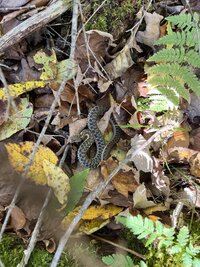

Thanks!Hate to disappoint all the want-it-to-be venomous snake people out there, but it is a Maritime Garter Snake.
Quite common in the eastern part of N.Y. Often found among the leaves.

Technically they are actually venomous. Very mild and less than a wasp. A lot of the taxonomy had a huge wrench thrown in it with venom evolution theory within herpetology. Quite fascinating as all of varanidae and inguanadae are also venomous as in a toxic saliva without a ‘traditional’ delivery method (hollow teeth or grooved teeth).Hate to disappoint all the want-it-to-be venomous snake people out there, but it is a Maritime Garter Snake.
Quite common in the eastern part of N.Y. Often found among the leaves.
I'm talking to this lab via email as a just in casePm me if you run into a block, I have the contact info for a lab in Oregon. I’d think you could find something much closer
The one in Oregon?I'm talking to this lab via email as a just in case