Practical pollarding techniques

Cool thread, I love these photos and discussion.

What is the origin of pollarding? I think I read once that euro farmers did it for some practical reason like making firewood or feed for livestock? I can't clearly remember where I read or heard that. Anyone know?
It was basically a way of taking firewood from a tree without killing it, whilst keeping the regrowth too high for grazing animals to take.
Or in other trees (willow for example ) a more regular cut for animal fodder.
 
I'm sure there's a scientific reason why the tree leaves are darker green on my pollarded sycamore versus a regular sycamore. Does anyone have any ideas why that would be?
 
It was basically a way of taking firewood from a tree without killing it, whilst keeping the regrowth too high for grazing animals to take.
Or in other trees (willow for example ) a more regular cut for animal fodder.
So pollarding is technically a form of coppicing? Like an annual coppice vs 5-10yr more backwoods style for example?
 
So pollarding is technically a form of coppicing? Like an annual coppice vs 5-10yr more backwoods style for example?

I think coppicing is done at shoulder level. I think pollarding is done at whatever highest level can be maintained (by ladder, etc.), or whatever height is arbitrarily pleasing.
 
It is a problematic subject, for the most part because people always try to assign things ’good’ or ‘bad’
One of the most spot on things you’ve said. Amen!
The stumps are called stools.
What did you just call me??

@L3VI, check our Poor Proles Almanac podcast for some episodes on pollarding. They make a good case for the use of Black locust pollarding because if timed properly you can supplement your livestock feed for a couple weeks and there also is some possibility that pruning a nitrogen fixing tree will release even more nitrogen ito the root zone as those roots die post prune. But that might just also be a permaculture wet dream, I haven’t been able to find a study that indicates that for sure.
 
Black locust does pollard and also coppice, killing its the hard part!

Attachement points very weak so regrowth breaks off very easily.
Aesthetically doesn’t look good either.

As a coppice for firewood/fenceposts or biomass it’s fine though.
 
Cool thread, I love these photos and discussion.

What is the origin of pollarding? I think I read once that euro farmers did it for some practical reason like making firewood or feed for livestock? I can't clearly remember where I read or heard that. Anyone know?
That is my understanding too. It started with coppicing, but when livestock became more of a thing they moved it higher up the stem. I believe staves was the primary product, baskets and furniture, arrows, bows etc.. Lots of things to be made from 1-3" limber shoots.
 
There is a real resurgence in interest in coppicing for animal fodder. Never a big deal in the US, even in colonial times, but 19th Century german forestry was all about that, much more than in cutting large sawlogs. I helped with a US project on that resulting in the book: http://www.coppiceagroforestry.com/


No, it's not a guide to proper pollarding of landscape plants, but does go into the history, principles, and practices for coppice and pollard production.
 
How do privets do with pollarding? I'm removing a bunch of trees in a pretty tight area there's smaller privet about 12ft tall somewhat bushy I was thinking may be a good candidate pollarding instead of removing since it's in a good spot as far as keeping privacy between the 3 houses as long as it doesn't get to tall.
 
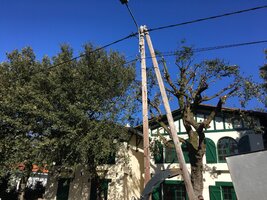
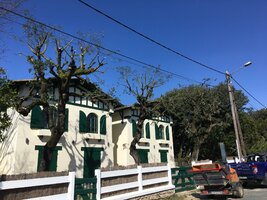
Here’s three Quercus Ilex I did in front of our house.
They had been topped/pollarded multiple times since the houses were built in the 1920s.
I decided to leave sap pullers on every head, though not strictly necessary, as they were my trees I thought I’d go the extra mile.
This was 2 years ago.
2254CBF9-0752-4620-9692-45F27B81B219.jpeg22D5F2EA-57E2-4A33-A820-2D205B8C5ABA.jpeg
 
Last edited:
How do privets do with pollarding? I'm removing a bunch of trees in a pretty tight area there's smaller privet about 12ft tall somewhat bushy I was thinking may be a good candidate pollarding instead of removing since it's in a good spot as far as keeping privacy between the 3 houses as long as it doesn't get to tall.
You can whack the hell out of a privet. Very strong regenerative properties.
 
Hey Mick, nice house! What are sap suckers?

Thanks, it’s our second house on the coast.
The theory is to leave a route for the rising sap to get to a leaf, thereby ensuring flow is maintained.
If you leave nothing there is a chance that the sap (not having a leaf or bud to reach) will cease to flow up that branch and close the branch off.
I mean I don’t think it’s necessary, certainly with this species, but I did it anyway,
My know-it-all BIL owns the other house, and if I killed the trees I’d never hear the last of it!
 
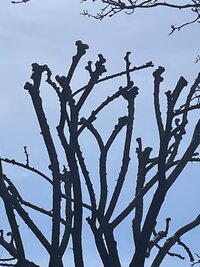
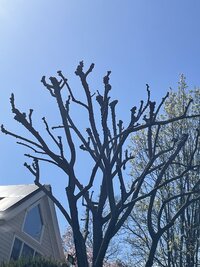
This is my first attempt at a pollard. I started it in 2017. Pruned it for third time today (about every two years) Like @Mick Dempsey oaks i made initial pruning cuts above / close to branch unions, it feels safer that way. However after maintaining them I wish I was braver initially and made heading cuts, I feel like better knobs would have formed. I think they would have been more spherical and easier to maintain, there also would be a lot less of them. Knobs are forming well with very little decay! There are just way to many of them, it takes forever to prune!
 

Attachments

  • 43ED730A-9CA3-46E6-BB66-9B8409D6097F.jpeg
    43ED730A-9CA3-46E6-BB66-9B8409D6097F.jpeg
    276.5 KB · Views: 14
  • D93BE187-644C-4D32-8E56-3CF752B39923.jpeg
    D93BE187-644C-4D32-8E56-3CF752B39923.jpeg
    473.8 KB · Views: 13

New threads New posts

Kask Stihl NORTHEASTERN Arborists Wesspur TreeStuff.com Teufelberger Westminster X-Rigging Teufelberger
Back
Top Bottom