SLD? Rapid expansion due to gasses?

evo

Been here much more than a while
Location
My Island, WA
On one of the Facebook arborist groups I recently heard someone talking about SLD due to the higher temps we have been having causing the moisture in the wood to expand and turn to gasses causing SLD.
Just today on a random walk outside Tacoma, waiting for a doctors appointment for my wife we went into a neighborhood and got caught (friendly ) admiring a huge pin oak. Got chatty with the owner, and apparently a few months ago the tree dropped a 20” limb. He shared the arborists explanation and it was identical! The wood was cut up right next to the tree, so I asked if I could come look. Right at the union there was a deformity on the top of the limb, with a decay pocket that ate away the tension wood to the pith. Quite obviously the cause of the failure but on a calm day in the mid 90’s.
This doesn’t fit the description of SLD, as my understanding has it that it only occurs in sound wood.
It’s been a while since this topic was brought up, and I’m not sure if I’m missing somthing in current knowledge.. I would have taken photos, but didn’t want to creep the guy out.
 
I still think SLD failure is a fake concept. As a fine woodworker said to me “Dead wood is what we build furniture and houses out of”.

So… if high temps cause parts of trees to die by whatever means, that makes sense.

What doesn’t make sense is SLD causing structural failure. That requires some other modality, ie: fungal rot, intrinsic structural flaw, “struck by” something, or wind/weather event.

I’ve witnessed two trees fail on a blue sky windless day and I’ve heard several large limb failures in the woods on calm days. Happens all the time, especially when leaf weight is maxed out on a flawed limb or compromised trunk tree in the growing season.

This black oak had just reached max foliage load late spring/early summer:


-AJ
 
Last edited:
If I recall, decay and oftentimes wet woods/Flux are usually involved. Seen big red and pin oaks "suddenly" drop BIG limbs that were in full leaf and looked healthy but all have always had white rot and discoloration
 
I still think SLD failure is a fake concept...

I’ve witnessed two trees fail on a blue sky windless day and I’ve heard several large limb failures in the woods on calm days. Happens all the time, especially when leaf weight is maxed out on a flawed limb or compromised trunk tree in the growing season...
-AJ

Your last paragraph defines SLD and seems to contradict your first statement, no?

Living trees are constantly changing and reacting to environmental conditions. Sometimes, conditions cause changes in living trees that create loads that exceed structural capacity, with or without an obvious structural flaw.
 
Water (moisture) couldn’t turn to gas/steam in a tree unless it was on fire. The sun couldn’t warm the water to 100c or 212f. Maybe lots of heat and little to no rain could cause the trees moisture levels to drop. No changing states of matter could take place though.
 
I’m sure it’s summer in lieu of sudden although the sudden would fit, I suppose. It was just a guess on my part based off the info given.

If it related to sycamores, it would be Sycamore Leaf Disease
 
Just because it's not a windy day, and dynamic loads are minimal, doesn't mean that static loads have also taken the day off. Last I heard, gravity still never takes a smoke break. If you think of fibers in trees like fibers in ropes, and consider cycles to failure, branches will eventually fail, even on blue sky days.
 
Water (moisture) couldn’t turn to gas/steam in a tree unless it was on fire. The sun couldn’t warm the water to 100c or 212f. Maybe lots of heat and little to no rain could cause the trees moisture levels to drop. No changing states of matter could take place though.
Agreed. I think the only expanding gasses were coming from their mouth.
 
It makes me wonder about drought being a cause of sld. Sure there’s many. It makes sense that it very well would be a reason. Dry wood become brittle. Brittle wood is weak. Week wood fails. Makes you think about a trees moisture content fluctuations and its impact on structural stability.
 
I've seen both summer and sudden. I wasn't "correcting" the sudden ...just augmenting.

Both apply.
Same here. And I’d like to be corrected if wrong, that’s the whole point of the post I want to be updated if anything has changed in the past 10-15 years I’m not privy to.
One of the common thoughts is the water column in trees is under negative pressure. Without looking it up, my thoughts is pressure dramatically effects the boiling point, not sure what negative pressure does.

So could there be some truth?
 
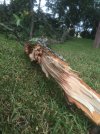
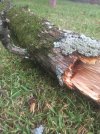
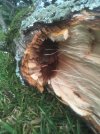
Here’s a pecan limb that broke. Granted I think this happened in some above average winds but, it had some tension wood that just broke. It didn’t really seem like the fibers were healthy. It’s like they broke as if the tissue had become brittle. No external indicators that I know of.
 

Attachments

  • 71AEABDA-1680-42F3-8A6C-B91076F24FBD.jpeg
    71AEABDA-1680-42F3-8A6C-B91076F24FBD.jpeg
    574.8 KB · Views: 17
  • 735BD933-5B5C-44EE-966E-BE1321E33E49.jpeg
    735BD933-5B5C-44EE-966E-BE1321E33E49.jpeg
    636.1 KB · Views: 17
  • DC65E7F5-91D0-419F-A747-94F631585661.jpeg
    DC65E7F5-91D0-419F-A747-94F631585661.jpeg
    488.9 KB · Views: 17
Here’s a pecan limb that broke. Granted I think this happened in some above average winds but, it had some tension wood that just broke. It didn’t really seem like the fibers were healthy. It’s like they broke as if the tissue had become brittle. No external indicators that I know of.
Is that discoloration heart wood or incipient decay?
 
Same here. And I’d like to be corrected if wrong, that’s the whole point of the post I want to be updated if anything has changed in the past 10-15 years I’m not privy to.
One of the common thoughts is the water column in trees is under negative pressure. Without looking it up, my thoughts is pressure dramatically effects the boiling point, not sure what negative pressure does.

So could there be some truth?
To boil water at ambient, the pressure needs to be extremely low, around 700mm Hg vacuum (absolute vacuum is 760mm Hg vacuum.)

Negative pressure isn't really a thing. It's just often more convenient or practical to measure pressure relative to atmospheric pressure. I don't believe there's anything magical about the pressure exerted by the weight of the atmosphere on the insignificant chunk of rock we call Earth.
 

New threads New posts

Kask Stihl NORTHEASTERN Arborists Wesspur TreeStuff.com Teufelberger Westminster X-Rigging Teufelberger
Back
Top Bottom