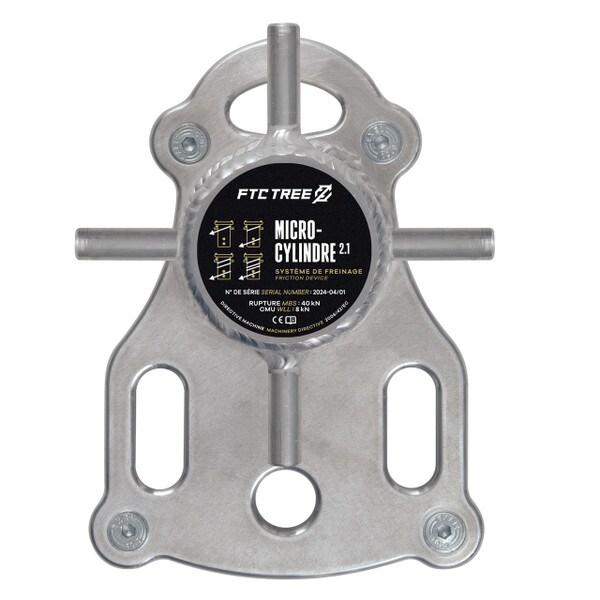
Easier to let it run w/ lrg. or med. Port-a-Wrap?

I've been using a size large Port-a-Wrap for many years now for most of my basic rigging. Probably a bit overkill, as I'm mostly using it for 1/2" line. When we rig 5/8" or 3/4" line, I usually switch up to the GRCS.

I'm curious whether anyone can compare which size of Port-a-Wrap is easier to let pieces run with 1/2" line: size large or size medium? Any noticeable difference between stainless steel versus nickel plated? Stainless seems smoother, which I could see being helpful, yet my nickel plate is worn pretty darn smooth at this point!
 
Buy
I think I'm going to invest in one of the small stein bollards that mounts on the tree in a similar manner to the grcs as the inconsistency of the portawrap can be frustrating when you're trying to let it run.
Exactly, a porty is fine if you’re snubbing stuff, which is no crime, but a rock solid bollard is far better for running it.
 
I think I'm going to invest in one of the small stein bollards that mounts on the tree in a similar manner to the grcs as the inconsistency of the portawrap can be frustrating when you're trying to let it run.
I’m loving the Micro Cylinder from FTC. Strongly recommend it.

 
I think I'm going to invest in one of the small stein bollards that mounts on the tree in a similar manner to the grcs as the inconsistency of the portawrap can be frustrating when you're trying to let it run.
A fixed bollard is good.

A $3 ratchet strap holding the POW upright rather than being floppy when negative rigging might help.

Easy to tension and re-tension.
 
I finally switched to a fixed bollard this year after years of looking at them. I got the Stein RCW-3001. The combination of it being fully locked in place, non-rotational and not floppy, with the larger bollard (good up to 19mm), makes for the best rope running that I've ever experienced while in the tree. I still use a porty for very simple overhead rigging sometimes because it's a bit quicker to set up, but any time I'll be negative rigging it's got to be the Stein for me...
 
Linear is easier to predict and understand, and more in the terms we intuitively expect, even when looking at radial.
Radial anything has surprises by comparison; the Ancients tried to highlight this key point to survive this long to us.
.
In theory, a larger radial is easier arc on the rope, and less heat concentration from frictions; perhaps even dial in frictions more precisely in partial arcs?
But very counter-intuitively the frictions are calc'd by degrees and compound per 180 degree 'stroke'(like stroke in engine terminology in my imagery) in their calculations. source: International Technical Rescue Symposium (1999) The Mechanics of Friction in Rope Rescue by Stephen W. Attaway, Ph.D. Presents math theory handed down for compounding the frictions w/math comparable to compounding interest. Linear friction rating between the 2 materials, amount of 180degree arc units, xTension are all factors from the rope used to calc also w/PI.
The body of study is even called the capstan theory; i take it as close as can, if not spot on.
.
In contrast to linear frictions calc by distance more intuitively, more simple, scalar of multiplication, pre-geometry type math , that just stack as expected w/o compounding. The above 16page paper 1st 2 pages shows a cement block pushed across flat surface on different sides etc. for linear frictions example. Then delves later into bollard/capstan even collective rack and around obstacle path as radial friction examples by contrast. Can duck heavy Greek symbols if like and come up again for air page_5 where they thin, and well into ropeBrake by page_7.
.
Linear or radial frictions is a choice with differences, just as radial or linear force input, linear or arc bridge/doorway/roof, linear or radial nip; even in basic drawing tools linear or radial. In each the geometry is more naturally self maximizing thru the usage of full organic radial instead of simple linear. Our mind works more like linear scalar progression and expects same, even in radials; but it is a different kind of mechanic.
The eye needs retrained.
.

 
Linear is easier to predict and understand, and more in the terms we intuitively expect, even when looking at radial.
Radial anything has surprises by comparison; the Ancients tried to highlight this key point to survive this long to us.
.
In theory, a larger radial is easier arc on the rope, and less heat concentration from frictions; perhaps even dial in frictions more precisely in partial arcs?
But very counter-intuitively the frictions are calc'd by degrees and compound per 180 degree 'stroke'(like stroke in engine terminology in my imagery) in their calculations. source: International Technical Rescue Symposium (1999) The Mechanics of Friction in Rope Rescue by Stephen W. Attaway, Ph.D. Presents math theory handed down for compounding the frictions w/math comparable to compounding interest. Linear friction rating between the 2 materials, amount of 180degree arc units, xTension are all factors from the rope used to calc also w/PI.
The body of study is even called the capstan theory; i take it as close as can, if not spot on.
.
In contrast to linear frictions calc by distance more intuitively, more simple, scalar of multiplication, pre-geometry type math , that just stack as expected w/o compounding. The above 16page paper 1st 2 pages shows a cement block pushed across flat surface on different sides etc. for linear frictions example. Then delves later into bollard/capstan even collective rack and around obstacle path as radial friction examples by contrast. Can duck heavy Greek symbols if like and come up again for air page_5 where they thin, and well into ropeBrake by page_7.
.
Linear or radial frictions is a choice with differences, just as radial or linear force input, linear or arc bridge/doorway/roof, linear or radial nip; even in basic drawing tools linear or radial. In each the geometry is more naturally self maximizing thru the usage of full organic radial instead of simple linear. Our mind works more like linear scalar progression and expects same, even in radials; but it is a different kind of mechanic.
The eye needs retrained.
.
@TheTreeSpider, I tried the two links in your footer; they appear to be out of commission. Is there a newer link?

 
À lightweight bollard would be a good thing, that Stein is a two man, lots of swearing, mounting operation.
I have a long piece of 3/8” double braid with a splice that I hang my GRCS from when I need to set it up by myself. It’s just a running bowline around the stem and wrap the splice around the fair leads. Much easier.
Your cable extension is really slick!
 
The big Stein is easy to set up with a top strap, you hang it first, then set up the side strap and bottom sling. I remove the top strap once everything is set up.
 

New threads New posts

Kask Stihl NORTHEASTERN Arborists Wesspur TreeStuff.com Teufelberger Westminster X-Rigging Teufelberger
Back
Top Bottom