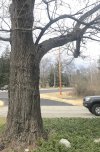
large split in Maple, is it appropriate for support?

awww boy -
Well you all will be glad to hear it's coming down.

I told them to put some mega ratchet straps around it in the meantime, and the crack was growing. I am traveling this weekend so couldn't get to it until Tuesday. They are rightly freaked out and called someone else who can do it tomorrow.
I was bummed about wasting time on it, but as my friend said "Great news. Not our problem."
So it's alright.

She was apologetic about switching the job and wants to hire me for some other stuff, including planting a tree in it's place.

Thanks again for all the input. It's a good reminder to be ready to suggest a bold change of plans.. they wanted to save the tree but that split said otherwise.
 
Did you recommend they ask if the power company would take it down?
Yes, I did. Thanks for that suggestion.
When they saw the crack expanding she just got right on it!! (don't know if she tried he utility)

She appreciated all the help, offered and sent a little dough for the input.

I was thinking, it's so often I roll up to a tree someone wants taken down and I give them ideas to keep it.. so it took a bit of switching gears to call for removal!!
Thanks again for all the encouragement here to bring that down.

I will go back through this thread; I have some more curiosity around cabling, and there was a lot of good concepts here.
Thanks
 
  • Like
Reactions: ATH
Take a walk along a river bank that is Norway canopy and understory, seeded from planted street trees. Big picture ecosystem, not a single cracked tree.
 
Man if the split got progressively worse after successive wind storms like that and your gut is having you verbally tell the client to sleep as far away as possible in wind storms id say the easy decision is removal.

And that’s not taking species into consideration.

Seems like a good opportunity to sell as a remove and replace as they seem to want to retain a tree in that space.
 
Last edited:
indeed, the tree is GONE.
I was busy for half a week, but another crew was able to do it next day so she made the call. It was a good job for a bucket truck anyway.

I am glad to get this much info about cabling and support up here. I learned a bunch.

I also learned to trust my instinct and read of the overall situation. It was a new thing for me to turn a request for cabling and preservation into a removal.

Getting a taste of reality here on the board was great and ultimately encouraged a good outcome for those folks.

Will post a follow up when we get a fruit tree in the ground over there!
 
Good thread - learned some things. I don't do hardly any cabling. Here's a mulberry that I mistakenly sugg. to the owner, cabling might B a possibility. But the innards aren't solid. It's hollow as hell and I see a lot of frass and nonsense. Also the recommendations here for putting rods thru and s__t - I don't have the euipment to put rods thru a trunk this size. After I read thru what you all have to say here, it's easy to recognize this mulberry's a gonner. (at least half of it) I would only cable a CRACK in otherwise strong, healthy wood. Never a hollow mess like this.

But I DO have a question about the TreeGuard rope system... HOW DO YOU TENSION IT? Do I use my 12:1 mech advantage system to pull the limbs in, splice the TreeGuard tight as I can... and then let it go?

Thank you.
 

Attachments

  • 06WinDK_mulberry_Cable2.jpeg
    06WinDK_mulberry_Cable2.jpeg
    261 KB · Views: 24
  • 06WinDk_mulberry_cropped.jpeg
    06WinDk_mulberry_cropped.jpeg
    426.7 KB · Views: 23
  • 808_mulberry_rev_cropped.jpeg
    808_mulberry_rev_cropped.jpeg
    415.1 KB · Views: 24
Last edited:
Good thread - learned some things. I don't do hardly any cabling. Here's a mulberry that I mistakenly sugg. to the owner, cabling might B a possibility. But the innards aren't solid. It's hollow as hell and I see a lot of frass and nonsense. Also the recommendations here for putting rods thru and s__t - I don't have the euipment to put rods thru a trunk this size. After I read thru what you all have to say here, it's easy to recognize this mulberry's a gonner. (at least half of it) I would only cable a CRACK in otherwise strong, healthy wood. Never a hollow mess like this.

But I DO have a question about the TreeGuard rope system... HOW DO YOU TENSION IT? Do I use my 12:1 mech advantage system to pull the limbs in, splice the TreeGuard tight as I can... and then let it go?

Thank you.
That is not a tree I would use a dynamic system in, because it is so badly compromised. If you are going to cable it, use steel cable. But be aware, without bolting the trunk, it is very likely it will fall apart anyway, cables or not.
 
  • Like
Reactions: ATH
How close is that tree to the conductors? It looks as though some parts are pretty close in one of the photos. If any part of the tree extends into the Miminum Approach Distance, then steel is out. I would strongly suggest purchasing the ISA BMP on Cabling and Support Systems and let that guide your considerations.
 
Last edited:
The ANSI standard for supplemental support is not digital about saving/not saving due to a structural issue. It mentions providing additional support. The level of risk is encapsulated in a risk assessment, which is a separate ANSI standard. The two topics are different things...

Risk is something that the arborist communicates to the tree manager, who in turn decides whether the risk is acceptable or not. The arborist does not decide whether the maple gets it or not, other than to decline to provide services if they believe the tree manager's decision is bad.

I'm guessing that no risk rating was provided to the client, and that is an area where our industry can improve; transitioning away from free estimates to paid consulting, and then consulting at a deeper level. A Level 2 Basic risk assessment would take 15-30 minutes, is billable for the arborist, and enables the tree manager to a great degree..

I'm not sure that the length of the split matters. Why does it matter if it's 5 inches or 10 feet all the way down through the root ball? Both conditions can be addressed, and quite similarly.

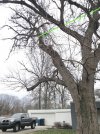
A lot of this discussion could be abbreviated by reading the ANSI standard and the BMP. A lot of good discussion too, but some of it seems like the standard and bmp simply are not being read. Things get a little hairbrained and we're supposed to be pros. Love you guys..
 
I'm not sure that the length of the split matters. Why does it matter if it's 5 inches or 10 feet all the way down through the root ball? Both conditions can be addressed, and quite similarly.
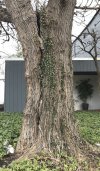
Sure, that relates to a remediation action. As far as risk assessment goes, surely for a Norway maple next to powerlines and whatever proximity to residential targets and vehicles etc. a split codom 10' down to the root plate is a higher risk classification than a 5" split at the top of the codominant structure. No?
-AJ
 
I think what @colb is driving at, is that the tree is the property of the owner, not the arborist, and that decisions regarding management actions for the tree belong entirely to the owner of the tree. If an arborist is being asked to advise a client in order to help them to make an informed decision, then ethics require that arborist to advise the owner of limitations to their experience and abilities. Just because they don't have the knowledge or experience to suitably mitigate risk on a given tree, doesn't mean that another arborist in that market with more advanced knowledge and experience won't be able to deliver risk mitigation options more in line with what the property owner asks for.

For an arborist to flatly state that there are no other options, puts the arborist' thumb directly on the scale. It deprives the tree owner of any opportunity to make a fully informed decision regarding their tree. It's unethical and lowers the bar for the entire industry.

There is absolutely no shame in an arborist telling a client that a particular scenario is outside of their work experience and/or the primary focus of their practice. A true all-star arborist would at that point, make this clear to the client, and provide referral information for other practitioners, better matched to the desires of the client.

There are some threads archived here in Treebuzz, which have information about an older declining Horse Chestnut tree in Amsterdam, next to the annex where Anne Frank and her family hid from Nazis. She mentioned the tree three times in her diary. The tree was infected with Ganoderma applenatum. After much back and forth between arborists and stakeholders, an informed decision was made to erect a steel exoskeleton around the trunk of the tree to provide support with the aim of extending the cultural contributions of the tree for a greater length of time. The cost was high, but so was the significance of the tree. The tree lasted another 3 years before failing altogether. Slight damage occurred to a wall and a garden.

I use this as a reference point for clients who want to preserve a tree, to illustrate that any tree can be preserved....for a price. It helps them decide where their own tree sits in a broad spectrum with "nuisance" at one end and "Anne Frank Tree" at the other.
 
Last edited:

New threads New posts

Kask Stihl NORTHEASTERN Arborists Wesspur TreeStuff.com Teufelberger Westminster X-Rigging Teufelberger
Back
Top Bottom