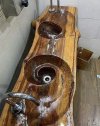
You need to have a good understanding of how wood reacts when it dries. You're guaranteed to have cracks forming in many slabs. You'll get lucky too.
I was talking to my buddy Brian a couple weeks ago. He told me that cutting slabs on the diagonal reduces cracking.
Logs To Lumber - Kiln Dried Hardwood Lumber - Domestic and Exotic Lumber - Live Edge Slabs - Table tops

www.logs-to-lumber.com
Before getting too involved trying to dry slabs to a LOT of reading about how others have done it.
Cracking happens because there is more wood by volume out on the bark edge. Remember pi? All of the wood shrinks at the same rate though. That leads to edge cracks telegraphing to the center.
Years ago I read about a process to deal with cracking. I haven't done it but I have seen a couple pictures of slabs that were patched and it works.
I'll share the steps in short terms. You need to be setup to go from start to finish in one process. Stopping part way will likely lead to failure.
Start with a big enough saw and bar to make one slabbing cut, top to bottom. Have the log up off the ground.
Mark the cut line
Cut three or more slabs.
Dowse them with water and wrap them in a tarp out of the sun temporarily
Look at the slabs and see if there is a crack starting of maybe by intuition you can see where a crack may form
Make a radial cut from the bark to the pith. You're creating the stress reliever 'crack' ahead of time. I'd use a cutting guide and circular saw cutting from both sides to leave a smooth cut surface on the 'crack'
In each slab do the same but make the cut about 120* apart so they don't line up if you were to restack.
Do what ever you are going to do with paint or end sealing. Wrap the slabs and stash them away to slowly dry
When the slabs are dry its time to have some fun. You will have learned how to accurately measure wood moisture content too. No guessing. A scale and some math will be involved.
Now you're going to cut pie slices to infill the 'crack' you cut. Use the slab you want to use and stack one of the other slabs under it. Line both up. Trace out the pie piece and cut it out. Make the pie piece a little larger so you can fit it tight.
As you fit the pie piece into the crack you'll see how the growth increments line up.
When I saw pics of this process the guy was a pro woodworker with a large [20 or 24"], old bandsaw. He could make nice crack and pie cuts with pretty smooth edges. In the end the cut edges weren't easy to see.
Good luck!