Need Your Opinions on This Tree Please

climbingmonkey24

Carpal tunnel level member
Location
United States
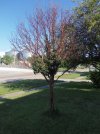
How aggressive would you be on taking this cherry in to tighten up and shape etc.? My thoughts were pruning it in a bit to the point that it has a more tightened and better shape but not too aggressive. Also dead wooding, thinning etc. The customer did say the last time they had it pruned they took a lot off and it grew back.

Also, is now a fine time to prune? I guess it’s supposed to be pink when it blooms etc. I believe.
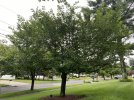
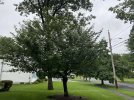
DB52A6D0-E975-408C-B3D7-5C9C1A396D79.jpegDF1D1861-DDA5-4419-962D-2AD4EE68AAF9.jpeg
 
How aggressive would you be on taking this cherry in to tighten up and shape etc.? My thoughts were pruning it in a bit to the point that it has a more tightened and better shape but not too aggressive. Also dead wooding, thinning etc. The customer did say the last time they had it pruned they took a lot off and it grew back.

Also, is now a fine time to prune? I guess it’s supposed to be pink when it blooms etc. I believe.

View attachment 76660View attachment 76661
Hi Climbingmonkey24,

Flowering Cherry are best pruned after bloom, and on dry weather days. They bloom on 2nd year wood.

I would suggest adding a book by Ed Gilman to your book/reference as well. An Illustrated Guide To Pruning.

Not too aggressive, any rubbing branches, dead wood, ect. A small pruning dose. Tree looks Vigorous.

Have a small hand spray bottle with a 50/50 mix of Potassium Phosphite.

Product like Reliant, and spray the new wound after pruning on anything larger than your pinky in Diameter. Bacterial Canker is the concern in the warmer and wetter season now.

Also have a look at the trunk, where it meets the soil line. I don't see much Taper and DO see mulch against the trunk.

Move/Excavate mulch a hands width away from the trunk root collar as well as any Roots at the surface. Flowering Cherry surface roots and Trunk collar should be exposed.

Enjoy the Holiday!
 
RCX is a great component of a tree care company.

Soil work is very overlooked, and under-available.


I was just going to read up on bacterial canker in flowering and fruiting cherries.
Thanks for the tip! Still will read up on it.

I have a handful of cherries to prune this year.
 
By my tiny phone screen it looks like there are some 3-4 yr old suckers that were let go. I’d do the dead/rubbing as suggested and then focus on knocking back a few of those to scaffold limbs or desirable lateral vs many small thinning cuts to reduce them. Cherries grow fast so focusing on better structure for long term vs a snipped back dome is preferable imo. Look up stone fruit pruning on cooperative extension databases for best pruning times for your area too.
 
RCX is a great component of a tree care company.

Soil work is very overlooked, and under-available.


I was just going to read up on bacterial canker in flowering and fruiting cherries.
Thanks for the tip! Still will read up on it.

I have a handful of cherries to prune this year.
What I read is that you don’t want to prune them in winter when it’s cold because that can increase the risk for bacterial canker and silver leaf.
 
Last edited:
They start blooming around 130 GDD (Base 50)

I know what GDD stands for, but what exactly does 130 GDD (Base 50) mean? Translate that to time of year, what specific months, etc. Everything I look online about it shows up about corn etc.

Some say prune them in winter, others say don’t prune them in winter prune them in spring or summer, and others say spring and fall. I’m confused.

I’m in Massachusetts. We are in summer now (as is the rest of the US). Typical temps in the 70s and 80s during the day, sometimes 90s during heat waves, etc.
 
Here is a good link for you : https://ag.umass.edu/landscape/fact...s-for-management-of-insect-pests-in-landscape

Amherst Mass weather station had 130 GDD around May 15th this year. The calculator is at the bottom of the page in the link above.

So with scheduling this can be very helpful with planning, in this case bloom time. Or simply look around your area.

If you do not want to learn and apply the GDD Science, then wait for bloom period to end before pruning your Flowering Cherry's.

Pruning is not cookie cutter. Skill and Knowledge both Theory and Practical play a role in success. I suggest again the Book mentioned by Ed Gillman as well as the ISA Certified Arborist study guide.
 
Depends what the goals are for the client. If you are going to focus on reduction to “maintain” a smaller crown, then don’t worry about thinning. Sure structural defects should be removed/mitigated but keep it to that. If the goal is to give it a “thinned, lacey” look because the client thinks it looks good, then by all means thin away. If that’s the case, I wouldn’t worry about how much reduction you do because the tree won’t have much of a future with an owner of that mentality.
 
Depends what the goals are for the client. If you are going to focus on reduction to “maintain” a smaller crown, then don’t worry about thinning. Sure structural defects should be removed/mitigated but keep it to that. If the goal is to give it a “thinned, lacey” look because the client thinks it looks good, then by all means thin away. If that’s the case, I wouldn’t worry about how much reduction you do because the tree won’t have much of a future with an owner of that mentality.
I talked the client out of that and suggested just a light crown reduction, taking it in just where there's overgrowth (branches sticking out, etc.) but not hacking it or taking too much off.

Essentially trimming back parts of the crown where branches are sticking out / overgrown, etc. and removing dead wood, crossing and rubbing branches. Not really thinnin out too much of the healthy growth.
 
Last edited:
I talked the client out of that and suggested just a light crown reduction, taking it in just where there's overgrowth (branches sticking out, etc.) but not hacking it or taking too much off.

Essentially trimming back parts of the crown where branches are sticking out / overgrown, etc. and removing dead wood, crossing and rubbing branches. Not really thinnin out too much of the healthy growth.
Good job for letting them know who the arborist is. For the reduction, just reduce what sticks furthest outside of the canopy profile. It was mentioned in the first two replies, but do make sure to do a root collar excavation to some extent on this tree. In my experience, the trunk wood of Prunus tends to decay faster than most so clear that up ASAP.
 
Good job for letting them know who the arborist is. For the reduction, just reduce what sticks furthest outside of the canopy profile. It was mentioned in the first two replies, but do make sure to do a root collar excavation to some extent on this tree. In my experience, the trunk wood of Prunus tends to decay faster than most so clear that up ASAP.

How exactly do you do the root collar excavation? Just pull the mulch away from the base of the trunk?
 
How exactly do you do the root collar excavation? Just pull the mulch away from the base of the trunk?
At bare minimum. In an ideal world. an air spade / air knife with a qualified technician who will blast the soil away until they find the true buttressing roots... remove the soil in the root zone... cut girdling roots (sometimes with a concrete saw)... build a retaining wall if the soil grade is quite a bit different from the buttressing roots...vertical mulch the entire tree with a witchy blend of organic material... and then mulch the entire drip zone. That is what I have seen and prescribed. Often at a cost equivalent or higher then the cost it would be to remove a tree.
 

New threads New posts

Kask Stihl NORTHEASTERN Arborists Wesspur TreeStuff.com Teufelberger Westminster X-Rigging Teufelberger
Back
Top Bottom