For the Arborists- Storm damage question

I work in Cedar Rapids Iowa. . . I'm sure many of you heard about the Derecho that rolled through here in August.

Anyway, currently working on a property with a large grove of gorgeous black oak that sustained significant damage. One particular black oak that sits over the house was marked for removal by another company who never came back to complete the work before leaving the state. . . So we were called. I think the tree is viable. . . Or at least worth giving a chance. I would estimate it lost somewhere around 25% of it's canopy. . . Mostly on one large limb that snapped about 6 feet from where it collars at the trunk.

So, here is my question. Normally we would clean up a bark tear with a good clean collar cut. But the limb was about a 12 inch diameter where it stems from the trunk. Im concerned that if we cut at the collar that's too large of a diameter for the cut to heal/ bark over and I don't want it to rot right into the trunk as a result.(trunk is about 26-28 inches at base). I've never done this, but if it's too large to heal properly regardless of how it's cut. . . should we leave a foot or so of clean cut limb stem to prevent or at least significant delay rot into the trunk. . . If you catch my drift. Or do we just go ahead and make a nice collar cut and hope for the best?

So many trees have been lost and are being taken down in the area we are really trying to do everything we can work with trees that might be viable.

Any input is appreciated. Thanks.
 
I think you are right on track. That is what I do in these situations for an otherwise healthy tree. I would also consider a follow up next spring with fertilization to help recover. Of course seeing some pictures may change that.

Sent from my SM-A205W using Tapatalk
 
You need to learn about deep cuts. Cuts that open heartwood. It will change the way you approach pruning. In the specific situation you speak of, a deep cut is unavoidable. Continued followup for the remaining life of the tree will be required. Cuts that open heartwood(3-4" in oak) will result in discolored/decay columns to form the goal is to improve the health and wound response so that new wood, formed after the wound, forms faster than the decay. You are on the right track though.
 
I work in Cedar Rapids Iowa. . . I'm sure many of you heard about the Derecho that rolled through here in August.

Anyway, currently working on a property with a large grove of gorgeous black oak that sustained significant damage. One particular black oak that sits over the house was marked for removal by another company who never came back to complete the work before leaving the state. . . So we were called. I think the tree is viable. . . Or at least worth giving a chance. I would estimate it lost somewhere around 25% of it's canopy. . . Mostly on one large limb that snapped about 6 feet from where it collars at the trunk.

So, here is my question. Normally we would clean up a bark tear with a good clean collar cut. But the limb was about a 12 inch diameter where it stems from the trunk. Im concerned that if we cut at the collar that's too large of a diameter for the cut to heal/ bark over and I don't want it to rot right into the trunk as a result.(trunk is about 26-28 inches at base). I've never done this, but if it's too large to heal properly regardless of how it's cut. . . should we leave a foot or so of clean cut limb stem to prevent or at least significant delay rot into the trunk. . . If you catch my drift. Or do we just go ahead and make a nice collar cut and hope for the best?

So many trees have been lost and are being taken down in the area we are really trying to do everything we can work with trees that might be viable.

Any input is appreciated. Thanks.
It is going to have a vertical decay column in the trunk, in the 5+ years moving forward, so do not give your client the expectation of full recovery. It sounds like a tree risk assessment candidate, then mitigate accordingly. Without on-site information, we here cannot help much in figuring out the viable path/s forward.

It has already developed wound wood response growth, so your cuts should be outside that. If you cannot see the presumably irregular line of the new growth/dead tissue boundary, do not cut until you can see it, then cut outside it.
 
So if I understand you correctly. . .you advise to go ahead and make the collar cut at the trunk even though it's exposing heartwood. . .
Cedar Rapids is pretty tore up. Ive been pretty busy myself when I have free time set aside from my normal job. Personal opinion is to make a good nice cut with a clean saw on the branch just enough to remove any of the rip or damage to the remaining partial branch. It will prolong heartwood damage and decay from getting into the main trunk of the tree.
 
Great article from the TCIA magazine last year that discusses your very question:

https://tcimag.tcia.org/tree-care/use-your-heading-cut-to-delay-decay/

It's a quick read - worth your time so I won't summarize it
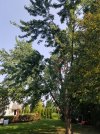
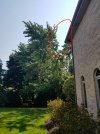
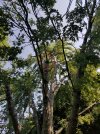
That was a good article. Made me feel better about my decision to head back a silver maple lead after a storm ripped its top out. Damaged lead still had some sizeable branches low down but it lost 25' above where I made the cut. It looks a little goofy but I think it will fill in some and I just couldn't bring myself to cut off the entire lead at the main trunk just yet. The one pic with the red circle in the sky just shows where the lead used to be. The lead my decay over time and eventually need removal but this was the best solution in my mind at the time. We can always revisit in a year, two or three. Homeowner was supportive and understood.
 

Attachments

  • 2020-08-25_18.00.48.jpg
    2020-08-25_18.00.48.jpg
    926.9 KB · Views: 16
  • 2020-08-25_18.01.48.jpg
    2020-08-25_18.01.48.jpg
    584.9 KB · Views: 13
  • Attach21399_20200825_180248.jpg
    Attach21399_20200825_180248.jpg
    956.5 KB · Views: 16

New threads New posts

Kask Stihl NORTHEASTERN Arborists Wesspur TreeStuff.com Teufelberger Westminster X-Rigging Teufelberger
Back
Top Bottom