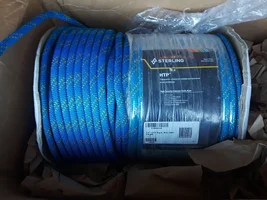
Sterling 12.5mm WorkPro.

The specs listed for 12.5 work pro say it's more elastic than 12.5 htp, but that doesn't always pan out in real world use. Blue moon is supposed to be more static than than 13mm km3, but I get no stretch from either at my max heights.
The specs on ropes can be really frustrating and misleading. Obviously the WorkPro is gonna have a little more stretch than the HTP, what with its nylon core..Sterling ropes are really hard to read sometimes because they can be stiff as fuck up to a certain point then all of the sudden become dynamic..The question is were is that point. The WorkPro specs say 3% elongation at 300lbs, but my intuition is telling me it would remain pretty static with my scrawny 155lbs ass?

Would be really nice if there was some sort of universal standard for specs on the ropes...
 
The specs on ropes can be really frustrating and misleading. Obviously the WorkPro is gonna have a little more stretch than the HTP, what with its nylon core..Sterling ropes are really hard to read sometimes because they can be stiff as fuck up to a certain point then all of the sudden become dynamic..The question is were is that point. The WorkPro specs say 3% elongation at 300lbs, but my intuition is telling me it would remain pretty static with my scrawny 155lbs ass?

Would be really nice if there was some sort of universal standard for specs on the ropes...
We've all been crying over this for as long as I've been paying attention (and probably decades longer).
Nobody has told me yet how we make them just tell us what we need to know in a way that lets us compare ropes from different manufacturers.
 
One of these days we need to get as many ropes as possible in one place with a super static and high anchor point, maybe a big crane, and do our own testing. Tcia expo seems like a good place. I guess all ropes would have to be new. It would also be nice to test new vs broken in. I imagine a milky rope would change a little when its been all equalised. If we could get a big supplier involved (wesspur?) to donate rope that might help. It would probably be easier than getting all the manufacturers to do it. It sucks that we each have to spend a big chunk of money to try a rope and half the time be disappointed and disgruntled by the result. Probably just a pipe dream, but it would be fun and awesome if we could make it happen!
 
The specs on ropes can be really frustrating and misleading.

Would be really nice if there was some sort of universal standard for specs on the ropes...

Seriously WTF! It truly is extremely frustrating..

So how are you going about trying to convert that 300lbs to be comparable to other "known" specs. Is that 300lbs an equal match to other manufacturers 10% reference? (I don't know what the work pro's actual specs are & I'm horrible at general math without my abacus)

If 300lbs is less than that normal listed 10% of MBS & is actually something like 5% of MBS, that cordage is going to be super stretchy..

Actually heres what i came up with after looking up the rope..
If you were to compare the numbers to a regular graph chart like Yale or Samson.. (please advise if you think I'm wrong here..) The MBS is 10565lbs right? 300lbs of that 10565 only equals something like 2.8% of MBS. So if charted like Samson it would read 3.2% elongation @ 2.8%MBS.

This is all assuming Sterling is basing that 3.2% off of MBS. If they are using a spliced or sewn strength as the other number, that 3.2% goes even higher.

Another thing is, the work pro is certified to a bunch of standards outside of treecare, those other standards (as you may already have guessed), may or may not require certain elongation.. Mist likley more than your trying to get away from.

If I'm wrong, with those numbers or how i went about it, please let me know as its how I've been going about judging catalog elongation numbers since i became interested in them.. Again, what a frigging pain.. Seriously need a set standard.
 
Climbing on them would give you an idea how they feel when you're climbing on them.. that's all... and of course, everybody would have their own opinion... which puts you back where you started.

You need a drop sled, too. You can climb on a hank of KM3 Max and say, "this is very static", but the rope has a nylon core, and if you dropped a few hundred pounds onto it, the stretch would be very obvious and it would absorb a lot of energy, which is what you want. You don't need the stretch while climbing, you need it when you're falling.

I think the important data would be how much the rope stretches with two fixed weights... let's just say 250 lbs. and 500 lbs. without dropping the weights, dropping them from two feet, then at four feet, then at six feet. Chart all of that and you'd get a graph of the ropes performance that we can actually use. It tells you a little about how much it stretches just weighting it, and a lot about how much energy it can absorb if something goes terribly wrong.

All of the other rope characteristics are subjective and involve a ton of variables... hard to define in a useful data presentation. But, an ongoing, long-term project could probably make useful data from testing for things like performance with a certain multicender, by developing a test that is independent of the climber. This takes a lot of thinking and planning, but isn't impossible. It would also take a hell of a lot of the arb community willing to participate. That could be a real challenge. I don't think any of the rope OEMs are going to take something like this on.

 
That's all a simplification of what you'd want to test for, of course. Things like length of rope in the test system, testing abrasion factors, break forces when the rope is over various edges or attachment diameters, blah blah blah could all be truly interesting when comparing ropes. Still, all of that stuff can be tested with some fairly simple fixtures and equipment. You really only need super expensive equipment and fixtures in a production environment. A decent load cell and a welder, some scrap steel and lumber... it's all doable with an active community involvement.
 
Climbing on them would give you an idea how they feel when you're climbing on them.. that's all... and of course, everybody would have their own opinion... which puts you back where you started.

You need a drop sled, too. You can climb on a hank of KM3 Max and say, "this is very static", but the rope has a nylon core, and if you dropped a few hundred pounds onto it, the stretch would be very obvious and it would absorb a lot of energy, which is what you want. You don't need the stretch while climbing, you need it when you're falling.

I think the important data would be how much the rope stretches with two fixed weights... let's just say 250 lbs. and 500 lbs. without dropping the weights, dropping them from two feet, then at four feet, then at six feet. Chart all of that and you'd get a graph of the ropes performance that we can actually use. It tells you a little about how much it stretches just weighting it, and a lot about how much energy it can absorb if something goes terribly wrong.

All of the other rope characteristics are subjective and involve a ton of variables... hard to define in a useful data presentation. But, an ongoing, long-term project could probably make useful data from testing for things like performance with a certain multicender, by developing a test that is independent of the climber. This takes a lot of thinking and planning, but isn't impossible. It would also take a hell of a lot of the arb community willing to participate. That could be a real challenge. I don't think any of the rope OEMs are going to take something like this on.
Ok, now we all need to take a month off for this. It would be cheaper to just try 10 different ropes each and find the ones we like best.
 
So what y'all think? Is my approach to calculating elongation on this cordage incorrect? Was it already known?
I thought we were trying to figure out what the actual specs were for WorkPro beyond the vague 3.2% @300lbs.. Yeah..? No..?
 
I also get 2.8% is 300lbs. Since rope is not going to stretch an equal amount for every pound (or 100 lbs) you add, the one nunber gives us not enough info to extrapolate any additional data.
 
@rico did you pick a new climbing line yet? I have a tree coming up that, if I choose to accept it, I will want to run a rope between 2 trees over the top of a third tree that has a decayed area in the main trunk that I dont want to climb past. My idea is to use 1/2 inch htp to create an overhead tie in point so I can safely rig down the compromised tree. The two trees I want to run the overhead rope between are at least 300 ft apart. I figure htp will give me the least sag, therefore need the least tension. So if you got the 1/2 inch htp, I am wondering what you think of it. I might be ordering a 600' spool.
 
There was some good video about MA in high line systems.

Long story short, NO MA... Hand tension only to keep forces from going up fast.

I had a 90' TIP, and dropping into the rope testing, was soft enough, but very little stretch.
 
I run my Wrench on 13mm safety blue a lot and it falls through the wrench like water. I really need a 12.5-13 mm rope with very little bounce.
Samson Vortex is absolutely a great rope.
Best rope I've ever owned in the hand, supple as hell, beautifully knots, holds it's shape, no detectable bounce.
I like the hot color as it starts of looking pink but morphs into an orange as it gets used (partial to orange).
The only down side is that it doesn't seem to be very durable and I don't mean holding up to long term use.

Just wrecked my third hank.
Seems to enjoy finding it's way into my spur placement and getting picked up by saw chains, pruning saws, etc.
It's a rope with a death wish.
Haven't had a chance to wear one out yet.

Just ordered a hank of TROPICAL Ivy after much deliberation and the subliminal coercion from @swingdude.
Hoping I'll have better luck with it and the RopeRunner you twisted my arm into buying.
 
@dsptech , just wondering if that was canopy tie or base tie with no detectable bounce on the Vortex Or if you can guesstimate how much rope between you and the tie? Feel free to tell me to fuck off or ignore this if it’s rude, but what’s your weight? No bounce on a tie that uses almost 150’ of that rope for a guy that weighs close to 200 lbs or more with gear sounds right up my alley.

I’m no expert on either Yale 11.7 or RopeRunners, but I’ve been doing my homework and both top the list of my next gear purchase. I hear Tropical Ivy and it’s assorted other colors with the RR is a match made in heaven, and if it’s not right away, it will be after the rope goes through a cycle in the washing machine. It might noticeably flatten some with RR but doesn’t effect performance, or so I hear.
 
@dsptech , just wondering if that was canopy tie or base tie with no detectable bounce on the Vortex Or if you can guesstimate how much rope between you and the tie? Feel free to tell me to fuck off or ignore this if it’s rude, but what’s your weight? No bounce on a tie that uses almost 150’ of that rope for a guy that weighs close to 200 lbs or more with gear sounds right up my alley.

I’m no expert on either Yale 11.7 or RopeRunners, but I’ve been doing my homework and both top the list of my next gear purchase. I hear Tropical Ivy and it’s assorted other colors with the RR is a match made in heaven, and if it’s not right away, it will be after the rope goes through a cycle in the washing machine. It might noticeably flatten some with RR but doesn’t effect performance, or so I hear.
I have used Vortex with both a base tie and tip tie.
Lately mostly using a tip tie as my preferred way unless it a heavily branched tree and I can't get my cinch snug to the stem.
Most of the trees we climb in the NE are typically 60' or less.

I have lost quite a bit of weight doing this work, about 40 lbs over the past three years and I'm currently 160 lbs.

I've read the same as you about the Yale 11.7mm variants of Ivy and that's why I decided to give it a try with my newly acquired RR (if Sherrill ever ships it).
I've only had one climb on the RR in a huge old Nasty White Pine that was oozing sap from everywhere.
I know better but I was excited to try it.
Decent was fine until I hit a patch of sap on my rope and the brakes kicked it.
Had to switch to back to the HH2.
Have to wait till the next non pine job till give it a good go.
 
Thanks man!
My mind is already made up I think, I’m just holding off until Black Friday tree gear sales and see if I can save on a RR, and a Yale Aztek Ivy Moon Frog whatever. Maybe I’ll try Vortex too, sounds nice, static, and fat for HH or wrench if it fits. I’ll take great pains to keep chains and spurs away from it and hopefully have better luck lol.
 
Thanks man!
My mind is already made up I think, I’m just holding off until Black Friday tree gear sales and see if I can save on a RR, and a Yale Aztek Ivy Moon Frog whatever. Maybe I’ll try Vortex too, sounds nice, static, and fat for HH or wrench if it fits. I’ll take great pains to keep chains and spurs away from it and hopefully have better luck lol.
Just so you know there are a few sales going on right now.
Sherrill has 15% off ropes.
Bartlett has 10% of Samson.
Wesspur has Samson rigging ropes on sale.
 
I just picked up 600ft of htp 12.5 mm for a special tree job I'm doing at the end of the month. I need it to run a high line between two trees that are about 300 ft apart so I can safely climb a compromised tree in between them. Once that is done, I am planning on cutting a 200ft piece to climb on. Hopefully it plays nicer with the wrench then the 13mm km3. 20191015_153907.webp
 

New threads New posts

Kask Stihl NORTHEASTERN Arborists Wesspur TreeStuff.com Teufelberger Westminster X-Rigging Teufelberger
Back
Top Bottom