












Navigation
Install the app
How to install the app on iOS
Follow along with the video below to see how to install our site as a web app on your home screen.
Note: This feature may not be available in some browsers.
More options
You are using an out of date browser. It may not display this or other websites correctly.
You should upgrade or use an alternative browser.
You should upgrade or use an alternative browser.
A Chunk of Metal With Some Holes
- Thread starter Brocky
- Start date


JMerritt
Branched out member
- Location
- santa cruz
woodworking bandsaw works great for cutting aluminum. all of the early akimbos were made that way. if you have a router you can use round over and chamfer bits if they are carbide.
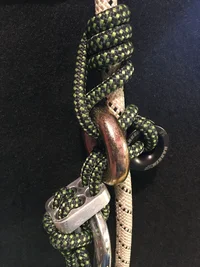
The next version, a little bigger with two more holes. The hitch cord captures the carabiner now. The extra holes provide sharp bends that cause enough friction to take weight off of the stopper knots, making them very easy to untie now. As a result there is less lengthening of the legs, like the first version, as the stoppers tightened up when loaded.

climbstihl
Branched out member
- Location
- Germany
Can you post a closeup of the terminations? Kinda hard to see on that pic.The next version, a little bigger with two more holes. The hitch cord captures the carabiner now. The extra holes provide sharp bends that cause enough friction to take weight off of the stopper knots, making them very easy to untie now. As a result there is less lengthening of the legs, like the first version, as the stoppers tightened up when loaded.
View attachment 61069

JMerritt
Branched out member
- Location
- santa cruz
@Brocky , if you made the two holes adjacent to the carabiner joined into a slot could to then eliminate the need to untie and retie your stopper knot? The slot would allow you to push a bight through and capture it with the biner. You could do one or both sides that way.

rope-a-dope
Branched out member
- Location
- Asheville
Rigging thimble looks like a sweet fair lead! The slot idea could make it more like a rappel plate and function in either placement in this frankenfriction stitchuation.
I said tuefelberger?View attachment 61084
An overhand knot for testing, might be all that’s needed with the sharp bend.
Yes, Petzl’s, and this is.....?
That bridge is the and is that red Kern hitch cord sterling too?The following is greatly inspired by the most excellent idea of the dogbone from the Hitch Hiker. Just put the friction hitch legs through the holes and tie stoppers.
View attachment 60791
After a few more complicated designs, this was the simplest, and seems the best for this type of design. With the small plate, hitch cords don’t need eyes or have to be a set length to function on certain hitches. The VT, and other hitches will be improve by being able to adjust the leg length. This would also make for cheaper hitch cords for those that buy eyed cords now. This is the first design I was able to make with what I had on hand. There will be a couple others when I get some more aluminum chunks. Here are a couple other ways to use.
View attachment 60792
View attachment 60793
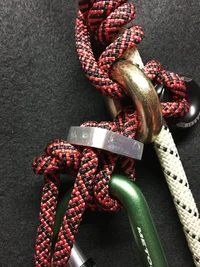
Nice idea, makes it much easier to make, and use without having to tie the stoppers each time. I made another six hole version with a v groove to possibly generate friction while descending. Needs more testing and to see if the plate could also act as a shock absorber.@Brocky , if you made the two holes adjacent to the carabiner joined into a slot could to then eliminate the need to untie and retie your stopper knot? The slot would allow you to push a bight through and capture it with the biner. You could do one or both sides that way.
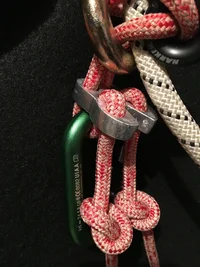
The rigging ring is used instead of a pulley, or the small strap for tending.
In the first post, both bridge and hitch cord are Sterling’s. The other red and black cord is Bluewater 7mm static cord, I’ve been trying to make the cover looser to make it more flexible, it wouldn’t grab as it comes off the reel, as it is too stiff.
You are definitely onto something but here brockyNice idea, makes it much easier to make, and use without having to tie the stoppers each time. I made another six hole version with a v groove to possibly generate friction while descending. Needs more testing and to see if the plate could also act as a shock absorber.
View attachment 61125
The rigging ring is used instead of a pulley, or the small strap for tending.
In the first post, both bridge and hitch cord are Sterling’s. The other red and black cord is Bluewater 7mm static cord, I’ve been trying to make the cover looser to make it more flexible, it wouldn’t grab as it comes off the reel, as it is too stiff.

Phil
Carpal tunnel level member
- Location
- Oak Lawn, IL
They say necessity is the mother of all invention. What is the need for this new friction hybrid dog bone paw thing? Or another way to ask the question is, what problem with the current eye to eye micro pulley fair lead systems that we currently use are you trying to solve?
So far it looks like you're switching from stitched or tied eye n eyes, to stopper knots. Beyond that this looks very congested to me. Pics don't always translate the story very well though.
Will this new friction setup be used for Ddrt (MRS) or SRT or both?
So far it looks like you're switching from stitched or tied eye n eyes, to stopper knots. Beyond that this looks very congested to me. Pics don't always translate the story very well though.
Will this new friction setup be used for Ddrt (MRS) or SRT or both?
climbstihl
Branched out member
- Location
- Germany
I agree with you, I don’t see a huge advantage over tying loops in the end, however, tgis last iteration seems promising, because the stoppers won't tighten much.They say necessity is the mother of all invention. What is the need for this new friction hybrid dog bone paw thing? Or another way to ask the question is, what problem with the current eye to eye micro pulley fair lead systems that we currently use are you trying to solve?
So far it looks like you're switching from stitched or tied eye n eyes, to stopper knots. Beyond that this looks very congested to me. Pics don't always translate the story very well though.
Will this new friction setup be used for Ddrt (MRS) or SRT or both?
Since most of the hitches used here are variations of the sticht hitch, I guess using them SRT is a big use.
The difference in price between a four foot length of hitch cord and what is charged for a sewn or spliced cord is one reason. Another is the length of the legs can be adjusted, which can fine tune a finicky Hitch like the VT. With the slot idea, the ideal length for the hitched used, and the stoppers can be be preset, you only need to clip in.
Phil
Carpal tunnel level member
- Location
- Oak Lawn, IL
I may not be understanding the pics very well. Would you be able to post a short video that shows how the hitch, ring, and dog paw bone move on the line in a mock climbing scenario?
climbstihl
Branched out member
- Location
- Germany
I still don't see any advantage of the regular dogbone over tied eyes, maybe I'd see one of I tried it. The version with the six holes is what looks best to me, that way the knots are easier to untie than regular fishermans loops or stoppers.The difference in price between a four foot length of hitch cord and what is charged for a sewn or spliced cord is one reason. Another is the length of the legs can be adjusted, which can fine tune a finicky Hitch like the VT. With the slot idea, the ideal length for the hitched used, and the stoppers can be be preset, you only need to clip in.
Your gonna save a lot of money not buying sewn cords and the point about being able to adjust the length of the legs of hitch cord is HUGE. You could really fine tune hitches so much more if we could adjust the length of the eyes like this.
I guess that really doesn't matter if you don't mind sit back or like your hitch to have long legs.
To understand the ring you would be better off reading the stitch hitch thread BC in short, the ring is taking friction off the hitch cord like a rope wrench.
So I'm guessing you might think " well my rope wrench is Lighter or about the same weight of all the hardware in brockys set up"
Which is a good point but if we figure this all out then this might become one of the most compact systems you can use. Meaning it will be great when blocking down a stem.
Most of this has been covered already in here and the stitch thread but if not then I guess this is my own feelings about it.
I guess that really doesn't matter if you don't mind sit back or like your hitch to have long legs.
To understand the ring you would be better off reading the stitch hitch thread BC in short, the ring is taking friction off the hitch cord like a rope wrench.
So I'm guessing you might think " well my rope wrench is Lighter or about the same weight of all the hardware in brockys set up"
Which is a good point but if we figure this all out then this might become one of the most compact systems you can use. Meaning it will be great when blocking down a stem.
Most of this has been covered already in here and the stitch thread but if not then I guess this is my own feelings about it.




















