Little tricks

What are some of the little tricks you have picked up through the years?

Recently, I have started to use a retrieval ball on my rigging line in the place of an overhand slip knot. It means that i can leavr in in place when the rope gets pulled back up and it doesn't fall out of my rigging point of choice. Where it also comes in handy is keeping the rope away from the bottom of the limb duri g an under cut. This way i don't need to take the time to undo the knot in the line.

0d6be9b4e35da8d74efa0ef6ba1db6cf.jpg

YOU ARE A SMART MAN. I LIKE YOU.
 
I like that in tree, especially for even earlier kerf close /support on horizontal trims etc.
.
Tried in top hop type close , but to get hop seems needs speed of slam input, so sometimes went opposite direction an d double kerf, trim rear sides for faster saw/less resistance on finale.
.
Semi truck tire changing spoon fits in kerf of climbing saw back cuts for in tree lever, kinda heavy to always carry tho. Can flex hinge over earlier sometimes , or tilt over heavy chunk onto Humboldt slide for friction and more controlled chunk drops.
.
With our tall palms and then dead, stripped trees down here, this worked very well,
Also doesn't necessitate feeding pull line up to point of thowline
>>so throw line point can be much weaker point, just tool to load pull line lower on strong part of tree.
Simply use throw line to pull rope up, and also to keep Bowline open, sometimes stepping Bowline over small stobs etc. Before allowing Bowline to close tight.
.

throwline_no_branches.png
 
Last edited:
If you ever get the desire to set a time something with poles, tie your monkey fist, then about a foot away tie an over hand knot with a loop. Hook this loop with the poles and up you go. When you get to the branch the monkeys fist is already over it and down the back side, no awkward flips required to get it to fall down where it's reachable
 
I climb on a treemotion. It has an extra set of D rings on the thigh pads straps. I pass a bight of my rigging line through it and then just poke the end of the rope through the bight. Essentially its just a quick hitch but its fast and doesnt add any extra gear. Same could be done with any utility ring with a small enough I.D.
I just wanted to say that this has been one of the biggest Time savers on job since I learned it. instead of just putting the end in I pop-up bite through so I can carry any length of rope hanging below me that I wish and it always stays there and it's in front of me and I can do it to my side D's or my lower D's or a carabiner hanging off of my saddle somewhere. It is a beautiful trick. please pardon the lack of proofreading I am voice to texting because my phone is super smash today.
 
Throw Ball In Thick Areas of Foliage
I use to Girth Hitch my ball but after getting it stuck many times from being to aggressive in thick areas of the tree, I now tie my throw line to it with a slip knot. The reason I tie it this way is because taking the ball off is like.........ohhhh sooooo freaking quick for the retrieval of the throw line on a missed shot. Another reason is if it does hang up (with out looping over a branch or crotch) I can give some heavy tension on the line and the slip knot pulls open, ball falls down and line pulls back to me. Here's the deal! It's doesn't work all the time and it took me a little time to figure out how tight to pull the slip knot down against the d-ring on the ball and how much line you pull through the knot. Too tight....... its not gonna pull through to release the ball. Too lose and it will release while pulling it back through any branches or foliage. Specially when you launch it with a big shot.........it will fly off the throw line in mid-flight. So I use this trick because I do have a chance that if it gets stuck it might come down without climbing up to get it.

Another way to get the ball back that is always going to work, is tie another throw line to the back of the ball before even taking a chance when pulling through thick areas of the canopy. Ball gets stuck.......just pull it back the other way. Some times you can even work you ball through the area pulling back and forth.

Grateful for learning this little trick because, I climb some trees that have lots of canarlyyyyy foliage and when I was going through the learning curve of how hard to shoot the Big Shot I would tend to shoot it way over my intended target area. Lots of hang ups at that time!
 
Last edited:
Throw Ball In Thick Areas of Foliage
I use to Girth Hitch my ball but after getting it stuck many times from being to aggressive in thick areas of the tree, I now tie my throw line to it with a slip knot. The reason I tie it this way is because taking the ball off is like.........ohhhh sooooo freaking quick for the retrieval of the throw line on a missed shot. Another reason is if it does hang up (with out looping over a branch or crotch) I can give some medium jerks on the line and the slip knot pulls open, ball falls down and line pulls back to me. Here's the deal! It took me a little time to figure out how tight to pull the slip knot down against the d-ring on the ball. Too tight....... its not gonna pull through to release the ball. Too lose and it will release while pulling it back through any branches or foliage. Specially when you launch it with a big shot.........it will fly off the throw line in mid-flight.

When you find the sweet spot..........it's soooooo sweet!

Grateful for learning this little trick because, I climb some trees that have lots of canarlyyyyy foliage and when I was going through the learning curve of how hard to shoot the Big Shot I would tend to shoot it way over my intended target area. Lots of hang ups at that time!
A girth hitch with a short tail (1-2”) will accomplish the same result, pulls free with some strong tension
 
Another simple kerf holder...

There are fiberglass wands sold to mark the edges of walks and drives. They come in different diameters. Cut them into 6-8" lengths. Drill a small hole in one end and use some throwline or cord to make a loop. Grind an angle on the other end.
slip 3-4 into your harness ditty bag for climbing

They are usually made in a hi viz color so not hard to find. The waands come in 48" lengths so they're cheap.

If you live in the snow region you'll find broken ones on the edges of parking lots when the -plow piles drive...free scavanging!
 
The stick-trick...when you can't flick your rope where you need it, sometimes outward for rigging, or inward for a TIP, clove hitch the rope to the end of a stout stick or fiberglass pole. Your arm is now effectively waaay longer and you can 'throw a loop' on the topside of the rope that will hop over the crotch/ branch... not a "sine wave" which dies at the branch every time.

If you are trying to go to the right, flick an "over the top' loop with some 'english' to the right or left. Works well when the rope is high in the tree, where you need MA to manipulate the rope.
 
Another simple kerf holder...

There are fiberglass wands sold to mark the edges of walks and drives. They come in different diameters. Cut them into 6-8" lengths. Drill a small hole in one end and use some throwline or cord to make a loop. Grind an angle on the other end.
slip 3-4 into your harness ditty bag for climbing

They are usually made in a hi viz color so not hard to find. The waands come in 48" lengths so they're cheap.

If you live in the snow region you'll find broken ones on the edges of parking lots when the -plow piles drive...free scavanging!

The europeans have *created* and marketed a design like this, called the Rollotube. Your fiberglass wand idea sounds waayyy cheaper and more easily customizable
Edit: TO be fair to the europeans, they do sell the Rollotube way cheaper if you don't opt for the retractable lanyard attachment.
https://shop.freeworker.com/ftc-rollotube-stick.html

For those who are visual learners, here's a video showing how this roller works:

 
The stick-trick...when you can't flick your rope where you need it, sometimes outward for rigging, or inward for a TIP, clove hitch the rope to the end of a stout stick or fiberglass pole. Your arm is now effectively waaay longer and you can 'throw a loop' on the topside of the rope that will hop over the crotch/ branch... not a "sine wave" which dies at the branch every time.

If you are trying to go to the right, flick an "over the top' loop with some 'english' to the right or left. Works well when the rope is high in the tree, where you need MA to manipulate the rope.

I use my pole pruner pole for this all the time. It's stiff, light, has a big cross section to clove hitch, and it's got tons of lever arm (4'). I can whip a HUGE "sine wave" 100' up to bounce my base anchored line over some stub or twig on conifer limbs. You get massively more power in your wave than if you're hand-whipping
 
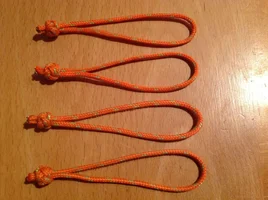
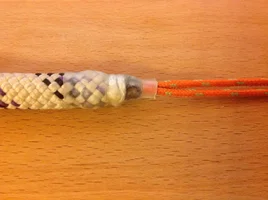
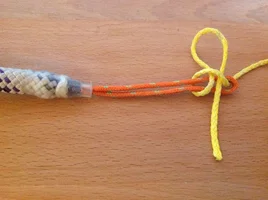
After you milk your rope leave the excess outer cover on. Use the extra outer cover to tie your rope onto your throwball for those tight unions.
An alternative, after you milk your rope, or cut an inch or so of the core, is to insert a loop blocked by a diamond knot... see pictures.
Very fast to attach the throwline (sheet bend) and, so far, very reliable. Not as straight forward as Deadwood's solution, though.
 

Attachments

  • 006.webp
    006.webp
    449.2 KB · Views: 71
  • 030.webp
    030.webp
    421.2 KB · Views: 76
  • 025.webp
    025.webp
    524.5 KB · Views: 76
Last edited:
A pile hitch is easier to tie than a clove and never seizes down so tight even with the slipped bite.

Another plus is that it can be easily tied/untied wearing gloves. This is a filter criteria for climbers working above the snow belt.
 
Pile Hitches are such a slick strategy, I like a Round Turn around Standing Part before final bight slipped over post/host mount.
.
Parbuckles are another slick strategy.
Log is it's own pulley for 2:1 pull, against then like on a rolling cart not dragging target,
Great up or down ramps loading trailers with truck pulling Parbuckle etc.
 
Last edited:
I don't understand the comparison to the clove hitch. They are completely different and used for different tasks and they don't exactly fill in for the other one.

It also looks like it requires a loop in the end of the rope, or a bight of rope.


My understanding is using the pile hitch to connect your rope to your throw line. In which case you are correct in stating you can use a loop or bight on the throw line
 

New threads New posts

Kask Stihl NORTHEASTERN Arborists Wesspur TreeStuff.com Teufelberger Westminster X-Rigging Teufelberger
Back
Top Bottom