









Dawn Redwood growing Too Fast ?

GregManning

Super Moderator
Staff member
Location
Chardon, OH
Is this Dawn Redwood growing too fast for its own good ?180810 Dawn Redwood - IMG_0206.webp
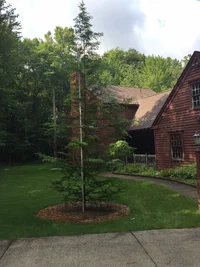
Two plus years ago I bought a balled Dawn Redwood from a nursery green house.
My guess is that it was in a green house for several years, and too close to other trees (based on slightly deformed lower branches.)
It was 8' 3" tall.

I'm in NE Ohio, 15 miles south of Lake Erie.
Snow capital of Ohio; 13+ ft of snow accumulation last year.
The tree is now 22' 2" tall.
That's an average annual growth rate of ~5.5 ft/yr !

The drip line is ~ 9' dia.
The mulch is ~ 8 ' dia. (I will increase next spring.)
The trunk at ground level is 5".
DBH = 3".

It is ~ 8' from a concrete driveway; and 12 ' from a concrete sidewalk.
See picture. The white surveyor's pole is 16.5' ht.

Is the root structure keeping up with the vertical growth ?

Winter wind here can be strong, but at least the tree is deciduous so the sail is minimized.
(In past years, I have lost a very nice Korean Pine due to wind.)

Comments ?
 
Growing 5 foot a year is not uncommon for the Metasequoia glyptostroboides. You almost certainly are going to regret having planted it that close to hardscape when it appears you had the room not to. Planting the mulched area with compatible species will help maintain a slightly slower, more stable and well-rounded growing system.
 
I grew up near you so I know the Snow Belt is no joke.

I like the idea of some under planting as well. a simple curved line from walk to walk would establish a nice pie slice shaped bed.
 
with the growth rate it is having or you describe I would say that the root health is on point. What you see above ground for the most part is a reflection of the health below ground.
@Fairfield @JD3000
My concern has been that the root growth would not support the extreme height.
Would you expect the roots to go beyond the drip line ?
Deeper than a slower growth tree ?
 
I would expect root spread to exceed the drip line by now, especially if the soil structure and soil richness are as I remember them from that section of Ohio.

Aside from snow loading which is unavoidable there, the tree looks pretty protected from stronger winds going off the pic.
 
Snow load has not been my concern since the needles start to brown & fall in early November.
At this site, 20 years ago, there was a group of 3 med-large hickory trees that were dying, removed & stumps ground out. (due to drive & house excavation ? )
I also had an Incense Cedar blow over nearby during the winter several years ago.
 
Last edited:
Did you see signs of good rooting or bad rooting in the incense cedar that blew over?


I tell people who are worried about their trees blowing over in big storms, "You remember that huge storm where almost every single tree didn't blow over? If trees blew over all the time, without reason, there is no way people would have these giant trees all over the place. They'd never have let them grow around their houses, or cut them all when the houses were built."
 
The root structure was not great. But it was in poor soil next to the garage excavation soil. There was no good place to stake it & bring it back upright.
The wind will be similar.
 
Some of both. It was not a great place to plant the tree. Seemed like a good esthetic idea at the time.
Likewise the Dawn Redwood placement was esthetic placement, as seen from the street.
I heard it was fast growing, but I didn't expect 5.5 ft vertical per year.
At least the diameter growth is substantially less.
 
Serial planting and removal of trees is a reasonable approach.

Why do people think all trees should be let to grow to their full potential? Right tree for the right location, doesn't mean that if the tree wants to grow to 700 years old, that the tree will stay for 700 years. Right tree, right location, right time-span.

New construction contractors always plant (often badly) for what looks right, right now. New homeowners should plant new trees in the right location for 10 years from now and 20 years, etc. The ones the contractor planted will probably be way too close to the house. Once usefulness is overpowered by maintenance, the 'underplanted' trees will be of decent size, so removal of the first generation will not de-nude the area.

I have doug-firs that will be on a 5-10 year serial replacement and removal plan. They screen the property, but will shade areas that I want sun, if I let them grow, grow, grow.

If you plant another tree(s) in 10-15 years, you will have other beautiful trees in place if you start having too much concern of risk or hardscape issues. Could even be another dawn redwood or three.


I tell people that for screening, serial underplanting can be an easy way for them to maintain screening, with trees that are cheap to plant (go dig some seedling up from the property) and can be taken down by them (lots of people around here can fell a 25-30' fir into the open), leaving the 15'-20' trees, and 5-10' trees beneath.

Also, if they want us to do that easy work, they will maybe have some other work needing to be done at the same time.

I want to move my next generation of trees closer to the fenceline, opening up useful space that wasn't in the plans of being used 10 years ago, when the originals were planted. Makes things flexible too, if you have a lot of 'younger' trees to work with.
 
Excellent !
My thoughts exactly.
Over the years I've plant many "test plant trees" received from my local arboretum.
If they grow fine, they will be nice to look at. If they don't grow then they didn't belong.

When I planted the Dawn Redwood, I knew that I would eventually have to do some lower branch pruning for the driveway & sidewalk.
I just didn't think that it would be in a few more years.
 
This would fall into the experiment category.
The goal would be to trigger reaction wood.
Toss a throw line up in the top. Pull the top over and stake it down, best done in spring when new wood is being put on the fastest. Leave it until late wood formation, then stake it vertical.
Following year repeat in the opposite direction.

Is the tree seeking sun?
 
This would fall into the experiment category.
The goal would be to trigger reaction wood.
Toss a throw line up in the top. Pull the top over and stake it down, best done in spring when new wood is being put on the fastest. Leave it until late wood formation, then stake it vertical.
Following year repeat in the opposite direction.
Is the tree seeking sun?

Very interesting experiment !
Back in approx. 1970 I had a college biology class the pointed out that permanently staked plants
were not nearly as strong as those that blew back & forth in the wind to develop strong wood.

This experiment would be an extreme intentional deflection.
Theoretically, I like the concept.

I will probably not try that with this tree since it is filling the desired aesthetic role.

Obviously, good experiments require multiple samples and controls.
Maybe, when this one starts producing cones, I can plant some seedlings.

The redwood has good, but not excessive sun.
The picture is facing due south, in very early morning.
 
Last edited:
Serial planting and removal of trees is a reasonable approach.
...
While I agree there is a time and place for "serial planting and removal" (like that term!), I think it should be the very rare exception to the norm. Trees have a very good ROI when properly cared for and allowed to develop over time. That favorable return, though, doesn't come (in almost every circumstance) until the tree starts to mature (age of maturity will vary by age).

For example, there are several studies finding that urban trees have less than 15-20 year lifespan on average. These are very expensive trees to plant and remove. In that time, they have provided relatively little shade and almost no storm water (compared to their potential - and storm water retention/diversion is probably one of the most significant reasons to plant trees in heavily urban areas). I have heard some say 'that is just the way it is'. It is...but it doesn't need to be that way...it shouldn't be that way. Cities are getting terrible ROI when a tree is only in the ground for 12 years. Proper planning, selection, installation, and maintenance should push that number much closer to 50 than 20.
 
.
... Proper planning, selection, installation, and maintenance should push that number much closer to 50 than 20.

It would not be unrealistic to strive for a much higher goal than that. We have many 80 to 100-year-old trees in our town. We know what trees require, we simply need to stop ignoring that by placing them as an afterthought to everything else.
 
Very interesting experiment !
Back in approx. 1970 I had a college biology class the pointed out that permanently staked plants
were not nearly as strong as those that blew back & forth in the wind to develop strong wood.

This experiment would be an extreme intentional deflection.
Theoretically, I like the concept.

I will probably not try that with this tree since it is filling the desired aesthetic role.

Obviously, good experiments require multiple samples and controls.
Maybe, when this one starts producing cones, I can plant some seedlings.

The redwood has good, but not excessive sun.
The picture is facing due south, in very early morning.
A similiar experiment had grad student assistants literally shake young trees vs those that were staked.
 
@GregManning; I agree with @DSMc that you planted that tree too close to the driveway. The neighborhood I live in has an unusual circumstance going on with it, because some guy got a bunch of samples of Dawn Redwoods back in the mid 1960's, and gave them away to people who lived in this one small area. Now the trees are all probably fifty years old or better, and most are in excess of 100 feet tall, from my amateur guestimation. The only one I can get close to, because it is near the street, appears to be between two and three feet in diameter at chest height. They are all magnificent specimens, and I think they deserve to have the room to grow and get as huge as they are capable of getting. They are just really cool looking trees. In forty years or so your tree may start to push the concrete up, and then whoever owns the place may be forced to cut down a tree that could have been left alone, if only it was set back a bit further.

My vote would be to do what @southsoundtree suggests, and plant another one at a distance that can accommodate its true growth potential. That way you'll have two beautiful trees to look at, at least until the first one becomes a problem. Thanks for posting your photo and telling us about the speed with which that tree can grow. I had no idea.

Tim
 
.

It would not be unrealistic to strive for a much higher goal than that. We have many 80 to 100-year-old trees in our town. We know what trees require, we simply need to stop ignoring that by placing them as an afterthought to everything else.
In yards and parks...yes. I was talking more about heavily urbanized downtown areas. I'd certainly like to see 80-100 more than I'd like to see 50!
 

New threads New posts

Kask Stihl NORTHEASTERN Arborists Wesspur TreeStuff.com Teufelberger Westminster X-Rigging Teufelberger
Back
Top Bottom












