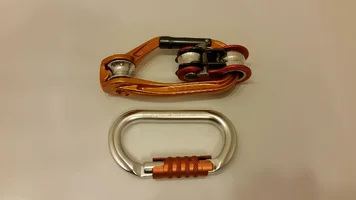
Getting back from a limb walk.

ok, last shot... M.A. is equal to output/input force in a simple system. In the system we are building the climber (load) doing the work you simply move shift the math around a little.

MA=output/input
In our situation the input force is the output so you get an extra measure of force. In order to apply input into the system, you have to subtract from the output, which decreases the weight of the load only while moving.

The math is there, you just have to work it.
 
I don't get your point.

Well, the only point is that we don't really have a frame of reference to understand relativity in physics without a visual demonstration, because some of it is alien to us... we walk on the ground and never think about how the ground itself applies force to objects. Gravity doesn't suck a 100 lb. rock through the planet because the surface of the planet is applying 100 lbs. of force opposite to the gravity. That's how physicists and engineers look at it. We tend to look at it as just a planet in the way of the gravity.

But when you take your feet off the ground and pull yourself up on DdRT, the forces that move you are inside of the system, not outside of it (as when your groundie pulls you up). The system goes from a change of direction to a 2:1 MA. You have to actually show most people that, before they'll believe it. The Fool's Tackle is like that in that when you look at a diagram of it, it seems like it should work just fine, but it doesn't. To a climber, the mechanical advantage is obvious... all you have to do is grab both ropes and pull. You're instantly back to 1:1 and lose the MA, because when you grab both ropes you put yourself outside of the system and the forces aren't working on the moveable (relative to you) pulley.

 
Last edited:
In a classic doubled rope system, with pulley above, if you pull the rope down 1 foot on one side, then of course the other side will go up 1 foot {1:1 for his groundie to pull him up). Why then is it easier for the climber? Because he is bearing half his weight on each leg of the rope, and he is actually pulling two feet of rope through the system relative to his own body movement {2:1 for pulling himself up) So the same exact system has two results.

Now I am thinking that a weight that moves on the rope opposite the climbers side of the system would be very neat.
 
Well, the only point is that we don't really have a frame of reference to understand relativity in physics without a visual demonstration, because some of it is alien to us... we walk on the ground and never think about how the ground itself applies force to objects. Gravity doesn't suck a 100 lb. rock through the planet because the surface of the planet is applying 100 lbs. of force opposite to the gravity. That's how physicists and engineers look at it. We tend to look at it as just a planet in the way of the gravity.

But when you take your feet off the ground and pull yourself up on DdRT, the forces that move you are inside of the system, not outside of it (as when your groundie pulls you up). The system goes from a change of direction to a 2:1 MA. You have to actually show most people that, before they'll believe it. The Fool's Tackle is like that in that when you look at a diagram of it, it seems like it should work just fine, but it doesn't. To a climber, the mechanical advantage is obvious... all you have to do is grab both ropes and pull. You're instantly back to 1:1 and lose the MA, because when you grab both ropes you put yourself outside of the system and the forces aren't working on the moveable (relative to you) pulley.
Who are you and what have you done with JeffGu? Ha just joking, but why so serious! No, that was good stuff.

I think Levi is in denial because he doesn't want to admit he has been getting help all these years.

Honestly if the work gets easier then you are benefiting from a simple machine/ mechanical advantage. If you climbed up a vertical ladder that is more work than if you walked up the same ladder but only at a 45 degree angle. Same ladder same length, but you are going up only half the distance. Same with climbing with rope or doing any work... you are benefiting from a mechanical advantage if the work gets easier with that method. If it is easier to pull yourself into a tree rather than having someone pull you into the tree then there is mechanichal advantage.
Sometimes it is easier to just get baptized and believe instead of looking for facts and worrying about life. ;)
 
I find it sad that we have become so dependent on "science" and "facts", which by the way change all the time when a component is altered, that we will argue against what we can feel and experience on a daily basis. The never and always thought pattern is counter to our very safety as tree workers.
 
...Any other options? Trying to expand the toolbox.

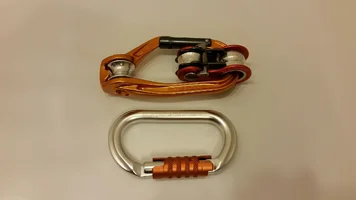
I have used a thimble prusic and revolver in the past, but find the Petzl roll n clip and the CT roll n lock to be faster to implement and smoother. They can be set and advanced after you get into a position that requires that 3:1 assistance.
 

Attachments

  • 20160430_075855_resized.webp
    20160430_075855_resized.webp
    76.5 KB · Views: 26
  • 20160430_075855_resized.webp
    20160430_075855_resized.webp
    76.5 KB · Views: 25
That technique is the true way to manage all slack while advancing back in from the limb. Only thing is, there's an almost infinite number of ways to set it up.

If you cannot unweight your line to create the config, you'll want a tiny ascender or a thimble prusik/biner. I personally would choose a Teufelberger OV6 Thimble Prusik and Wire Gate Revolver. I do realize that "quick"
Is "key", but my feeling is a bit more related to safety...it's totally possible to set up an ascender in a clear area, but I want to be certain that as I change location through my work that nothing with teeth is getting pressed against a limb. The rope on rope is very forgiving in that scenario and I don't consider it a problem.

If you can unweight your line, the cleanest kit is a biner such as a Petzl William HMS alone. Open the gate and put 3 wraps of climb line above your Rope Wrench around the spine of the William, then lay in the fall of line from below the Rope Wrench. Keep your tail with you, of course.

The nice thing about the biner alone is that you can set it up once for a series of limb walks as you work down one side of the crown. After the work is done, just unweight your system and pull on both legs of the tail and the biner will pull right back to you for removal.

I have to thank THE Rich Hattier for showing me this trick. @CutHighnLetFly posted a quick vid of this a good while ago, too.

Ramble done...Cheers, and welcome to the Rad World of SRWP!

Just getting started reading this thread, so my post might seem out of sequence with the current conversation. Just wanted to say thanks for posting this; it's a real gem, even if you're just passing it on from others. I think I've seen the video you mentioned, and then promptly forgot all about it.

Thanks for bringing it up again.

Tim
 
I have used a thimble prusic and revolver in the past, but find the Petzl roll n clip and the CT roll n lock to be faster to implement and smoother. They can be set and advanced after you get into a position that requires that 3:1 assistance.
Thanks DSMc. This looks like something I will try.

As for the rest of you goons, you're terrible at answering a simple question :lol:
 
Recent convert from DRT, how do you guys get back in from long limb walks? Pulling on one leg of a DRT system was how I did it before.. how I do it now is I use a sling on a carabiner near my last redirect and clip my tail through it to create a 2:1, keep the tail with me and haul myself back in when I'm done.

Any other options? Trying to expand the toolbox.
We got sidetracked on the hauling back mechanical advantage stuff, and I forgot to say that one of my favorite ways of getting back is either a long lanyard or the tail of your climbing line. Create a DdRT system out at the end of the limb and float back in with tons of control. You can do this with a long lanyard, I have a 25' which gets me 12 feet back before I have to resituate. The tail of your line often will get you farther. Anyway, just another option.
 
I just did the simple experiment, if I am a climber using this system and I raise myself 2' I will have pulled 4' of tail through the pulley.
You pulled 4' of rope through the top pulley and moved 2' closer to it. But you also moved past 2' of rope while getting closer, so a total of 6' of rope passed your ending position to get you 2' closer.
 
Last edited:
Dave, look at the image showing the gun tackle. Does that look like a typical ddrt system to you?

I'm late to the party, so maybe this has been resolved already. When I look at the image of the gun tackle the difference I see between the gun tackle and DdRT is the point of attachment of the termination end of the rope. The gun tackle goes one step further than does DdRT, attaching at the high block. With DdRT, the rope would simply be going up and over the high block in the illustration, and attaching to a connection point on the lower block, (which would represent the body of the climber, to my way of thinking).

Tim
 
I'm late to the party, so maybe this has been resolved already. When I look at the image of the gun tackle the difference I see between the gun tackle and DdRT is the point of attachment of the termination end of the rope. The gun tackle goes one step further than does DdRT, attaching at the high block. With DdRT, the rope would simply be going up and over the high block in the illustration, and attaching to a connection point on the lower block, (which would represent the body of the climber, to my way of thinking).

Tim
I believe he's comparing the gun tackle to the 3:1 limb walk haul back system, not DdRT.
 
I find it sad that we have become so dependent on "science" and "facts", which by the way change all the time when a component is altered, that we will argue against what we can feel and experience on a daily basis. The never and always thought pattern is counter to our very safety as tree workers.
Here is Dave again preaching the gospel. Don't pay attention to science and facts? Really?

The FACT remains that none of you have presented a clear and concise mathematical formula to support your claims. Meanwhile several people have said "It's out there" these are faith based statements. Show me the money!!!
 
You pulled 4' of rope through the top pulley and moved 2' closer to it. But you also moved past 2' of rope while getting closer, so a total of 6' of rope passed your ending position to get you 2' closer.
I measured the leg of rope were the effort was being applied, as is the proper way.
 
Here is Dave again preaching the gospel....The FACT remains that none of you have presented a clear and concise mathematical formula to support your claims....

Wow, again. You really can be a snotty little prick, can't you. I am just a tree man, not a mathematician and I have given you plenty of provable examples. You just refuse to accept them.

In the link you provided, fig.6 and fig.13 are examples of a 2:1 and a 3:1 as explained in the text. So you don't agree with those either?
 

New threads New posts

Kask Stihl NORTHEASTERN Arborists Wesspur TreeStuff.com Teufelberger Westminster X-Rigging Teufelberger
Back
Top Bottom