Women Arborist Injured at New York Botanical garden?

Hope she gets back up there.

Nothing is going to stop that girl. She is bright, sharp, alert and knows (answered every question I tried to ask Rob) about the ropes and rigging being used at the comp. Not to mention she nice, sweet and humorous. Thanks Rachel really enjoyed the afternoon with you and Mark. Wished we could have come out for some beers with all those people involved with the comp but duty called. I am sure we'll all meet again.

And for those concerned as I was. Although she does experience some pain at times you would not expect this girl had a thing wrong with her. She stood for most of the afternoon. She wore a smile the whole time. She claimed lifting anything is out but I watched as she stood from sitting on the ground and there was no sign of any discomfort. She walks with a cane but can walk without it fine. Good luck again Rachel and we'll see you in the trees!
 
You tried to ask me something?? Must've been preoccupied. I think what we saw was the miracle of modern medicine in her lack of discomfort. She's still got a long way to go before she's back to relative normal. Good luck!
 
Your decision to climb on an improperly set up system, not the type of system, is what set the stage. A traditional DdRT system set up as poorly as the SRWP system you were using that day would have most likely also ended with the need for an aerial rescue.

I am pointing this out not to be a jerk but because I see a focus in this thread on the botched rescue and the safety of SRWP. This imho is an industry wide problem at the moment. Though being able to execute a safe aerial rescue is an important component of climbing, it should never so dominate our thoughts that unsafe practices go unnoticed and unchanged.

I think maybe we can discuss this a little further, I didn't decide to climb on an improperly set up system. I ascended and worked for a solid thirty minutes on my hitch. Where it gave me no trouble, and I recall thinking that I would like to use the configuration again. I am a lighter climber and had a brand new rope, due to the decreased friction of having a new jacket I was attempting to manage it by tying a new variation to my regular hitch. I believe this caused an extra conflict in an already stressful situation once it bound up on me during the swarm and again after the rapid descent. If I had 10 more seconds from when he cut my rope I might have reached the ground.

The entire accident can be my fault due to my lack of equanimity during the swarm, I was not physiologically prepared for that type of attack and thought I was going to die. I definitely panicked, and probably panicked everyone within a 1/2 mile around me- because I was screaming in pain and fear. That's why I don't blame my crew member because I know he was only trying to help me.

You can blame the hornets
You can blame me for panicking
You can blame our lack of training
You can blame our work environment
but don't try to suggest that I would endanger my life by climbing on a system that I didn't understand

Don't worry though, I don't think your a jerk. I'm sure your a very nice guy.
 
Having been able to discuss this accident and climbing in general with R4chel I can attest to her knowledge of systems, knots and the tools used for setting up those systems. How many times have we ourselves adjusted our systems or made slight modifications within the work day or week? But that's just a piece of the puzzle that lies before us.

By coming here and posting in detail to the best of her recollection the circumstances as they unfolded is beyond admirable. What she's afforded us is an opportunity to look at an accident, dissect it, analyze it, and then draw out from it information that can be used to reconstruct it. As Dekker points out we have the luxury of working at this from the perspective of knowing what the outcome is. Doing that we look at it with a mind to pinpoint the failings and thus allocation of responsibility (some would say blame). That's easy in fact but, not valuable in gaining valuable insight into our working environment that can lead to modification in SOP, training, even our attitudes toward the crew members.

What the TRUE cause of the accident is doesn't reside in one aspect. We have protocols to account for potential deviation from the norm. Oldoak's scenario is a good example of this and instead of reading about another fall, we're reading about the success of a SOP; double check your system when switching form one form of attachment to another.

Can we walk through this information, without the bias of the outcome to first uncover all the relevant information we would need? Let's say, from the tailgate meeting on through to the aftermath? What do we need to know? How can we parse this to really drill down and once we have all the pieces go through this step by step, not to identify, where things went "wrong", but where the gaps between what was and what was supposed to be. Take the scenario of the modification did it contribute and in what way? What does the SOP say about this and despite the SOP was this actually in line with what in fact had become the real SOP in the field?

Personally taking this to the highest level of analysis is well worth the price of the 4 rods in her back, wouldn't you?
 
I
The entire accident can be my fault due to my lack of equanimity during the swarm, I was not physiologically prepared for that type of attack and thought I was going to die
.

I can't speak for you but you don't think "when or if" they are going to let you go and stop stinging you...you can't help but wonder WHY they would let you go and stop stinging you. Seems totally illogical given the attackers. Is a group consensus suddenly reached lol. "RETREAT!!"

Real close friend of mine working in a hundred foot plus oak for Bartlett on an estate way back when got involved with a bald face hornets nest and fleeing, on descent he ran out of rope and had to recrotch while getting mauled. He was ambulenced to the emergency ward where he came an eyelash from dying according to the doc.
 
...This Fly was retried by me to be used as a 'conifer rope' as it had seen a few years in the field and was beginning to show more fuzz than a rope you would climb on daily..... Additionally I was having difficulty with my hitch, it was a 30'' bee line (typically use it for Drt) with the hitch I tied that day, a Distel-with tresse's. The top of the hitch was jumping directly under the Rope Wrench (10'' hard tether) ..... I failed to provide the necessary distance between them to work them both. So in my initial descent I had to step up take the weight of the Wrench, place the load fully on the hitch and then break the hitch and then re-position the Wrench. It was very rough, awkward, .....I'll most certainly won't make that mistake with my hitch again, if my knot had been smoother I wouldn't stopped and likely could have reached the ground before the rope was cut......Rachel

OK, jerk alert!!! So do I believe this calm and concise description of how the system you chose to climb on that day was setup and performing, or the one from your most recent post, where I presume I got your blood up, that describes a well tuned system that was performing so well it was worth repeating for other climbs?
Rachel, I don't know you but from everything I have read, you are an extraordinary and gifted climber. The fact that you intend to continue with your climbing career and for others that it may help, is the only reason I am pressing you on this point.
I can only base my judgment on what happened by what you wrote. Based on that, I stand by my comments. This has nothing to do with blame, it's about learning.
 
Hi R4chel,

I have been there. I cut into a paper wasp's nest during a cottonwood removal in Colorado Springs about 10 years ago. I had a short line I was tied into and a long separate climbing line dangling from my harness. When they started stinging me, I had to set up a rappel with an old school ATC device to descend. I sustained 40+ stings, most to my face and hands. As it was happening I was also screaming and came close to jumping out of the tree (committing suicide) at 50 feet to the cement pad underneath. I set up my rappel and sustained severe rope burns to my brake hand descending. I have gone through some pretty bad stuff in my life and I have the scars to prove it. These paper wasps were probably the worst. I run a more modern system now.

You survived a horrible situation with wasps. I disagree with DSMC that your system set the stage. The wasps set the stage. Unless someone has been through an attack its hard to understand how unpleasant it is and how it can drive a person to panic.

There is a common attitude among arborists that any injury that happens on a job site is a result of incompetence on the part of the tree worker. This is a defense mechanism we use to convince ourselves that we are too skilled to get injured on the job like many folks around us. The fact is it is an inherently dangerous job with repeated and long term exposure for pros and we try to reduce risk with good planning and technique. We can't account for all the dangers we will encounter in a job. I was felling aspen in a natural stand in Wyoming when a tree (that I wasn't cutting and did not brush) fell down and struck me. Hard to anticipate, good thing I was wearing a hard hat.

I attribute 99% of the fault of your accident on a bum break running into wasps. It sucks but I love your attitude.
 
The hornets were the catalyst that revealed a series of problems not the problem itself. The whole point of our protocols and systems, SOPs and rescue training is to expect the unexpected and then respond to it without loosing it.
 
Well said, treehumper. Good protocols and systems, a good attitude for safety and good gear setup can help us safely handle almost all unexpected events.

All that said, the most safety conscious of us may be killed working tomorrow. We work in a very dangerous job with repeated high exposure where we don't control all the variables (like texting drivers).

Wasps is one of the worst lottery ticket I've drawn, and I've drawn some bad ones, got scars to prove it. "Losing it" is the proper evolutionary natural reaction to being swarmed and stung. I still can't always quickly and easily switch from ascending to descending, because I think wasps are rare and it would be a pain to retool my system. Like most of us, I work cost-benefit and risk-management profiles to keep going in this industry.

What R4chel gets from me is empathy and respect without negative judgement. It's a hard thing you came up against, congratulations on surviving it.
 
Slack tending systems are without a doubt a boon to the industry in work ability, safety and comfort but...so many more moving parts and pieces of equipment inherently resulting in more time in changeover from ascending to descending like said above. Old school often meant NO tie in ascending and with just a length of rope, no snaps or anything else one could just toss the line over a crotch, tie an attachment to the saddle with a tail for a hitch while hopefully being lanyarded in then bale out in seconds.

But you can't turn out the lights in a room and get out before the room gets dark just like you cannot get hit with a swarm of hornets and hope to escape unscathed under any circumstances. The hornets WERE the problem...minor miscalculations entered the picture..ie the hitch binding under a stressful situation (hornets) and the severing of the rope under a stressful situation (hornets). The contentious guy above would have gotten tagged just as many times as you and would have likely been fortunate not to take the fall as his hitch would have gotten him to the ground with no need for a second party to intervene and cause an accident....maybe.
 
Stopping at the hornets is not going to solve the other issues. Those are the systemic problems the ones that exasperated the initial problem (the hornets). One of these being climbing on an as yet untested reconfiguring of the system. While we understand our jobs are dangerous we too often enter a tree with an initial mindset that belies the reality that we don't know exactly what we could be facing. For me, I let myself rationalize not following a SOP, rope in a main union, because I was thinking about the time it was taking and that I wanted to get to the next job sooner. What I wasn't thinking about was that I was entering a storm damaged tree which could have limb damage I can't see. If I had been thinking about the tree I was entering instead of all the other things, I may have be more mindful of the risk I was truly facing. In other words, the defect in the limb, like the hornets in R4chel's case, wasn't the real problem at all but where my head was at during a critical step in the process.
 
The heart of the problem is the industry.
Its a loaded gun and we are the target and all thats needed is
a distraction or uncontrollable variable/the trigger.
In almost every instance the industry as whole is responsible because
it is a voluntary trade with so much left to chance. Plain and simple its the wild west!
We have to compete and survive in an industry that does not respect
the worker. I probabley should have been dead a few times. It is only by the grace of god, dumb luck or whatever that I have survived.
I pray for you all to see that a few extra dollars at the end of day is not worth any amount of danger you encounter.
Union talk aside, a concerted effort is needed desperately to protect our special breed of arbclimbers.
It should be like other high risk industries. Mandatory licensing, certification, training and education, time spent in the field with an experienced and educated authority etc.
Not to single any one out but I see training companies come into the area to teach individuals to climb and cut trees. Only for the profit of a few at the expense of the climber. Anyone can call themselves an arborist here and undercut and devalue the vocation with out reprimand.
It is disheartening to say the least.
I love my vocation and hate the industry/association.
the industry is a race for dead last.
Rachel you are an unwitting participant as we all are.
Thanks for sharing your misfortune so others may keep safe.
I appreciate your courage.
 
The heart of the problem is the industry.
Its a loaded gun and we are the target and all thats needed is
a distraction or uncontrollable variable/the trigger.
In almost every instance the industry as whole is responsible because
it is a voluntary trade with so much left to chance. Plain and simple its the wild west!
We have to compete and survive in an industry that does not respect
the worker. I probabley should have been dead a few times. It is only by the grace of god, dumb luck or whatever that I have survived.
I pray for you all to see that a few extra dollars at the end of day is not worth any amount of danger you encounter.
Union talk aside, a concerted effort is needed desperately to protect our special breed of arbclimbers.
It should be like other high risk industries. Mandatory licensing, certification, training and education, time spent in the field with an experienced and educated authority etc.
Not to single any one out but I see training companies come into the area to teach individuals to climb and cut trees. Only for the profit of a few at the expense of the climber. Anyone can call themselves an arborist here and undercut and devalue the vocation with out reprimand.
It is disheartening to say the least.
I love my vocation and hate the industry/association.
the industry is a race for dead last.
Rachel you are an unwitting participant as we all are.
Thanks for sharing your misfortune so others may keep safe.
I appreciate your courage.
Cool rope for the love of the unknown and for the life of trees. Amen
 
Glad you're ok Rachel.

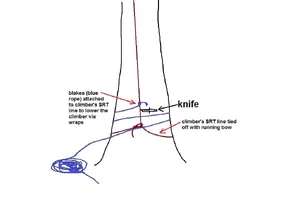
Is this how the rescue attempt looked at the base anchor from what you can tell?

srt accident.webp
 
That's how I've been seeing where the point of the release was. I've been thinking the blakes didn't grab because there wasn't enough rope to grab it or the rope was cut too close the hitch. Now, if Rachel knew she was going to climb into a bees nest this day she would have tied an alpine butterfly into the system above the bowline and groundman could of tied into this and done a couple of raps and Rachel would have been able to finish up the season. Thanks TC for the drawing, helps.
 
It's not the knowing of the particular hazard but that there is a chance of one arising. If the system lends itself to rescue then it can be done more assuredly.

Rope, to your point the industry, and by that what is really meant is the group of individuals that make up the industry needs to move away from this war mentality and into a different paradigm. We are not "fighting" a battle everyday we go to work, nor do we live to "fight" another day. While war and the "Art of War" may be good analogies for business in how it is organized, it suffers when it's applied to the people who are actually doing the work. We work to live and live to see another day. While they're maybe an acceptable number of casualties in battle, there are none in work.
 
The heart of the problem is the industry.
Its a loaded gun and we are the target and all thats needed is
a distraction or uncontrollable variable/the trigger.
Rope I agree whole heartedly that the industry is to blame for our misfortunes. And I agree that something needs to changes or we will continue to cause injury. Lets look at it in a little different way for a moment though. The industry is made up of a series of individuals and change has to start at those individuals. The industry as a whole can not change over night we each need to over time. Sure I don't blame Rachel or her ground guy for this (first of all I wasn't there and can place no blame, just like everyone else here), but the change starts with her. Everyone has a circle of influence, Rachel's just got very large. I used to set up just like her... Until I heard of her accident. We did a basal anchor rescue safety meeting a couple weeks later.
As a individual with in this industry we all need to stop blaming the industry and do something about it. When we blame the industry we spend a lot of time wasted complaining rather than thinking of a way to change. It starts with you.

Rachel thank you for sharing, and hopefully saving me from a similar fate someday. Stay strong, be safe.
 
In that line of thought, what RopeShield mentioned about mandatory licensing is important. You'll never be able to weed out all the hacks but mandatory licensing would go a long ways toward that while also improving public perception. If the regulatory bodies don't see fit to have mandatory licensing in Arboriculture, why should a customer?
 
When change starts at the bottom or with the individual, it can begin the grassroots movement. In order for it to become adopted as industry standard practice then the oversight bodies and leadership in the industry also have to embrace and champion the change.
 

New threads New posts

Kask Stihl NORTHEASTERN Arborists Wesspur TreeStuff.com Teufelberger Westminster X-Rigging Teufelberger
Back
Top Bottom