Who's a self taught climber?

Thanks Tim, good advice. Confidence seems to be the key, as i go higher I become more and more acutely aware of all those parts in the chain, some of them seem so small lol.

I have to admit, it's harder than I thought it would be, which is good because I like a challenge.

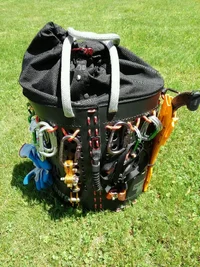
Here is my gear bag in all it's newness, looking forward to actually using that saw.

Notice the knot cheat cards on the left (instills confidence in my spectators).

My gear.webp
 
Hey, fitz!

The following quote is in response to a post by a great arborist named August Hunicke, in a different forum. Rather than rewrite my whole response to him, I chose to copy and paste it here, along with a video of great import to climbers who use the Rope Runner, which I think I see hanging on the outside of your bag.

"I look forward to hearing your continuing impressions about the various climbing tools that you choose to experiment with. You are probably aware of this, but I think I've read that the spring at the top of the Rope Runner is critical to its function. Yoyoman did a video on his YouTube channel about it. You just need to check it all the time to make sure that it's functional, I think. I do not yet own a Rope Runner, for the sake of full disclosure. I believe the Rope Runner still works without a functioning spring, but you have to manually engage it before you sit your weight into it, just like the early days of the Rope Wrench with a floppy tether.

The big difference is, the Rope Wrench was not life support, the hitch was. The Rope Runner is life support, and if you sit back into it with a broken or missing spring, without manually engaging the Rope Runner first, it could drop you. So I guess the rule is to check every time that the Rope Runner has engaged before putting your life on it, just like you would with a hitch. I would guess that a failure of the spring is a really low probability event, but the importance of the spring in the function of the Rope Runner is, in my opinion, something that every climber using the Rope Runner should be aware of.

Having said all of that, I'm really proud of Kevin Bingham for both of his inventions, and I look forward to owning a Rope Runner myself, when times are better for me."


Maybe you've already seen this information in another form already, but I thought it is important enough to make sure that you have.

Tim
 
Thanks again Tim! I really do appreciate you taking the time to help a beginner/nobody over the internet.

The Rope Runner is tricky, and definitely an advanced tool.

I can deal with being careful with pushing down on the bird and controlling my decent, (I'm getting pretty good at it). But the part that bugs me about it is when ascending sometimes the bird doesn't engage and just flops back down, I have to manually push the bird up for it to engage. A stronger spring maybe? It's not life threatening, it will engage back to where it started, but I can't seem to figure out why it does it on occasion, mostly with a foot ascender, not when I'm foot locking.

I've watched all of Mr. Mumfords videos several times.

As much information that's over the internet, it's surprising how little there is about tree climbing compared to other activities, tree climbers must be a very small group.
 
Hey, fitz! You are most welcome for anything I do that you find at all helpful. I'm still a fairly new climber myself compared to most on here, probably. I may have been climbing for between two and three years, just guessing, and that is sporadic.

Everything I know was gained in just the way that you are doing it, so I owe a huge debt to all of the climbers around the world who choose to share their knowledge on the forums and in their videos. I understand what you are saying about how tough it is to find the videos you are looking for to learn how to do this stuff. On YouTube, it's tough because you're always looking at a selection of individual videos, and it can be difficult to wade through all the stuff. It's almost like trying to find a word in a dictionary that is not arranged in alphabetical order.

There is one climber that I'm not sure ever participates much in the forums, but whom I credit almost completely with the fact that I climb at all, because he came up with the solution to the problem outlined in the paragraph above. His name is Daniel Holliday, and he hosts a website that contains the single most comprehensive set of videos pertaining to climbing trees and doing arb work anywhere. Especially for those new to the entire subject. I've sung his praises before, so hopefully the members here are not rolling their eyes when I do it again.

The thing that makes Daniel so different is that I can tell he had a plan in mind before he ever started producing his videos. He set out to produce a fairly complete set of videos, going from the most basic techniques to the newest and most complex, and he succeeded. The advantage to his website is that the videos are arranged by category, which makes it easy to study one area intensively.

Here is the link to his website.

http://www.climbingarborist.com

To see a small bio of Daniel, click on the "About" tab at the top of the page.

I do not yet own the Rope Runner, so I cannot fully understand the significance of your statements regarding the spring and the bird on the Rope Runner. Having said that, failure of the top part of the Rope Runner to engage is what could cause a rapid and uncontrolled descent, I think. I think you participated in the thread on this forum about "Rope Runner Problems" or something similar. Multiple people commented on having a "weak spring", or words to that effect. Monkeylove said he put more twists on the spring to make it react better. I think you need to go back and read every post in that thread closely. A spring failure on the Rope Runner can be fatal, if I'm understanding things correctly, and I think the latest iteration of the Rope Runner made a change to the spring for just the reasons you have outlined.

Making sure that the Rope Runner engages prior to putting your full weight into it, either because it's acting as it should, or because you set it with your hand in a manual fashion, is an absolute requirement for safe use of the Rope Runner.

Also, I think Kevin Bingham himself said in a post that he uses the "bird" primarily to get the descent started, but that he uses his hand on the back side of the Rope Runner to really control his descent, if I'm remembering correctly. I think using just the "bird" to control descent makes things a bit more jerky than it has to be, according to Kevin.

Too wordy, once again. Thanks for putting up with the long post.

Tim

 
Hey, fitz! You are most welcome for anything I do that you find at all helpful. I'm still a fairly new climber myself compared to most on here, probably. I may have been climbing for between two and three years, just guessing, and that is sporadic.

Everything I know was gained in just the way that you are doing it, so I owe a huge debt to all of the climbers around the world who choose to share their knowledge on the forums and in their videos. I understand what you are saying about how tough it is to find the videos you are looking for to learn how to do this stuff. On YouTube, it's tough because you're always looking at a selection of individual videos, and it can be difficult to wade through all the stuff. It's almost like trying to find a word in a dictionary that is not arranged in alphabetical order.

There is one climber that I'm not sure ever participates much in the forums, but whom I credit almost completely with the fact that I climb at all, because he came up with the solution to the problem outlined in the paragraph above. His name is Daniel Holliday, and he hosts a website that contains the single most comprehensive set of videos pertaining to climbing trees and doing arb work anywhere. Especially for those new to the entire subject. I've sung his praises before, so hopefully the members here are not rolling their eyes when I do it again.

The thing that makes Daniel so different is that I can tell he had a plan in mind before he ever started producing his videos. He set out to produce a fairly complete set of videos, going from the most basic techniques to the newest and most complex, and he succeeded. The advantage to his website is that the videos are arranged by category, which makes it easy to study one area intensively.

Here is the link to his website.

http://www.climbingarborist.com

To see a small bio of Daniel, click on the "About" tab at the top of the page.

I do not yet own the Rope Runner, so I cannot fully understand the significance of your statements regarding the spring and the bird on the Rope Runner. Having said that, failure of the top part of the Rope Runner to engage is what could cause a rapid and uncontrolled descent, I think. I think you participated in the thread on this forum about "Rope Runner Problems" or something similar. Multiple people commented on having a "weak spring", or words to that effect. Monkeylove said he put more twists on the spring to make it react better. I think you need to go back and read every post in that thread closely. A spring failure on the Rope Runner can be fatal, if I'm understanding things correctly, and I think the latest iteration of the Rope Runner made a change to the spring for just the reasons you have outlined.

Making sure that the Rope Runner engages prior to putting your full weight into it, either because it's acting as it should, or because you set it with your hand in a manual fashion, is an absolute requirement for safe use of the Rope Runner.

Also, I think Kevin Bingham himself said in a post that he uses the "bird" primarily to get the descent started, but that he uses his hand on the back side of the Rope Runner to really control his descent, if I'm remembering correctly. I think using just the "bird" to control descent makes things a bit more jerky than it has to be, according to Kevin.

Too wordy, once again. Thanks for putting up with the long post.

Tim
Yes climbing arborist.com. that site changed my life. It's great having some extra tricks in the bag while using the same gear.
Reading , watching and my big Norway maple in the back yard have been my training.
 
Thanks Tim, not wordy at all, any and all help is greatly appreciated.

That's a great website, already spent a lot of time looking at it.

I posted in that thread to see if anyone can give some insight.
 
Well i started this topic a while ago to ask a question. It has been awesome reading every comment. I'm addicted to climbing now. Im just getting into srt now with a hitch hiker. Its funny that the company i work for don't use this technique too much especially after watching our superviser spend ages trying to isolate a branch to prune a ponderosa pine. I was in the neighbouring tree within minutes on a basal anchor. I want to learn more...
 
...I can deal with being careful with pushing down on the bird and controlling my decent, (I'm getting pretty good at it)....

As important as careful modulation of the device during controlled descent, is how you react when things become uncontrolled. When I started using the SRT devices (hitch hiker, rope wrench, rope runner, etc.) one of the first things I did was to repeatedly do short fast drops and let go of the device/hitch until the "muscle memory" was ingrained to release the hitch instead of "holding on for dear life" when things got 'scary'.

You also need the presence of mind to push up on the "bird", hitch, etc, if you are not stopping.

Short version...practice a few panic situations so you become accustomed to dealing with them.
 
As important as careful modulation of the device during controlled descent, is how you react when things become uncontrolled. When I started using the SRT devices (hitch hiker, rope wrench, rope runner, etc.) one of the first things I did was to repeatedly do short fast drops and let go of the device/hitch until the "muscle memory" was ingrained to release the hitch instead of "holding on for dear life" when things got 'scary'.

You also need the presence of mind to push up on the "bird", hitch, etc, if you are not stopping.

Short version...practice a few panic situations so you become accustomed to dealing with them.

Good advice, thank you, along with this, in order to get accustomed to the device, and the extent in which it operates I tested how hard I would fall if I pushed down hard on the bird, well, I found out. :sorprendido3:

I learned to push up on the bird from watching Mr. Mumford's videos.

It's interesting how my other activity of racing sport bikes on the track, what might appear two very dissimilar activities share a lot of the same practices, gear inspection, confidence and so on.

Often what we do at the track we use the analogy of walking a tight rope, our contact with the ground and what keeps us from falling (160 mph horizontally) is very small, much like the contact with our rope.
 
Last edited:
Here is my gear bag in all it's newness, looking forward to actually using that saw.

You've probably already learned this elsewhere, but make sure that you have at least one additional attachment to the tree before making any cuts, be it with a hand saw or a chainsaw.

When a climbing rope is loaded with a climber's weight, just barely touching the climbing rope with a hand saw can cause it to pop and be severed almost instantly. This is one of the reasons I like to climb with two ropes. If you're using only one rope and your second means of attachment is a short lanyard, and you do manage to cut your one and only climbing line, you won't be killed in a fall, but you won't have a way back down, either. So that's one more advantage of climbing with two ropes, and two systems.

I'm sure a lot of pro arbs, which I am not, think of two ropes and two systems as overkill, and maybe that it takes too long to set up. It works for me, though, and I like the safety it provides and as well as the advantages in work positioning.

Sean, aka southsoundtree, recommends capturing your climbing line with a carabiner and pinning it to your saddle away from the cut, if the rope is anywhere near the area you're trying to cut.

Thanks for your time.

Tim
 
Last edited:
I'm sure a lot of pro arbs, which I am not, think of two ropes and two systems as overkill, and maybe that it takes too long to set up. It works for me, though, and I like the safety it provides and as well as the advantages in work positioning.


Tim

Thanks again Tim, since you mentioned this I've done a little reading about this, is what they call DRT?

Yea, welcome to my mind.

LOL, now that's funny, that might be why I've had to watch them so many times.

Oh and thank you for taking the time making those videos, they have been a tremendous help, one of the reasons I bought a Rope Runner actually, (you just make it all look so easy, lol).
 
Why different standards "rec" climbing?

You've never encountered a less than perfect TIP in the course of a removal? If given the choice between a lighter duty TIP for a better work position VS a bomber one with no work position component in a rec climb. . .
 
Thanks again Tim, since you mentioned this I've done a little reading about this, is what they call DRT?

Fitz, you are right about the nomenclature being confusing or difficult, or whatever. I think JohnnyPro may be responsible and due the credit for naming his technique the "Twin Rope Technique". Though I'm not sure I've yet seen anyone call it TRT, for short.

My understanding of what Double Rope Technique, (DRT) is, (senior members can correct me if I'm wrong) is the method people use during the footlocking competitions. It consists of having a rope pulled up and over and back down a really strong tie-in point, which I assume would optimally be one big, strong branch. The rope remains stationary, with the two legs of the rope hanging side by side. I believe the climbers use what is called a footlock prusic, which is a fairly long piece of friction hitch cord, that attaches to the harness bridge, and can be pushed up the rope to the limit of a climber's reach. Footlocking is a technique that takes skill and lots of practice to perfect, and consists basically of raising the knees up and trapping the rope in between ones' feet, and then standing up, thereby gaining height once the prussic is pushed up to capture progress. I'm sure there are videos of the technique on YouTube.

The problems understanding the terms is why some folks are trying to get new terminology adopted for the same old techniques, which adds another layer of confusion to the mix. I'm not going to get into the new terminology, and will stick with what I've learned already, and which I believe you are asking about.

DdRT (big D, small d), is Doubled dynamic Rope Technique. The dynamic part is because the rope actually moves as you climb, unlike with footlocking. With DdRT, the rope goes over a single, isolated, strong branch, and ties into the harness. Pulling on the other side of the rope pulls your body up, as the rope moves. It's important to buy and use a friction saver when using this technique, to prevent damage to the cambium of the branch your rope is running over. Visit climbingarborist.com for all the knots and techniques you are referring to. It is just an outstanding resource.

http://www.climbingarborist.com/

Thanks for listening.

Tim
 
Last edited:
Acronyms can be confusing but DRT, to most of us, I'd Double Rope Technique. Its two ropes, two devices and sometimes, two separate tie ins.
 

New threads New posts

Kask Stihl NORTHEASTERN Arborists Wesspur TreeStuff.com Teufelberger Westminster X-Rigging Teufelberger
Back
Top Bottom