who needs a winch (hard lean tale)

dspacio

Branched out member
Location
Narragansett Bay
returned to a Silver Maple, which had one stem fall in a spring storm, to bring down the rest.
three main stems, all leaning away from the yard, over a fresh new fence.
not huge (13-22dbh), each progressively smaller, and with more lean.
Centers of Gravity lean away about 2 ft, 5 ft, and 8 ft, respectively.
Set up a great pull system to a maple and clothesline post way across the yard.
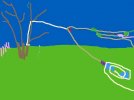
hardlean.jpg

with this I could tension with a 2:1, 6:1, followed by more with a 10:1.
25% face cuts. backcut a bit and tension. tree went down revealing rotten middle.
first went well (could have been felled with just wedges, served as test tree)

the second was the highest risk, big section, CoG needs to move maybe 6 feet. I had a decent high crotch to handle the tension. made my final reality check after getting it all set. crucial to the plan was not running out of rope between the blocks.

to break this down: pull line from tree ends in a pinto pulley, through which one end of nystron rope runs to a block on tree, back to another pinto prussiked on that leg; other end meets a 5:1 fiddleblock anchored to clothesline post.
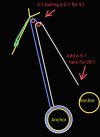
It's the first time I used M.A. multiplier, by pulling a 2:1 system with more advantage. As I understand, the force multiples (2:1 x 3:1 = 6:1 )

Generally I have seen pulls like this done with winches, trucks, machines; never with rope and man alone, so I was in an uncharted water feel. It was not a play scenario, I had a spotless fence under a hard leaning tree (20 and 40 degrees off vertical?).
I trusted to principle, my assessment of tree weight and whether I was balancing the force I would need with the amount of reach I needed to move the tree that far.
I was able to start hauling stem 2 for real while still having about 30% hingewood (with a bit of core nipped out). I truly did run out of rope on the extra MA setups, right about the time the tree was nearing a point of balance, and I could haul right on the 2:1 directly and bring it on home.

The 3rd stem went about the same, though I needed to haul it way further, it was about half the weight and went without a hitch.

Reason I am sharing. Some night I remember reading about force multiplier in MA systems, no idea why, it just came up and I logged it as a cool tidbit. I showed up yesterday prepared to climb this thing and piece it out, maybe fall it. Then I saw the new fence, meaning it was more rigging. It was with a few doubts I considered hauling these things over. Ultimately this trust in known methods, just in a new combination, let me fall these safely and in half the time climbing could have.
So the half hour of reading about M.A. multiplier saved me half a day of work. Sometimes I study after seeing the challenge, but this time a whole bunch of things came together (including face cut and backcut principles, using hinge, the experience to expect rotten core) so I could bring these down in a good controlled way.

I also was super jazzed about the variability this pull system gave me. I recently set up that dedicated 5:1 with some of that maple leaf double braid, super handy to have as an easy addition.
no winch required. any advantage can be had, just avoid making and fighting friction.

Anyway, enough writing.
 
I’m not sure you’d gain anything with the 5:1 on one side and the 3:1 on the other. But for the main line of that was run to a pulley and back up to a mid line block and the 5:1 pulling on that tail, you’d get a 15:1
I'd agree. However with how it's set up, the 3:1 could be used to get all of the stretch out of the rope, making the 5:1 more efficient. However the 15:1 ultimately would have created a more powerful pull.

@dspacio congrats on the new tool in the toolbox.
 
I only pull trees by hand. I tend to use the setup @evo just mentioned, which uses essentially the same equipment. I'll set up a z-rig (3:1) on the pull rope coming from the tree and pull it with a dedicated 5:1 system for 15:1 total (theoretical.) I may redirect the pull line closer to the ground so I can fully reset the z-rig if needed. My 5:1 has a progress capture cam on one of the double pulleys, which can be disengaged if desired. For heavy pulls, I put tandem prussiks as progress capture on the z-rig.

I may flip the 5:1 around and pull towards the load (which makes it a 4:1) if that lets me pull downhill instead of uphill.

I have thrown another pulley in for even more MA/ease of pulling, but you have to start considering the loads on each component in the system as it's easy to get on the wrong side of desired safety factors.

I enjoy rigging up haul systems. Sounds like you do too.
 
Just for future thought, if you have multiple rigging lines, this is an easy compound mechanical advantage system that allows for using traditional rigging blocks that are already on your truck.

Since getting a winch on my mini, I've not really used this but it used to come out often.
I'd get everything set up and tie each end of the rope off, to avoid a rope pulling out of the pulley/block, then I'd pull the green rope as tight as I could by hand and secure the basal leg with a midline knot. With a progress capture on your 5:1 or a puller like the rope jack, this gives you the entire length of your white rope to pull with. Very unlikely to bottom out your pull system.

As mentioned above, be aware of your safety factor with your equipment, however sometimes creating more mechanical advantage is more about making it an easier pull than maxing out the system. Screenshot_20220825-222130_Samsung Notes.jpg
 
Just for future thought, if you have multiple rigging lines, this is an easy compound mechanical advantage system that allows for using traditional rigging blocks that are already on your truck.

Since getting a winch on my mini, I've not really used this but it used to come out often.
I'd get everything set up and tie each end of the rope off, to avoid a rope pulling out of the pulley/block, then I'd pull the green rope as tight as I could by hand and secure the basal leg with a midline knot. With a progress capture on your 5:1 or a puller like the rope jack, this gives you the entire length of your white rope to pull with. Very unlikely to bottom out your pull system.

As mentioned above, be aware of your safety factor with your equipment, however sometimes creating more mechanical advantage is more about making it an easier pull than maxing out the system. View attachment 83296
A few of my thoughts...

To me, one drawback of the double 2:1 system is the tree/stem is likely to land on one or maybe both pulleys.

Having a long enough rope, I'd typically use one rope for the blue and white lines; tie a butterfly at the anchor point and attach it to the anchor with a sling.

Adding progress capture for the double 2:1 is not as straightforward as with a z-rig if you want the capability to reset the 5:1.

Anchoring everything to the same anchor point maximizes efficiency. The further the 5:1 anchor point moves out of line from the "base" system, the greater the efficiency loss. Of course, having lines so close they rub each other adds friction too.
 
To add what I can’t quite recall beyond practicality there is a tipping point. Pulley efficiency will negate the benefit of theoretical MA gains.
While I have enough pulleys and blocks to test this I might not have enough rope! Nor a load cell..


Taking dontations
 
Just a question. When you're using that much leverage, do you feel comfortable using a base anchored pull line connection to tree. The base anchor by it's nature will impart a force vector down the stem, though how much depends on friction up top and rope angle obviously. I would rarely question it for lighter pulls, but for something getting up to those kinds of leverage, it seems it might be a consideration, especially if the tree has decay and the hinge may not be 100% reliable.
 
The tension ratio on a typical pulley 180 degrees rope bend is 1.2. For each bend you multiply another 1.2

three bends 1.2 cubed = 1.728

six bends 1.2 to 6th = 2.98 so you theorise I think 6:1 advantage but penalize it divided by three(wrong see edit) from all 6 tension drops around the pulley bends - edit the 6th pulley exit is accomplishing attempted x2 but divided by three of the original rope pull approximately

eventually the next additional pulley gain factor is nullified by the cumulative power of the tension drop (ratio)

I didn't know this years ago straightening a cherry tree and just figured the root plate was really fighting me :)

edit - friction using biners like pulleys is tabulated in the Basal SRT tip forces thread

edit - it's not a simple divide by. For each new added pulley that pulley is divided by. The total advantage is only less x1.2 at the first pulley, then less x1.44 at the second then less 1.728 at the third pulley etc so you have to add up the progressively less effective pulley contributions. Sorry for the error. Kenny, formula for sum of exponential series? Tried looking it up and a warning siren went off and smoke started coming out of my ears.
 
Last edited:
ok here goes. 1/ 1.2 = 0.83 the ratio r

sum of the series = term1 x (1-r to the n) / (1-r)

n = 6 pulleys term1 is hand pull on rope so
(1 - .83 to the 6th) / (1 - .83) = (1 - .327) / (.17) = .573 / .17 = 3.37

so the hand pull diminished by 6 pulleys but adding up all 6 attempted tension gains gives 3.37:1 actual mechanical advantage. Moral of the story - use good bigger pulleys on your fat rigging line!

try r = 1 / 1.1 = 0.91
(1 - .91 to the 6th) / (1 - .91) = (1 - .568) / (.09) = .432 / .09 = 4.8 significantly closer to 6:1

real rope on a real pulley unfortunately is the 1.2 tension ratio. doh! maybe smaller amsteel on a 4" pulley would give 1.1 tension ratio. For extra points do it with rope on biner friction. fail.

So open question, is the geometric (exponential?) sum formula correct? Seems so to me. It also predicts the limit as you add pulleys. 1/(1-r) gives 5.88:1 max advantage on 1.2 tension ratio rope/pulleys. 11.11:1 for 1.1 tension ratio rope/pulleys
 
ok here goes. 1/ 1.2 = 0.83 the ratio r

sum of the series = term1 x (1-r to the n) / (1-r)

n = 6 pulleys term1 is hand pull on rope so
(1 - .83 to the 6th) / (1 - .83) = (1 - .327) / (.17) = .573 / .17 = 3.37

so the hand pull diminished by 6 pulleys but adding up all 6 attempted tension gains gives 3.37:1 actual mechanical advantage. Moral of the story - use good bigger pulleys on your fat rigging line!

try r = 1 / 1.1 = 0.91
(1 - .91 to the 6th) / (1 - .91) = (1 - .568) / (.09) = .432 / .09 = 4.8 significantly closer to 6:1

real rope on a real pulley unfortunately is the 1.2 tension ratio. doh! maybe smaller amsteel on a 4" pulley would give 1.1 tension ratio. For extra points do it with rope on biner friction. fail.

So open question, is the geometric (exponential?) sum formula correct? Seems so to me. It also predicts the limit as you add pulleys. 1/(1-r) gives 5.88:1 max advantage on 1.2 tension ratio rope/pulleys. 11.11:1 for 1.1 tension ratio rope/pulleys
Your math is a little farther into mechanical advantage than I was prepared to go. Lol. I just know it works. :D


Helpful info for anyone building a mechanical system, either designated or building it on the fly on a jobsite.

At the last Jambo a couple of years ago Taylor Hamel was talking about pulley efficiency and mechanical advantage systems. I've probably forgotten some of what he said, but the jist was to always use your most efficient pulley closest to your pulling source.

The less efficient a pulley, the less pull transfered into the rest of your mechanical advantage system.

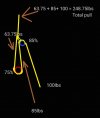
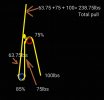
Below is the exact same system but with two different efficiency pulleys placed at different spots, and ends up creating a different amount of pull.

****Disclaimer: it's been a long time since I was in any sort of math class; but I believe the equation shown is how you'd figure out the true mechanical advantage for a system, when knowing your pulley efficiencies, since as we all know the 3:1 (300lbs of pull) is a
theoretical advantage for the below system.

Screenshot_20220827-194412_Samsung Notes.jpgScreenshot_20220827-194428_Samsung Notes.jpg
 
@Bart_ I think you need to use n-1 in the exponent. The total pull is the sum of the lines, and one line, the one you're operating, doesn't get reduced by the factor. Right?
 
An Omni Block 1.5 with 11mm Bluewater tests at 93.2% efficiency in a 2:1. The make/model pulleys used and the stretch of the rope have significant bearing on how far actual MA deviates from theoretical. In general, complex systems provide better real world efficiency than simple systems. Just another reason I like the z-rig.
 
I’m not sure you’d gain anything with the 5:1 on one side and the 3:1 on the other. But for the main line of that was run to a pulley and back up to a mid line block and the 5:1 pulling on that tail, you’d get a 15:1
As I understand it, the pull rope ending in a pulley creates a 2:1 for the line pulling off that. each end was essentially anchored when grabbed by the progress capture. then the other systems multiply that 2:1, that's how I see it. Feels like that's what happened.

the 3:1 could be used to get all of the stretch out of the rope, making the 5:1 more efficient. However the 15:1 ultimately would have created a more powerful pull.

@dspacio congrats on the new tool in the toolbox.
thanks! this was exactly how it worked, first tensioning with the 3:1. once I got everything I could from that side, went to the 5:1 and could get just a bit more pulling over there.
The 5:1 is barely more effective, because of all the friction (it's an old set of blocks from a used marine consignment store); but I could feel it, just a touch more advantage on that leg.

Just a question. When you're using that much leverage, do you feel comfortable using a base anchored pull line connection to tree.
I am more comfortable with the base anchor than just pulling at the top. the reason is to direct the force more down the stem. just pulling the top I easily could have snapped the top out. On one of the pulls, I intentionally snapped a top out first, that I was over with my initial line setting. (also was over a solid preffered crotch that it settled down into afterward) it is absolutely crucial to not overestimate the strength of the top you are pulling!
One of the stems also had a cavity about 8 feet up, that I wrapped the line around a few times, but mainly the base anchor helps pull the whole stem, rather than just bending the top over.
 
Personally I would have set a ground anchor instead of a cloth line post. Although they can be substantial. I have a set at the shop I can’t even wiggle with the mini.
 
Personally I would have set a ground anchor instead of a cloth line post. Although they can be substantial. I have a set at the shop I can’t even wiggle with the mini.
that is cool. would be a great thing to have. These trees themselves weren't very big, weight-wise, it was just a huge amount of lean. sharing the load between two anchors, also allowed the post to be in play. It was a 4x4 firmly in the ground, I assessed it's movement as a tensioned everything. it did the trick.
 

New threads New posts

Kask Stihl NORTHEASTERN Arborists Wesspur TreeStuff.com Teufelberger Westminster X-Rigging Teufelberger
Back
Top Bottom