
What can be done to kill a single tree root, that's intruded far under a slab?

What ability is there to kill or stunt a single tree root, without seriously endangering the entire tree?

Here the tree is one of a row between two houses. There's perhaps 10 feet to the house foundation,
then 3 feet down, then under a slab then.... poof... here's the root. This 3" root emerges in a basement parallel to a 3" cast iron sewer line from the 1920's. The root was fresh and wet when cut. There is no practical way to dig and follow the root back from the cut point.

Because it's a row of identical trees each about 25" high, identifying the match from root to tree may be impossible. The sewer itself is not (yet) impacted as far as can be told, but this is a big enough root to crack those pipes and the slab. The trees are mature, and not particularly unique specimens.
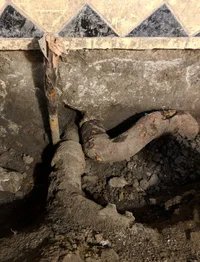
 
Specifically, this root is in Berkeley, California on heavy clay soil. There is no telling where the root dives under the slab.
Ppneumatic excavation might get lucky and nail this root in an accessible spot, or it might require removing concrete steps and 8' of hardscape and then produce no results.

Here's a photo:
The left is a caped cold water pipe that rusted through, apparently years ago. This pipe has been verified as live.
Then a 3" cast iron sewer pipe. Also live.
Then a 3" fresh and pulpy tree root, sharing the same foundation opening. And what do you know, live in a different way.

Tracing Root Under Slab Back To Tree.webp

Has anyone heard of a product like a tracer die that could be injected into the root, then traced back to either the tree
or at least to a candidate invasive root?

So far the best I can figure is to to inject this root (with agreement from the neighbor property owners), then monitor which tree shows stress, and cut that tree out. Better options?
 
Unfortunately many species of trees have a tendency to graft root systems underground where two (or more) trees interact with each other. Injecting a chemical/dye into this root has as much a chance to show in all of your trees as it does just the one attached to that root. Air or water excavation is still you best direct source to that particular root. You know where the sewer line goes in (thus the root). Start there follow it back a couple feet and prune it off. And as timberjack mentioned add a root barrier of some sort when the ground is open.
 
Roots will only grow where they can. They do not make holes in metal or plastic pipe they will just exploit them. Cutting a root from one tree will not stop the other trees roots from finding openings in the pipes. Cut the roots and fix your pipes. Use a root barrier to protect other hardscapes after roots are cut.
 
Thanks for the input on this situation!

The sewer line is 100% under hardscape from this point.
The root must intersect the sewer at a 90 degree angle, which narrows it down to about four trees.

It looks like a root seeking sewer effluent.
I believe it's actually a root seeking the pictured wet spot and a nearby uphill year round spring.
The cast iron pipes appear to be completely undamaged as of yet.
The slab it's under is undamaged, as of yet.

Option 1: pneumatic excavation, requiring removal of slab floor, a sunken 1920's concrete stairwell and sidewalk. Expensive.
Option 2: poison root, and take out whatever trees show stress or die. Not cheap either.
Option 3: do nothing, and risk future slab crack and pipe failure. Try to dry out the wet spot with a french drain to lower the root's activity.
Option 4: proactively remove the trees, let roots rot in place.

I've got one more question: given a root, is it possible to verify the direction the root grew?
And yes, that's a broomstick in the broken cold water main pictured.
 
I've got one more question: given a root, is it possible to verify the direction the root grew?
And yes, that's a broomstick in the broken cold water main pictured.

Ground penetrating radar or dig it out. GPR can give you a general picture of the root system of a tree. But the raw data is far more complicated then it sounds and takes a very intelligent individual to interpret it. We played with it a bit at my previous employer and it was cool.

What about option 5: dig it out a little more from the basement, cut it back as far as you can reach and paint both ends with a tar based wound sealer. I know the sealer will kill the cambium, but it will also prevent re-growth from the end of the root. Then put the root on a 1, 2 or 3 year inspection program it insure no further problems arise.
It might even be worth sending a drain camera down that pipe to investigate and see if tree roots have found their way in through the joints. We saved a maple tree this way. The line was being clogged every year by roots, and the plumber always blamed the tree. We got the call to remove the nuisance tree. Instead we suggested the line be scoped, and low and behold the roots were coming in right under a forsythia bush. Bush gone sewer problems gone.
 
Thanks for all the thoughts!
In this case I'm fairly certain, but not quite certain, I know which way this root goes.

Is there a way to tell from the middle of a cut 3" root, which way goes back to the tree?
The root dives out of view in both directions, and is relatively uniform in thickness.
 
A few days ago I cut the root.
One end (that dives under the slab toward the tree) is dry.
The other end (that heads somewhere under the crawl space) is dripping wet. The dirt in that area is soaked.

Does this give a clue which direction the tree is?
 
Ok, we're getting close to killing whatever tree or tress that root came from.
From a 3" root, what's the best way to kill the attached tree? Start with copper nails?
 
Ok, we're getting close to killing whatever tree or tress that root came from.
From a 3" root, what's the best way to kill the attached tree? Start with copper nails?

For all the talk about copper toxicity we drive a whole lot of copper into trees in the form of lightning protection... for the benefit of the trees. I have yet to see one die from it.
As I stated before be mindful that trees graft roots under ground, some species more than others, and an effort to kill one tree could kill them all inadvertently. If this is such an issue why not just cut them all down now, pave it and paint it green.
 

New threads New posts

Back
Top Bottom