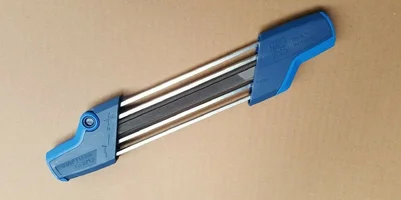
Thoughts on Stihl (or other!) "2-in-1" sharpener / rake-grinder units?

@TreeCo either we're talking about two different things or you don't understand how the Pferd works. When I was cutting full time I sharpened many loops of chain from off the spool to the scrap bucket with ONLY the Pferd units.

What I'm saying Tom is that a tooth that is 75% used up and a tooth that is 30% used up when set to the same measured distance above the depth gauge (.025", usually) is that the less used up tooth will take a bigger chip.

This is because the more used up tooth will have a smaller angle of attack into the wood.

Saw chain porpoises as it cuts.

I've had three sizes of the Pferd combo files since the mid nineties. I believe I know how they work.

Look into progressive chain saw depth gauge filing. The Pferd system is not progressive.

Tom have you ever done any square filing? A file for square filing is right next to the three Pferds. It's made by Sharp Edge and they make great files.
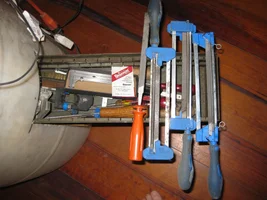
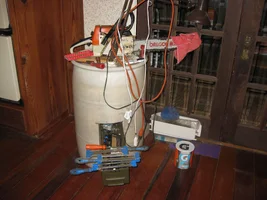
Pferd.webpPferd1.webp
 
@TreeCo is it possible that you are talking about different Pferd units than the ones that the OP, @LordFarkwad and @Tom Dunlap are talking about? I've never seen the ones you pictured so I could easily be wrong. Yours might just be an earlier version of mine and work exactly the same, I don't know... Here is a pic of the ones that I "think" everyone is talking about. I thought they work like @LordFarkwad described back in post 14. I'm curious to learn if they dont.Pferd_4.0_1_1575x.webp
 
Last edited:
@TreeCo is it possible that you are talking about different Pferd units than the ones that the OP, @LordFarkwad and @Tom Dunlap are talking about? I've never seen the ones you pictured so I could easily be wrong. Yours might just be an earlier version of mine and work exactly the same, I don't know... Here is a pic of the ones that I "think" everyone is talking about. I thought they work like @LordFarkwad described back in post 14. I'm curious to learn if they dont.

Those are different from mine. Yes mine are 20 plus years old.

Yours look to have a fixed depth gauge setting just like my old ones do.

I do like the Pferd filing combo. I'm just saying that they are not the ultimate and you can bet chain saw racers do it differently. They write about it on the internet, too.
 
But as the tooth gets filed back the depth gauge should become progressively shorter. In other words what starts out as .025" increases to 0.30, .035 or even more when at the back of the tooth. If the depth gauge is not lowered progressively then the chain takes a smaller and smaller chip. It is about the tooth face angle of attack into the wood
I use the 2-n-1 and I tend to agree with what @TreeCo said about the need for progressive. This was an issue for me, especially when using the .043" chains. The shorter the cutters got while using the 2-n-1, the more dust and less chips were being generated.

However, I also found something else that may have been the main issue - this mainly applies to any chain than has a wider style depth gauge like say a Stihl PMM3 or other chains with any type of bumpered drive link (but only when you've actually filed down to the bumper). Anyway, I don't know how many of you redress the leading edge of the depth gauge/drive bumper when you sharpen, but if you don't, you will eventually throw more dust and less chip as the teeth get shorter no matter how well the teeth are sharpened. Like @TreeCo said, it's all about the angle of attack, and as the depth gauges develop that long plateau, it reduces the angle of attack because it moves the pivot point further from the leading edge of the cutter. If you go file the leading edge of the depth gauges back to where they pivot at the same location as new chain, then you'll go back to throwing chips. I have some chains that don't have those wide depth gauges and I don't have that problem with those. Stihl and Oregon both address this in their literature, but I never paid it much mind until I got tired of my PMM3 chains throwing dust even when I knew they were sharp.
 
In the early 1990's when I first started square grinding saw chain(when I bought the Stihl USG square grinding attachment, it is a rare piece) I had a Stihl tech. tell me to try taking just a 'nip' off of the side of the depth gauge. The idea is that as the cutting tooth is ground back that the cutter is prevented from taking as much 'side' cut resulting in a gradually reduced kerf width as the chain is repeatedly sharpening.Square Grinding USG Attachment 019.webp
 
Man, that totally makes sense. Dag.

I've never placed that much importance on dressing the gauge's leading edge.
Here's an example of what I mean. 2 brand new 3/8P safety chains - one a Stihl PMM3 (.043), the other an Oregon 91PXL (.050). On the PMM3, the distance from the cutter point to the highest point on the depth gauge (the pivot point) is .265". On the 91PXL, that same measurement is only .185". That's probably the real reason the 91PXL is considered "grabby" until after a few sharpeneings. It's the angle of attack. Steeper on the Oregon, shallower on the Stihl, and only gets shallower as you flatten the depth gauge. It's also one of the reasons I'm moving away from PMM3 except for the occasional pruning of really small stuff like shrubs. PMM3 starts out handicapped in a sense.

Point is that I initially thought the 2-n-1 might be the issue, but it wasn't.
 
What if one were to scribe a vertical line (downward towards the bar) on each depth gauge when the chain was new, from the point at which the line from top of cutter to top of gauge is tangent to the gauge (forming the angle we are all referring to). Then, as the chain is filed, just ensure that the leading edge of each gauge is always dressed back to that line. Would that keep the angle consistent and avoid the distortion in angle due to the plateau formed from filling? The assumption is that the 'highest' point on the gauge (in other words, that the line forming the angle between gauge and cutter always rides on leading edge of gauge) is indeed always located at that leading edge.
 
Crap diagram...not up to usual standards :D trying to illustrate the above text on a smart phone.
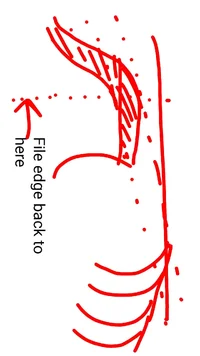
Edit: hatched stuff is filed away material. Cutter has multiple edges traced to show the tooth being filed back.

sketch-1561838817373.webp

sketch-1561838817373.webp
 
Last edited:
So how I was taught to file chain is to hold the file level to the ground and then at the appropriate angle for the cutter.

The rakers come up at an angle from the drive links, so the rakers should be filed square to their angle. This is not level to the ground, but 90 degrees to the profile of the raker. The first time or two, just a lick. For each time there after, take your lick, but then hold the file vertical, taking a rolling stroke up the leading edge of the raker to the top.
 
  • Like
Reactions: ATH
What if one were to scribe a vertical line (downward towards the bar) on each depth gauge when the chain was new, from the point at which the line from top of cutter to top of gauge is tangent to the gauge
Because the cutter edge get farther away from depth gauge as you sharpen, then the line would have to not be vertical, but actually slope rearward toward drive sprocket. HINT, look at the way Stihl slopes the trailing edge of the depth gauge on a PMM3. HINT, that's pretty damn close to the line you're wanting. TRANSLATE, just let the peak of the depth gauge become where the plateau ends on the trailing edge.
 
Ah, it's obvious once you say it. Thanks!

That would be THE way to shape the leading edge of the gauge, so it makes sense that someone's already figured it out and implemented it.
 

New threads New posts

Back
Top Bottom