THANK YOU

to Dr. Kevin T. Smith for being our guest speaker for this mornings (sponsored) Advanced Arboriculture Discussion.
The topic was decay and tree response but we managed to derail things quite a bit with a small talk about the soils ability to sequester carbon. Fantastic opportunity for Knowledgequest to advance his knowledge base.

Thanks again Kevin.
 
Let's hear more about this sequestering carbon business!

jp
grin.gif
 
Well it all starts when people who don't understand trees start thinking it's a good idea to rake up their leaves and litter and sequester them in a remote trash or recycle can.

The tree's gettin a totally raw deal man.

jomoco
 
[ QUOTE ]
Let's hear more about this sequestering carbon business!

jp
grin.gif


[/ QUOTE ]

Apparently, forest soils sequester it's fair share above and beyond plant material.

[ QUOTE ]
[ QUOTE ]
this mornings (sponsored) Advanced Arboriculture Discussion.

[/ QUOTE ]What channel?

[/ QUOTE ]

Why don't I shoot you the conference telephone #. It would be an honor to have you speak to our group. We are 6 arborist from Canada, Montana, New Hampshire, North Carolina and even one in Germany meeting every monday, wednesday and friday for at least one hour for the past 10 months or so for the expressed purpose of preparing for the BCMA exam.

RCA, Dave Leonard was especially helpful in the soil fracturing arena, perhaps you could expand on that with a talk on your work with SGRs.

Thanks
ed (ww)
 
[ QUOTE ]
Let's hear more about this sequestering carbon business!

jp
grin.gif


[/ QUOTE ]

Mike Amaranthus, Ph.D., recently had an article in TCIA's mag or Arborist News (sorry I'm not remembering which) on Soil and Carbon. Soil, or perhaps more accurately, fungi within the soil have the ability to sequester far more carbon that any plant life growing upon it.

This is not to discount the benefit of planting trees and greenery, but we need to understand how important the soil itself is. The really unfortunate problem is this ability to sequester is disturbed or degraded or prohibited altogether by tillage and the use of chemicals.

So if you picture all the ag land throughout the world that is tilled up, sprayed, planted with annual crops which are in turn sprayed some more, you can see how we have reduced the planet's ability to sequester carbon far beyond the cutting of our forests. Compounding the issue in a big way. Dr. Smith pointed out that trees will eventually die and emit the carbon they have sequestered. The sequestration ability of the soil is actually far more important.

Dr. Smith had only a brief time to devote to this interesting and important topic as we spent a great deal of time talking about compartmentalization. We all hope he will be able to join us again.

Sylvia
 
[ QUOTE ]
[ QUOTE ]
Let's hear more about this sequestering carbon business!

jp
grin.gif


[/ QUOTE ]


This is not to discount the benefit of planting trees and greenery, but we need to understand how important the soil itself is. The really unfortunate problem is this ability to sequester is disturbed or degraded or prohibited altogether by tillage and the use of chemicals.

.

Sylvia

[/ QUOTE ]
I don't know about the chemicals affect on the sequestration process but when soil is tilled it actually releases it's stored carbon. So when you can let er' stay green!!!
grin.gif
 
[ QUOTE ]
The really unfortunate problem is this ability to sequester is disturbed or degraded or prohibited altogether by tillage and the use of chemicals.

[/ QUOTE ]

AND through construction disturbance.


Thank you for sharing, Sylvia!
Even a brief recap like this of these "discussions" posted on the Buzz from time to time would be great!

If (when
grin.gif
)you get Guy to do a discussion on SGR I have 2 questions for him:

1) Is there a specific time of year to cut SGRs (especially the larger ones)?
(i.e. considering food storage, water transportation etc . and depending on deciduous vs conifer.)
**I have heard conflicting information about this.

2) How close to the main stem can a root be cut?
(i.e. considering this is within the critical root crown/flare area and there are no branch protection zone-like tissues such as further up the stem.)
**Depending on the size of the root (& age of the tree) sometimes I choose not to cut the root because it's making a 'wound' too close (or too large) in this critical area.
Thus I'm forced to take the lesser-of-two-evils stance.

Keep us updated!

-Diane-
 
Excellent questions, Diane!! I would like to hear the answers to those myself.

If he doesn't respond here, and he comes onboard the Study Group I will be sure to ask these questions as I know the rest of the group would be interested as well.

Sylvia
 
Thanks all for letting me be part of the group last week. Part of the joy as well as part of the frustration of learning about this stuff is that everything is connected with everything else! So the topic of wood decay in living trees (where I came in 30 years ago) is also the topic of tree hazards, which is also the topic of soil formation which is also key to the topics of acid rain recovery, carbon storage, ecosystem services, etc.
In practical terms, sometimes we have to choose which slice we are going to look at, and just concentrate there!
 
this seems like a derail but...

[ QUOTE ]
1) Is there a specific time of year to cut SGRs (especially the larger ones)?
(i.e. considering food storage, water transportation etc . and depending on deciduous vs conifer.)
**I have heard conflicting information about this.

[/ QUOTE ]as stated in the article and based on multiple studies, late summer. What time COULD be better?

[ QUOTE ]
2) How close to the main stem can a root be cut?
(i.e. considering this is within the critical root crown/flare area and there are no branch protection zone-like tissues such as further up the stem.)
**Depending on the size of the root (& age of the tree) sometimes I choose not to cut the root because it's making a 'wound' too close (or too large) in this critical area.

[/ QUOTE ]No comprende'--yes there are protection zones/ "collars"; cut to the origin or to a good lateral or node--sound familiar?
laugh.gif
in general roots codit better than stems.

yes if the girdling is not severe and the root large then best to leave alone.

Buy the Proceedings book--chock full of new stuff from Europe etc.
santa.gif


But this will probably not be in the bcma test; too new.
 
[ QUOTE ]
We are 6 arborist from Canada, Montana, New Hampshire, North Carolina and even one in Germany meeting every monday, wednesday and friday for at least one hour for the past 10 months or so for the expressed purpose of preparing for the BCMA exam. ed (ww)

[/ QUOTE ]

I would like to point out that whereas the core group got together initially with the purpose of studying for this advanced arboricultural exam, there is one regular attendee who has no intention of taking it and yet contributes significantly. We also have expressed the desire to continue this think tank post exam taking as we have found the diverse knowledge and experience that we all bring to the table, with the variety of backgrounds and actual physical locations, has enhanced our understanding and appreciation of arboriculture immensely.

We have all brought "real life" scenarios to the group for discussion and input. The opportunity to share instantly and spontaneously is invaluable.

Sylvia
 
[ QUOTE ]
this seems like a derail but...

[/ QUOTE ]

No, Guy...it's merely an extended thought process
grin.gif


[ QUOTE ]

Quote:
1) Is there a specific time of year to cut SGRs (especially the larger ones)?
(i.e. considering food storage, water transportation etc . and depending on deciduous vs conifer.)
**I have heard conflicting information about this.

as stated in the article and based on multiple studies, late summer. What time COULD be better?

[/ QUOTE ]

For deciduous trees root prune during dormancy.
For conifers - winter or in late Spring after sap has risen.

Of course, this is regional specific as there is not 10 ft. of snow & frozen soil to dig through on the west coast!
Again, just as in tree pruning of branches I think there are variables involved depending on site, species, region and health of tree and thus should be stated as such.


[ QUOTE ]
No comprende'--yes there are protection zones/ "collars"; cut to the origin or to a good lateral or node--sound familiar? in general roots codit better than stems.

[/ QUOTE ]

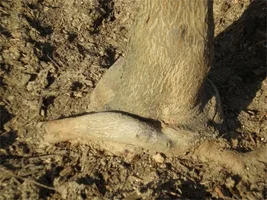
I'm referring to the 'beginning' of the root that is coming off the trunk flare. (See attached)
I'm fully aware of roots having the ability to codit well - it's the 'location' of this cut (nearest to the trunk) that I'm referring to.
How close to the trunk is cutting it too close?

Thanks, Guy.

-Diane-

 

Attachments

  • 193348-P5180057(Changed).webp
    193348-P5180057(Changed).webp
    88.1 KB · Views: 80
[ QUOTE ]
For deciduous trees root prune during dormancy.
For conifers - winter or in late Spring after sap has risen.


[/ QUOTE ]where does this come from? the late summer guideline is based on multiple and solid research studies. no variables i can think of to factor in.[ QUOTE ]

I'm referring to the 'beginning' of the root that is coming off the trunk flare. (See attached)

[/ QUOTE ]Very nice pic, Diane. That root girdles <10% stem circ and is >10% stem diameter so the Let It Be option looks pretty good for now...is the tree in decline?

but if that root girdled a lot more stem I would whack it at the origin--looks like a collar to me!
 
[ QUOTE ]
no variables i can think of to factor in.

[/ QUOTE ]

Okay, for now...I think.
Research is always developing...

and I'm a life-student of bonsai which has an extensive history on tree root pruning - some of which is applicable to landscape-planted trees.


[ QUOTE ]
but if that root girdled a lot more stem I would whack it at the origin--looks like a collar to me!

[/ QUOTE ]

I agree AND I will be cutting the root at its origin because:

This Japanese maple tree was planted by a landscaper last year and was obviously very root/pot-bound which was not addressed at the time of planting. There are several smaller crossing roots on its backside.
I'll probably even dig up the tree and do more extensive root work and replant it.

The client paid $120 for this 15 gal. tree that already had problems before even leaving the nursery.

One of my on-going efforts is educating landscapers and HO about what to look for at time of purchase so they can tell the nursery what is unacceptable plant material.
Hopefully, this will eventually get through to the nurseries and growers which is where girdling roots generally begin!

Thanks, Guy.

-Diane-
 
[ QUOTE ]
and I'm a life-student of bonsai which has an extensive history on tree root pruning - some of which is applicable to landscape-planted trees.

[/ QUOTE ] yes, bonsai informs retrenchment pruning on root-damaged trees, etc.


[ QUOTE ]
I will be cutting the root at its origin because:

This Japanese maple tree was planted by a landscaper last year and was obviously very root/pot-bound which was not addressed at the time of planting. There are several smaller crossing roots on its backside.

[/ QUOTE ]Diane there appears to be one whopper on the backside that is embedded deeply into the stem. From the looks of it here 3000 miles away, you will need a sharp chisel and a lot of patience to get that out with no stem damage.

Strongly advise to correct the most severe defects first, then consider whether the tree can handle the increased dose of root pruning in the removal of that big one in front, which only seems to be girdling one buttress, and little stem.

Maybe next year for that one? Once you see the entire root mass you will know what to do. another good reason for doing it this time of year is to avoid sunscald. a ca buddy found the flare on his parent's baby maple last spring, and it scalded 270 degrees of the stem.
shocked.gif


Great idea to bareroot and replant if it has only been in for a year. re education, this works really good for me, underlining the flare info. http://www.treesaregood.org/treecare/buying_highquality.aspx
 
I hear ya, Guy.
No worries.
I've got the hands and patience of a surgeon (from my great-grandfather
smile.gif
).

Plus I love doing this kind of intricate/precision work.
Trees and I have a rapport.


[ QUOTE ]
Maybe next year for that one? Once you see the entire root mass you will know what to do

[/ QUOTE ]
icon14.gif


Acer palmatums can take a lot.
I've had worse on much older trees and they've come back very nicely.


[ QUOTE ]
another good reason for doing it this time of year is to avoid sunscald.

[/ QUOTE ]

Yup, I'm always aware of this especially with Japanese maple's thin bark.
After explaining sunscald to one artistic client she chiseled a 2ft. high upright stone and placed it to cast a shadow on her young Japanese maple's trunk and root flare.
It fit in perfectly with the tree's setting.


-Diane-
 
[ QUOTE ]
After explaining sunscald to one artistic client she chiseled a 2ft. high upright stone and placed it to cast a shadow on her young Japanese maple's trunk and root flare.
It fit in perfectly with the tree's setting.

[/ QUOTE ]

Perfect!

Vine on trellis can work nicely to shade the shank too.
 
BUMP!

[ QUOTE ]
o and btw i will be trying to do a bcma test prep type activity at tci this year, in federal hill park where the student climbing thing will be. it will be scenario based and similar to what i did at isa in 08, attached.

[/ QUOTE ]

Guy, any chance of getting you to post the photo's associated with the practice/example exam you posted?

ThanX!
 

New threads New posts

Back
Top Bottom