Sycamore and Elm climbing.

ClimbingTN

Branched out member
Location
Columbia
I’ve run across a bunch of very large native Elms (Slippery/American) and Sycamore. What do I need to know about climbing them? I’m thinking mostly recreational but, I would like to know in case I get work involving them. Both have a very nice wide spreading canopy. I did some scouting today and saw a few that were easily 100ft plus. Some were beautiful trees. What ya think? Craig
 
Don't cause any damage to the elms during the growing season. Its not improbable that they are susceptible to Dutch Elm Disease, but have not been exposed. The disease is carried by a bug that can be attracted to fresh wounds...so don't damage when the bugs are out. Having said that, they will probably still get DED, but the longer it is delayed the better.

OK...with that out of the way:
Elm can have a lot of tight angles on branches making it easy to get ropes stuck. Any tree can....but they tend to have more. Sycamore tend to be wider spreading with many branches closer to 90 degrees to the trunk. I think some of the most spectacular climbing trees I have seen are Sycamore.
 
I second that Tight unions on the elms can be a real problem, but American, red, etc elms are super strong and bendy, small TIPs are ok with me. Siberian, Chinese elms are less reliable. Elms tend to be super fibrous and good hinging wood, so cutting and rigging with them has its advantages and disadvantages. They also love to peel, face cuts, undercuts, cheek cuts are all good ideas when pruning. Even tiny stubs will peel if you’re not careful. Also they push out some sort of “sap”, if you make a lot of cuts you might experience the sap collecting on your handsaw or chainsaw bar and that can add a lot of”drag” in the cut.
Sycamore are also super strong. Small TIPs are ok with me on these too. Sometimes their shape can be challenging to work with, really long ascending branches and the smooth bark can add difficultly to limb walks. Don’t try it when they are wet. A hook or secondary line can help. Some people react to sycamore dust from chipping or cutting. If you work one you might feel some irritation in your throat

 
.... Some people react to sycamore dust from chipping or cutting. If you work one you might feel some irritation in your throat

That's the only allergy I have. For me, I'm pretty sure it's the little hairs on the back of the leaves. I'm fine working in the tree for the most part but when we start cleanup - especially with a blower I start sneezing and nose running. Fortunately it goes away as soon as we finish.
 
I personally am very sensitive to the leaf hairs. Even light pruning with pole pruner, if I get the hairs in my throat it really gets me coughing for a spell. Climbing the tree and getting the dust/hairs all over the skin is a nightmare for me.

Beautiful trees though!
 
  • Like
Reactions: ATH
Sure, but climbing and working a respirator sucks and that won't do anything for the itchy skin. Luckily there's only like 2 Sycamore trees here.
 
  • Like
Reactions: ATH
I find difficulty breathing now and into the future to be a reasonable reason to protect oneself, at least in the dustier conditions.

I find a respirator to be something I adjust to pretty easily.


London planetree's leaf tricomes are we worth not breathing.
 
Yeah... wearing a respirator sounds worse than a temporary runny nose. Maybe I'd think different if I worked on Sycamore 2-3 days a week. It's more like 2-3 days per year.

A better option wouybe put them off until winter. They don't bother me then. But I just deal with it.
 
Sycamore have great structure for climbing and most of the crotches seem open and rounded, which is good for not getting rope stuck. But their cambium is thin and easily damaged. Definitely use a friction/cambium saver. I use one even if I'm climbing SRS as just the constant weighting/unweighting the climb line is enough to burn through its skin. I avoid them in spring when they seem even more vulnerable. Also, I've had large diameter dead limbs pop off at the trunk with little warning.
 
I've always wondered about SRT rope crotch sawing. Wouldn't it depend on the smoothness of the bark, the angle of the union and whether you climbed rammy like you're trying to win a race vs smooth stealthy climbing style. This is a call out for a go-pro pro to film a few scenarios. Soft spring bark/cambium is more vulnerable to my understanding, and at upper unions with younger structure than unions nearer to the ground with rougher bark. Maybe one sacrificial DRT rope saw could also be filmed in the name of science. Case to be made for cambium saver SRT or DRT equally.

Sorry for the derail. If you work an american elm they're also informally called piss elms - you'll know why.
 
I find american elms to be one of the most challenging trees to climb and prune. I prefer using a moving rope system on each end of a 200' climb line. I also have a 22' work positioning lanyard on a unicender that can be used MRS or SRS.

I recommend against climbing either when they are wet. MRS helps me with mechanical advantage and fine adjustment while working flat angles. You will come out better a better climber on the other end of the challenge.

I assume we are talking about climbing without spurs, otherwise it is easy

If rigging sycamore, capture a branch on the piece to be rigged with the rope. If none are available cut appropriate notches to hold the rope. Years ago I had a top slip out of the rigging and smash a 6x8 top beam off a swing like a match stick.
 
I agree with the comments regarding Elm trees. The tight crotches and stuck ropes are a bitch. Sycamore and London Plane leaf dust is worst in the spring when the leaves are young. I have also been affected in winter when the seed balls break apart as well. My daughter has about 60 London Plane trees lining her driveway. Guess who gets to prune them...
 
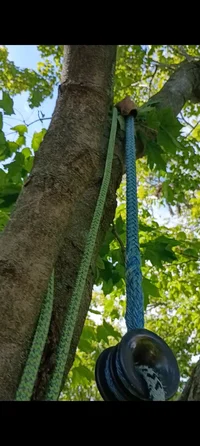
Leather tube cambium savers are so easy to install and use, and can be pulled out into concrete/ delicate areas without concern.
Cheap and easy.

3/4" fit spliced eyes.

Can be used for climbing and rigging with minimal/ no strength reduction.
A modification I make to the leather cambium saver cutting the ends at 45 degree angles. It makes them easier to install remotely, imo.
 

Attachments

  • Screenshot_20260104-210519_Photos.webp
    Screenshot_20260104-210519_Photos.webp
    106.2 KB · Views: 20
Wow. Thanks folks. The elms I’ve encountered are mostly forest trees. I’ve found a few at field edges that were pretty wide. The sycamores are definitely tall crazy long limbs regardless where I’ve seen them. I have a few different cambium savers but, no leather or Dan H type tubular ones. Craig
 
I've always wondered about SRT rope crotch sawing. Wouldn't it depend on the smoothness of the bark, the angle of the union and whether you climbed rammy like you're trying to win a race vs smooth stealthy climbing style. This is a call out for a go-pro pro to film a few scenarios. Soft spring bark/cambium is more vulnerable to my understanding, and at upper unions with younger structure than unions nearer to the ground with rougher bark. Maybe one sacrificial DRT rope saw could also be filmed in the name of science. Case to be made for cambium saver SRT or DRT equally.

Sorry for the derail. If you work an american elm they're also informally called piss elms - you'll know why.

3463743676_ed58f2efcf_b.jpg

DdRT on sycamore with Liquid-tite conduit sleeve 2009 (!)

SRT base ties (or canobase) will easily cut into upper/younger white pine limbs and younger wood no matter the species. It is pretty much guaranteed. A smoother climbing motion helps but the digging in happens no matter what. A leather or liquid-tite conduit (Dan House sleeve) cambium saver takes care of it as @southsoundtree mentioned.

I'll second the motion, elms are pretty horrible to climb when they're wet, slip and slide all the way.
-AJ
 
Last edited:

New threads New posts

Kask Stihl NORTHEASTERN Arborists Wesspur TreeStuff.com Teufelberger Westminster X-Rigging Teufelberger
Back
Top Bottom