Strange Bark on Hemlock

Wish I had, but I was just passing by on a job site so couldn’t dwell too long. Must be fungal but it had such a bark-like appearance and texture that it kind of threw me for a loop. It’s like a bark-gall.
 
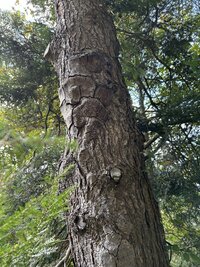
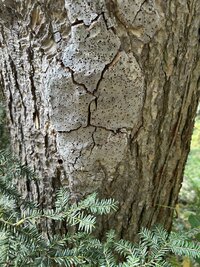
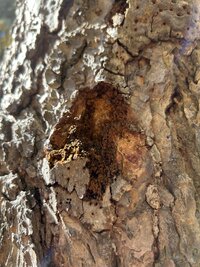
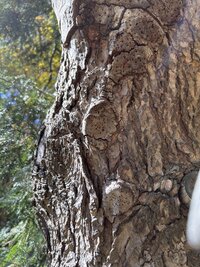
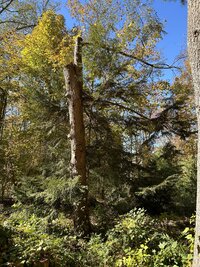
Site is in New York, tree is eastern hemlock. Cracked woody plates with what looks like emergence holes all over. Any ideas? Never seen this before.
Please keep us updated. I've got 200+ Eastern Hemlocks that I planted in 1999 along 600 ft of tree lawn. (NE Ohio)
 
Last edited:
Difficult to confirm remotely, but I'd first rule out "Felt Disease" produced by Septobasidum species. The fungus felt covers scale insects and forms a mutually beneficial relationship to the fungus. Does it matter to the tree? Lots on line, I'd start with: https://ccmedia.fdacs.gov/content/download/11353/file/pp346.pdf and https://www.ncbi.nlm.nih.gov/pmc/articles/PMC4838593/. Follow that up with local Ag/Forestry Extension folks.

Sure, looks like Septobasium but hard to confirm remotely.

Kevin
 
Might be: Agrobacterium tumefaciens

It inserts it's genes into it's host genes.

Hemlock is listed in several of the links below:


The pattern of cracks and small holes is more consistent with Felt Disease than Crown Gall which usually retains bark patterns with inflation!
Easier to exclude Felt Disease than Crown Gall, the latter of which is usually hard to tell definitively from a single specimen. Still, could be!
 
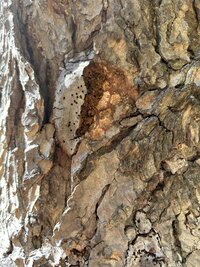
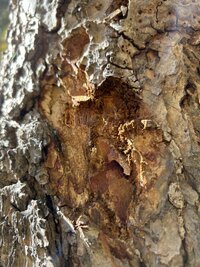
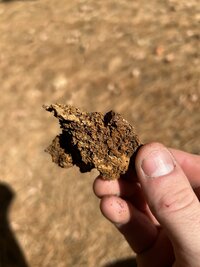
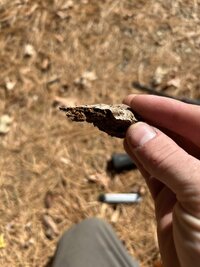
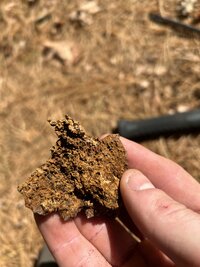
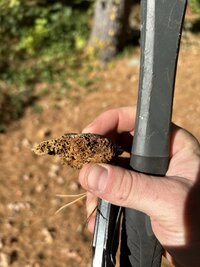
So I returned to the job site and did some more poking around. I popped one of the plates off with a flathead, it came off fairly easily. Texture inside was dry and flaky and full of galleries containing what appeared to be a couple different species of insects, and a whole lotta poop(?). The growth (which I think must be fungal) appears to be sitting on top of a thin layer of outer bark and the biggest plates are over an inch thick. Worth noting that the tree is in pretty poor health with only a handful of live branches left, though the live tissue that does exist seems to be stable.
 

Attachments

  • IMG_0942.jpeg
    IMG_0942.jpeg
    954.3 KB · Views: 11
  • IMG_0940.jpeg
    IMG_0940.jpeg
    741.8 KB · Views: 10
  • IMG_0939.jpeg
    IMG_0939.jpeg
    354 KB · Views: 8
  • IMG_0938.jpeg
    IMG_0938.jpeg
    407.7 KB · Views: 8
  • IMG_0936.jpeg
    IMG_0936.jpeg
    358.5 KB · Views: 8
  • IMG_0934.jpeg
    IMG_0934.jpeg
    435.1 KB · Views: 7
  • IMG_0932.jpeg
    IMG_0932.jpeg
    714.6 KB · Views: 7
  • IMG_0930.jpeg
    IMG_0930.jpeg
    943.3 KB · Views: 8
  • IMG_0947.jpeg
    IMG_0947.jpeg
    1.5 MB · Views: 8
  • IMG_0950.jpeg
    IMG_0950.jpeg
    424 KB · Views: 10
From afar it looks similar to cases of old Biscogniauxia I’ve seen, but have no idea if it can grow to these depths or even colonize hemlocks. Or what it looks like on the inside.
 
So I returned to the job site and did some more poking around. I popped one of the plates off with a flathead, it came off fairly easily. Texture inside was dry and flaky and full of galleries containing what appeared to be a couple different species of insects, and a whole lotta poop(?). The growth (which I think must be fungal) appears to be sitting on top of a thin layer of outer bark and the biggest plates are over an inch thick. Worth noting that the tree is in pretty poor health with only a handful of live branches left, though the live tissue that does exist seems to be stable.
Thanks for the extra effort !
 

New threads New posts

Kask Stihl NORTHEASTERN Arborists Wesspur TreeStuff.com Teufelberger Westminster X-Rigging Teufelberger
Back
Top Bottom