SRT Rescue techniques

If there on a wrench or a uni or a rads than its no problem. If they are on one way ascenders, they should at least have a trunk belay or they are asking for trouble. the treemagineers present a good technique of cointer balanceing the victim to lift the victim, or you have to set up somemechanical advantage to lift the victim off the ascenders. This style of one way climbing seems crazy to me now though.
 
This is exactly why I never converted to SRT before I got 2 rope wrenches. This way I could be using one RW, and have my trainee using another. Now I know for a fact that my groundee/potential rescuer can quickly and easily come up and get me in case I am incapacitated. It's not only about how easily you can get up the tree, it's about how easy it is to get down or be brought down quickly and in one piece! It's also disturbing to me how often folks don't hang an access line. It takes so little time, and the benefits in an emergency situation are crucial!
 
It's a lot easier to rescue someone from his/her access line whatever access technique is used compared to some branches way out in the tree where a person could get harmed....

The possibilty of an emergency while accessing the tree is far less as the risk during pruning or rigging ;-)

Keep the crew you work with up to shape and up to the newest gear and methods and practice every now and than a rescue on different access and work setups.

climb safe
wouter
 
[ QUOTE ]
Gday all have been wondering what methods and techniques everyone uses for rescuing someone from SRT...?????

[/ QUOTE ]

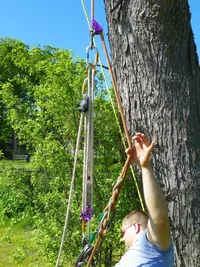
I use a 5 to 1 MA system to 'pick em off' an SRT or Ddrt system, and put them on another rope. A Pinto pulley can be 'prusiked' to the ascent line or above the Microcender and a Dddrt system installed in that for lowering. In the attachment I'm using a Double Microcender, cause I'm showing it on a Ddrt system. I also have a Single Microcender for use on an SRT system. Very easy to switch from the double to the single.
I was able to lift my son, who weighs in at 220 lbs., from a sitting position. The rescue (lifting) system, running end, is long enough to use a Pantin as well.
 

Attachments

  • 291990-pick.off.strap1-Copy.webp
    291990-pick.off.strap1-Copy.webp
    345.3 KB · Views: 159
Strictly SRT with ascenders: Make a counterbalance with the top ascender using your body weight. While you lift the patient with the counter balance release the lower ascender(s). Install a descender on the line below the upper ascender or a ddrt on a false crotch or another line. Load the descender/climbing system as you lower the patient back down on the counter balance. Remove the upper ascender. Descend with the patient.
This obviously only works with folks who are in the same weight class. If the patient is vastly heavier than the rescuer than you might want to employ a MA as has been suggested. Also this is quick and dirty. Both climbers are on a single ascender during this maneuver. Some will take issue with it, but it's the fastest way I've found to do it short of using the upper ascender as a false crotch, installing a second lowering system and cutting the patient's rope below the upper ascender.
A really good resource for SRT ascender based climbing system pick-offs is "Alpine Caving Techniques". Though only the frog system is covered, a lot can be inferred from there once you understand the load transfer using the upper ascender.
I'll aggree with Wouter though. A rescue of a person using ascenders on an access line isn't going to be that difficult. It could be a lot worse once the climber has started working the tree, depending on the tree and the accident of course.
 
Hey Norm, Is it ok to use the CMI Double Sheave Pulleys for that system? You had told me that with the large holes in the cheekplates they weren't allowed in the Illinois TCC as a redirect, because of the potential to side load the gate of your carabiner
 

New threads New posts

Kask Stihl NORTHEASTERN Arborists Wesspur TreeStuff.com Teufelberger Westminster X-Rigging Teufelberger
Back
Top Bottom