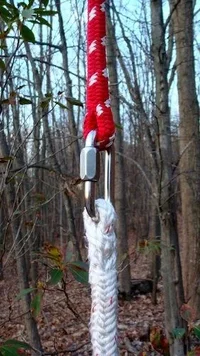
splicing instead of tying anchor line

First, thanks everyone on the buzz for posting and sharing so many awesome ideas and experiences. It's nice to have such a support network in cyberspace and beyond.

I wanted to get people opinion on splicing 2 new climbing lines together, 16 strand arbormaster 150' w/ 16 strand hi-viz under 100'. It will only be for SRT when a TIP can't be isolated and I tie back to the base. I'll always be climbing on the arbormaster so all hitches and ascenders will wear on that line.

I know that two lines can be tied together in several different ways to have a safe and secure joining of rope to climb on. More so, I'll never be passing the ropes where the join on a climb.

My question is wouldn't an end for end splice be stronger and safer then any other method of joining two ropes together? What do you think of splicing two different ropes together even if there extremely similar (hi-vee has the 3 blue inner strands).

I'm an experienced splicer and will get around to posting on the 'show off them splices' forum, although most are used and not as fancy with the whipping.
Thanks All
 
Hi,

I'm glad to have you aboard!

This will be an interesting thread. From the tiny bit that I know about splicing I'm sure that you'll hear that splicing two different ropes together is not an accepted practice. Doing an end to end splice of the same rope...I can't imagine how that would be any different than any other splice.

If you're using half inch rope for SRT you MUST check the compatibility of your climbing tools to half inch/+13mm rope. Most climbing tools are designed and tested for minus 13mm/half inch climbing rope. Don't mix and match ropes and tools.
 
Don't know about the splicing part of your question, but I do know that my pantin tore up my arbor master pretty good. Lots of picks and fuzzing, so I pick up some HTP and have been very satisfied with it. Good luck and welcome to treebuzz!
Jon
 
First, welcome INT. Good to have you aboard.

I have to side with Jon on this, I just got some HTP and although I haven't used it much, I can say it makes a huge difference on the ascent. The ascenders seem to glide up the rope, you don't have to fight them like you do on 13mm lines. John Hartenberg at Knot and Rope supply or Rich Hattier at Anchor Bridge Ropeworks will be able to definitively answer the splice question.
 
<u><font color="blue">YALE KERNMASTER 11MM STATIC ROPE</font></u> </font>
Not splicable but BEST SRT IMO
jamminz.gif


369271-JOININGROPES281x500.jpg
 

Attachments

  • 369271-JOININGROPES281x500.webp
    369271-JOININGROPES281x500.webp
    44.1 KB · Views: 36
I Agree that semi static rope is the best for longer ascents of which I have only tried escalator. I foresee getting a long semi static line in the future. I do use tachyon and prefer it to the 16 strands for the most part.

But I have close to 240 feet combined of 16 strand and my question has to do with splicing. And as said earlier ropes can be bended or knotted to extend a rope, why not an end for end splice.

Tom I use the basic and pantin and I don`t have problems with either on the arbormaster. Oh and the first gen rope wrench and it adjust to the half inch nice.
 
In the Tree,

Using the Pantin with any rope isn't an issue since it's not life support.

Using the Petzl Basic, or any rope tool, with a rope diameter that isn't within it's design specs isn't good practice.

This is what I learned about how cams work in ascenders and how the rope diameter is critical.

Cams are nothing more than curved levers. The pin is the fulcrum and the distance from the center of the pin to the point of contact is the length of the lever. Think of teeter totters, maybe I'm dating myself hahahaha!

At some configuration you're going to reach a point where the cam/lever doesn't have the power that is needed for it to develop enough closing power...that's when slippage occurs.

Trust the engineers who build our tools. If the tool is labeled for a particular rope diameter don't use a rope outside that range.

Sure...it will work...until???

Think of what you're doing like speeding. Most of us do and get away with it. But, once the radar gun snaps our picture...FAIL!

Have you looked on the rope manufacturer's website to see if they have end for end splicing guidelines?

From what I understand about splicing it would seem that an end to end splice might be configured similar to an eye splice...BUT!!!...don't go on my understanding!
 
I'll say don't do it. You don't want to load the throat of a splice. There are to many variables at play in your intended use to guarantee that you'll never load the throat. Everyone has opinions on the "best" rope for climbing. My opinion is that you should get the right rope. The right rope is one that is compatible with your gear and LONG ENOUGH for the job.
 
If you're using the rope for ascending only, why not join them with 2 eye splices? Put a teardrop thimble in each eye to help reduce rope on rope wear.

OR

Put an eye splice, with thimble, in each rope and couple them together with a quick link?
 
Norm, you read my mind. I was even thinking of suggesting using one x ring. Splice an x ring in then end on line, and and splice an eye through the eye of the x ring... But if you did connect the two ropes why not do it in a way where they can be disconnected? I'm just adding to the conversation, and I'd just bite the bullet and get a different rope.
 
Yes, you can splice them together. The only issue i see with this is then you have a spot in the rope, similar to a knot, that you would not be able to ascend or descend past. and you would not be able to untie it like you would be able to with a knot.
I do not think it would be any safer to have a splice mid line as opposed to a knot.
I also think that mix and matching different manufactures ropes would be a bit of a faux pas. If in the unlikely scenario that you're splices, or rope was to fail the manufactures would say that their splices/ ropes were never intended to be used together.
I agree with most of the comments above that this would be a silly use of resources.
 
Thanks all for the comments.

SInglejack has a good picture up and I agree with the other comments that I can just join two spliced eyes together. I was just wanting some splicers opinions on the feasibility of it. But I will leave well enough alone, besides joining two ropes with a connector makes more sense. I was just thinking stream line, but no longer. Cheers all.

Tom the basic is rated for 13mm, all good there, pulse I'm not even using it for life safety. I use it in a rope walker configuration. Thanks for the concern.
 
By the way, I would splice the two ropes you talked about in a heart beat. It would TOTALLY work in an end to end. The constructions of the rope are too similar.

However, just putting a tight eye in the end of each rope will give you 3 ropes to choose from- the two shorter ones can be used individually, plus you got the long one if you join them together.

Just buy a loooong piece of Kernmaster Safari!
 
Thanks Nick! I was looking for someone with your experience to comment. I figured as much because there construction is so similar. Not going to do it and stick with the optional configurations.
Really though...
looking at all those semi static lines. The new safari looks good as does the platinum ll.5(pricey).
Hard to decide with out giving test tries.

Personal thanks for all your many post through the buzz.
Happy Climbs,
James
 
I am new here also. What a great site.
I have not read all the post on this but why not do a tight eye splice with each rope around a ISC ring. This seems a bit perminet as opposed to tying a double fishermans knot , this way both ropes can be used seperately in other applications. Another option is the removable rings that are made for the Sequoia saddles, I my have the wrong saddles but I remember years back seeing removable rings on a saddle with a set machine bolt that allowed it to open. Here is a link to it. Not available till mid April though, and a bit pricey too.
Petzel Split Rings
 
I am new here also. What a great site.
I have not read all the post on this but why not do a tight eye splice with each rope around a ISC ring.
One reason is there are times when pulling the rope through crotches in the tree, it would have the potential to get hung up.
 
But for "In The Tree's" OP he said that he would be using the shorter line for a basel TIP, so for that aplication the split ring would work great, it eleminates rope on rope and a carabiner or screw link in that application could side load. I thought it was a great idea for the application originally posted.
 

New threads New posts

Back
Top Bottom