s r t multiple redirect flex

For a while now I have been utilizing the RIG for certain jobs where it seems the most efficient. Usually when I couldn't isolate my line or I was able to just set a static line directly over my work. But after reading the Buzz lately I decided to use srt to work a tree that I had to move around and do some rigging and retrieving blocks and such. I ascended a static line choked just above reach from the ground to a point were I would normally tie in Ddrt. Then switched over to my RIG and worked that section (pruning for house clearance). I then moved to the next lead which in this particular tree I probably would have normally reset on the new lead, instead I pulled my lineup through a natural crotch then reset the RIG. I immediately noticed a bouncy feeling from the two leads pulling on each other. A feeling that I didn't like but I dealt with and worked that section. I then moved to the next lead and redirected again. I definitely felt like I hate pulling my whole lineup andover a redirect. Now my line runs from the base up over the mid point of a lead then over the top of a lead then circles the crown through two other leads. At this point there is so much flex in the system that it's almost unusable. The system constantly pulls on you and then settles and then settles more. I had to readjust 3 times to make a cut and then as soon as I moved a little I was pulled a foot up. It was worse then climbing on Trueblue. I also could imagine my line cutting into the tree as I moved. I had to get half way out on a limb and make a couple hansaw cuts and limb walking was ridiculous it was so spongy. I love learning new climbing techniques and will not give up on working SRT but my first experience with multiple redirects did not leave me wanting more.
how do you deal with that flex? this was a sugar maple and I was climbing on blue moon which is fairly low stretch but not a true static line but I could see the system moving the flex was in the tree because my line was trying to pull all the sections together. Is that really something you get use to? I love the constant friction of SRT, but the flex of multiple redirects in this case, sucked. Is there something I'm missing? how do you run your line through the tips of multiple leads on a willow and not have 5 feet of stretch?
 
Re: SRT multiple redirect flex

Five feet of 'stretch'...I think that you mean movement.

In all of my years of SRT I've never had much movement when I use redirects. There is some but I get the feel of how much each time I change redis. This isn't any different than how climbers get used to how much movement they feel in their footing when they move out further on a bending limb. You adjust and accommodate for movement.

Changing from years of DdRT to SRT will take mental adjustment. there are trade-offs, mostly in a positive direction towards SRT. In time you'll get the feeling.

Another thing to think about is your choice of redirects. If I was in any tree, especially a willow, and there was five feet of movement in my TIP I would know that the TIP/redis are probably too small.

Think of the load that you could generate if you fell/swung and overloaded your redis. If you're moving that much I am going to take a long distance view and say that you'd break out a redi, maybe zipper more. As they are breaking, you;re falling and accumulating energy. Once you stop falling you're going to load the next redi.

There are compromises when using redis for DdRT or SRT. Getting better rope angle and position is offset by rigging/retrieving redis. To me, and most SRT converts, this is one of the biggest advantages of SRT.

Rope movement from moving redis which might result in cambium damaage is an important consideration. Again, if you're having that much movement maybe you're up too far. It's not hard to set an inline retrievable false crotch redi.
 
I just couldn't get used to this either with the wrench, I don't know how I could have improved this pulling sensation. I got this happening with velocity and tachyon. So for now it,s back to Ddrt. I will give it a go again when I feel the pull but for now I want to give it a break. I definitely liked the constant friction and the 1:1 ratio advancing but there just seemed to be too much negatives ( just my experience so don't go jumping on this ). I guess relearning the climbing experience at work where productivity really counts definitely has put me off. Using it in a practice scenario was fine but employing it at work was difficult to swallow. Ddrt just seems to me such a breeze, but with all these climbers giving such praise to SRT I guess I will eventually just have to work some stuff out. The type of work I do might have something to do with it. Maybe the shape of our trees also.
 
I know...I should have more patience with new converts. My SRT techniques developed over many years and mostly by myself. No one to use as a sounding board. Lots of little trial and errors over the years.

The groundswell is forming! SRT is the future...maybe not in comps but at work.
 
I wrote mine before your post Tom, and I understand choosing the TIP and the redirects are crucial, its funny I never have had problems choosing TIP for Ddrt but with SRT it was touch and go maybe I need to keep at it, but I am basically teaching this stuff to myself as I am the only one on the island even remotely interested in learning SRT. I'll leave it at that and see what others have to say. I was so excited after the first couple of rec tries but when I put it to work pruning a large mahogany tree it turned into a nightmare.
 
I know practice makes perfect but at this moment I have a young baby boy in the house and the rec climbing was taking me away from time with him and I spend too much time on the buzz trying to learn these new SRT techniques as it is. No excuses but family is important to me.
 
Re: SRT multiple redirect flex

thanks tom, all good points. I didn't feel any apprehension about the leads them selves as I would have tied into any 1 of them even higher on Ddrt. I thought of all installing a FS with a stopper behind it but I wanted to try the multiple redirects. The leads were still 6 inches with 3 inch branches where I was redirecting. there would not have been much movement at all if I were on 1 of them but the multiples pulling on each other created a ton of movement.
I guess it just comes with experience of how the system will act.
I still love the unchanging friction of being on a single line.
thanks to all you pioneers of SRT for the inspiration.
I will continue to play with working SRT.
 
Re: SRT multiple redirect flex

Bill...you're getting a lesson in tree dynamics too. Look at the loads you're putting on the redis. Usually they aren't normal vectors. After doing this a few times I could understand better how to design better cabling systems. Sharing the load amongst several limbs makes a better cabling system.
 
Re: SRT multiple redirect flex

Swing... I'm glad I'm not the only one that felt the pull and hated it. I can see advantages to working SRT. But I'm also loving the Spiderjack and Pullysaver.
 
I was in one today with two stems, four different tops, did the basal tie off, had the RW and SRT ready to go, spiked up the center leader, (didn't want to use throw line - wish I would have) and found a nice crotch at the top. Re-Directed the rigging line so It wouldn't rub against a low voltage wire (running through the middle of the tree attached to adjacent tree, attached to the house). Went over to stem #1 over home, hooked up DMM carabiner with mini pulley in it (i forget the name) for my redirect, set red block, started descending to work the spar from the bottom up.
-One thing I do notice about SRT is that I looked over to my original tie in point to my redirect and it was level to the ground (I've never been able to do that DRT).- this of course was pulling these two stems together as I would put my body weight on it, causing natural bounce in the system-
I cut/lowered the brush, with a tight DZ, and big pieces. Got to the top, did my thing, and chunked down firewood, then the lead and done. Swung to the third one, cleaned it up on the way up, and then decided to natural crotch redirect - went to the 4th spar, chunked and bounced it off the trees below. Then on my way down hooked up a couple pull lines and ended up being able to fall the remaining two trunks.

...Yeah i guess you might be up a bit too far up the tree and I could see this happening more on prune jobs than removals.

... swingdude this is your family
 
Some trees with flex are better done with cinched TIP. Long wobble limb and wind pushing limbs around makes some redirects not good! Set up with a long tail reachable from ground or short hook pole. SRT can be used in place of DRT anytime ya want.
 
It's the natural bounce and movement I don't like. But I am going to have to choose my TIP carefully. I might try ascending to the TIP and changing it over to a top tie with tail. Retrievable but it just means getting a longer rope, as I onlt have 3- 150' ( depending on the tree these probably will work or I use a piece of throwline ) ropes at the moment. I just have to go back to the drawing board. Something I do often to mix things up.

Yeah Bill you ain't alone there. And the spiderjack is on my list I hearing ya.

Bixler TB is way cool but on a cold rainy night when I am feeling peckish I KNOW who is there for me ( the wife smiles ).
wink.gif
 
Check> gotcha but Tom read the whole bracketed sentence, I know to use throwline. Thanks anyway. I am certainly not dropping SRT just have to work out the kinks in my head and apply them.
 
[ QUOTE ]
but on a cold rainy night ( the wife smiles ).
wink.gif


[/ QUOTE ]
thats funny from a dood in barbados. I would love to have one of your cold and rainy nights. Im so sick of rain and mud right now!
 
[ QUOTE ]
Ooops...my eyes hadn't gotten their caffeine yet
wink.gif


Take a look at Moss's solution.

[/ QUOTE ]

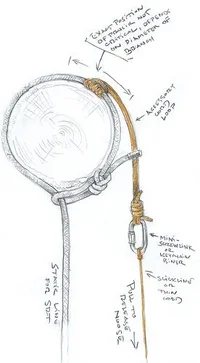
Just so you know what that pulldown is all about... I've been in situations where it was difficult to overcome the friction when cinched on a wide diameter limb or a limb with rough bark texture. The other problem is when the pulldown is attached at the bowline is you're pulling against the weight of the rope as it changes direction through the running bowline loop. So I decided to try attaching the pulldown at the upper side of the limb instead of at the bowline. Turns out it works great, when the pulldown is closer to 12:00 it lifts the the running end and creates slack at the loop at the same time which allows the cinch to release easily.

-AJ
 

New threads New posts

Back
Top Bottom