Tr33Climb3r
Participating member
- Location
- Wisconsin
I love it!
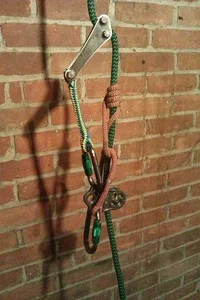
So after being on the rope wrench for a few months I wanted to share my experiences.
First Example:
This past weekend my dad and I did some oak pruning. The first job we had one large white oak (I pruned this with the wrench) and 3 small red oaks which were all about 35 feet in height (Dad did these).
The white oak was large and had a pretty good spread. It was located about 15-20 feet off the corner of the house. I broke the tree into sections. Working from the highest section to the lowest from this point I would just descend to the ground and be finished. I had my rope up after two throwball shots and started up. For my long ascents with the rope wrench I use the Double Line Rope Walker that was first used for doubled rope. It allows you to use both legs and walk up the rope. The job was to give the oak a full prune with deadwood at 1.5 inch and larger. In large mature white oaks this means getting to the tips.
These are the few things that the rope wrench allowed me to do:
Set up natural redirects that always gives you great working angles (this is the biggest plus)
Consistent friction the entire climb
This one is hard to explain…On the few limb walks I had to do I would sit into the rope and it would flex with the tree and I was parallel with the limb then when I went to take the weight off the rope and start to stand up I was “picked up” in a way. It is awkward at first but after a few of them I started to like this.
I have found that if you plan your route right your rarely have to work up. Unless two sections of the tree are completely separated from each other. This oak tree had me do it once which was easy and efficient with the 1:1 as well as the DLRW putting it all in my legs.
I was finished and out of the tree in about 2.5 hours. My dad bid it for 4 hours with each of us doing half the tree at two hours. Looking at it with doubled rope technique in mind I would have agreed with him. I told him I would tackle this tree in the amount of time it took him to do the 3 smaller trees and I was right.
We finished up the job well under bid and my dad and I were both impressed.
I really give credit to the rope wrench for being more efficient on the job as well as on my body.
I had this climb on helmet cam and will try to put it together so that you can get some perspective.
Second Example:
I have a picture of this one which really explains it all. This oak tree was in serious decline which was in the condition of a bunch of sprouts on a fair amount of branches. The job was to remove the stubs, dead branches and suppress back the dead tips. The oak was over shadowed by a larger silver maple and had a large branch that went over the top of it. In one throwball shot I had it at the tip of the silver maple branch and to the ground. This is the red line in the picture. Then once I got into the oak tree I redirected in the oak itself which is the red dotted line. I did it this way to be able to work every part of the oak tree but not rely on the oak itself as a tie in point which was in serious decline. It allowed me to do the job more efficiently as well as safer when it came to a tie in point.

The rope wrench overall does change your climbing style. It makes you look at the tree in a different way. Like Cary says it is like a chess match. But really I see you winning every time. As this product further develops I see this as the future of tree climbing. It makes sense in so many ways. If you try it and give it a true run I really don’t see how you can’t like it. The rope wrench is a lot of fun.

edit: after looking over the helmet cam vid...had it running the entire climb and it came to 2.5 hours
So after being on the rope wrench for a few months I wanted to share my experiences.
First Example:
This past weekend my dad and I did some oak pruning. The first job we had one large white oak (I pruned this with the wrench) and 3 small red oaks which were all about 35 feet in height (Dad did these).
The white oak was large and had a pretty good spread. It was located about 15-20 feet off the corner of the house. I broke the tree into sections. Working from the highest section to the lowest from this point I would just descend to the ground and be finished. I had my rope up after two throwball shots and started up. For my long ascents with the rope wrench I use the Double Line Rope Walker that was first used for doubled rope. It allows you to use both legs and walk up the rope. The job was to give the oak a full prune with deadwood at 1.5 inch and larger. In large mature white oaks this means getting to the tips.
These are the few things that the rope wrench allowed me to do:
Set up natural redirects that always gives you great working angles (this is the biggest plus)
Consistent friction the entire climb
This one is hard to explain…On the few limb walks I had to do I would sit into the rope and it would flex with the tree and I was parallel with the limb then when I went to take the weight off the rope and start to stand up I was “picked up” in a way. It is awkward at first but after a few of them I started to like this.
I have found that if you plan your route right your rarely have to work up. Unless two sections of the tree are completely separated from each other. This oak tree had me do it once which was easy and efficient with the 1:1 as well as the DLRW putting it all in my legs.
I was finished and out of the tree in about 2.5 hours. My dad bid it for 4 hours with each of us doing half the tree at two hours. Looking at it with doubled rope technique in mind I would have agreed with him. I told him I would tackle this tree in the amount of time it took him to do the 3 smaller trees and I was right.
We finished up the job well under bid and my dad and I were both impressed.
I really give credit to the rope wrench for being more efficient on the job as well as on my body.
I had this climb on helmet cam and will try to put it together so that you can get some perspective.
Second Example:
I have a picture of this one which really explains it all. This oak tree was in serious decline which was in the condition of a bunch of sprouts on a fair amount of branches. The job was to remove the stubs, dead branches and suppress back the dead tips. The oak was over shadowed by a larger silver maple and had a large branch that went over the top of it. In one throwball shot I had it at the tip of the silver maple branch and to the ground. This is the red line in the picture. Then once I got into the oak tree I redirected in the oak itself which is the red dotted line. I did it this way to be able to work every part of the oak tree but not rely on the oak itself as a tie in point which was in serious decline. It allowed me to do the job more efficiently as well as safer when it came to a tie in point.
The rope wrench overall does change your climbing style. It makes you look at the tree in a different way. Like Cary says it is like a chess match. But really I see you winning every time. As this product further develops I see this as the future of tree climbing. It makes sense in so many ways. If you try it and give it a true run I really don’t see how you can’t like it. The rope wrench is a lot of fun.
edit: after looking over the helmet cam vid...had it running the entire climb and it came to 2.5 hours