Rope walker tie off

Just checking with everyone on what you use to tie off a rope walker system at the bass of the tree. I have been using a running bowline, but I know there are other/better ways of doing this. Pictures would be great if you have some.
Thanks guys Sam
 
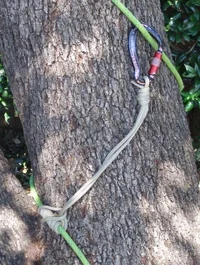
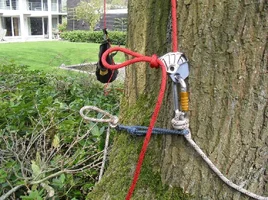
I use a trunk wrap with a eye/eye sling made from Ice.

This picture is of a sling that I used before I had the E/E made up.

Below the Klemheist I'll tie a slipped half hitch and then put a half hitch over the 'slipped' loop to lock it off.

I've tested this setup to see if non-rope or non-climbers can figure out how to untie it and lower me. Every time I've tested it they can. When I've used devices they have been challenged to figure them out.

Add enough wraps or trunk friction up above so that the sling becomes a back up or brake.
 

Attachments

  • 243374-anchorbelay2.webp
    243374-anchorbelay2.webp
    100.2 KB · Views: 161
Its important to remind people to tie a stopper knot in the end of the rope so that it will jam against your tie-off/ emergency lowering friction hitch, preventng the would-be rescuer from dropping the climber victim after getting to the end of the rope. For lowering someone, it takes up to three times the rope length of ground to TIP, if the climber is near the TIP.
 
For taller trees, where one rope isn't long enough for lowering a climber, what knots would you use for joining two ropes, knowing that the joined section will have to go through crotches?

European Death Knot with an additional overhand knot, maybe???
 
I believe a very efficient tie off is with the porta wrap With a prussic back up. I don't have a pic but I did a quick paint. sorry if confusing. Pics are out there tho. Im sure will be posted. I beleive this is easily understandable with your crew and even other personnel
 

Attachments

"Keeps the POW for lowering wood"

I have to hope and pray that no one is using a rigging POW to anchor a climber...did I miss an emoticon? :)


Tying a stopper in the end is a great idea. I don't do that all of the time though. It will depend on how high my TIP is.

A way to make a safer belay and not have to worry about rope length is to tie the ends together using a grapevine with long tails. Now you have a loop. The catch is that you have to have a pretty clean, clear route to the TIP.

One time I had a short rope and wanted to have the tail free to set redis. To make sure that the rope was long enough for a rescue I took another short rope, tied them together and put the grapevine above the biner/hitch anchor.
 
Tom, you make a good point about rigging versus life support gear. There are people that don't have enough gear that would do it.

I should have said,
"this prevents you from having to have a dedicated POW and anchor rope for life-support functions".
 
Jimmy,

If the gate isn't positioned right it could be bad, I agree.

After using it for a number of years and watching this setup with other climbers I don't see that it is an issue. If side loading was ever a concern changing to a shackle or screw link would solve the challenge.

As with most SRT issues there has to be more care and thought put into setups. In some ways SRT is way more complicated than trad climbing. There sure are more considerations that need to be addressed.

If there is a POW dedicated just for climbing I could see it being used. I've tried other belay devices with novice rope handlers. Every time they get something balled up or let the 'victim', usually a log, drop to fast because they've lost control. In every trunk wrap test the belayer is able to dial in the friction intuitively. The hitch stays on as a back up in case the belayer needs to let go of the rope for some reason.

 
Thanks guys, MattD my crew consists of my two bosses (brothers) and me. We do bucket and climbing work. They had very little knologe about climbing before I came on and I still have to walk them through ALOT. So when I explain to them how to lower me its hard to tell if they actually are following what I'm saying or just saying they understand and forget 5 min. later. what if you did a trunk wrap with a section of rope chocked off with a steel binner and a friction hitch that your rope would connect to with a alpine butterfly below the hitch for a stopper knot incase the hitch were to slid alittle. (this is if your bosses WOUNT buy you a gri gri or a Petzel I'D). Would this set up work?
 
This is a nice way to tie off the SRT system.
Point off safety, the groundcrew or other climber can lower the climber on the SRT system using the Cinch. Be aware to use a stopper knot under the Cinch.

picture :

243422-cinchsrt.JPG
 

Attachments

  • 243422-cinchsrt.webp
    243422-cinchsrt.webp
    251.8 KB · Views: 29
I ususally run a running bowline up the tree around a sturdy limb. Sometime I will tie a running bowline around the base of the tree I'm climbing or a nearby tree. I see very little need of being able to lower a srt climber that only uses srt to access the tree top.
 
I have a very nice set of Zeiss binos that I scour the route with first, very clear, sharp and brite ....I can pick out a knat's a$$ at 100 feet with them, so I'm confident before I climb.
ALL climbers should carry a set of binos IMO.
 
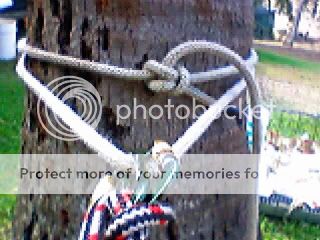
i just started using the rope walker system and learned from a friend here a great tie off system. i tie a sling or long enough piece of rope to the tree with a 2 wraps and a bowline, attach a carabiner to that where the climbing line is tied in a munter hitch on the biner and then to tie of the system i use a mule knot then finally a overhand backup. this way if i need to be belayed or rescued they can simply untie the overhand, pull the mule knot then VIOLLA!! on belay~

trunk wrap
trunkwrap.jpg


munter hitch
munterhitch.jpg


mule knot
muleknot.jpg


overhand backup
overhandbackup.jpg
 
A limitation that a munter and most belay devices have is that they have a learning curve. Not only in how to use them at the best of times but if the chips are down and there is a real rescue happening has the belayer attained enough muscle memory? Can the lower be stopped? What happens if/when the belayer does something wrong and lets the rope go or gives slack at the wrong time?

By using a trunk wrap the extra gear is minimal and the friction is built into the system upstream from the ground.

Maybe this is a generational thing, but, anyone who cut their teeth on rigging with trunk wraps can see how to make this work easily.
 

New threads New posts

Back
Top Bottom