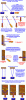
Thanx Dan, am werking on the leveraging that happens to lines at the other end of the spectrum. Like when the spread angle is gone, but the angle of line is now closed too much; per line's own stiffness. Flexibles like line supports invoke angle and not length multipliers to the load force. Non-flexibles like a wooden lever invoke angle multipliers X the length. But in a tight bight; even though the teepee is pointed/ forces relaxed; we can run into the range that the rope resists bending even unloaded; like a wooden lever. Like when mounted on krab or Porty eye etc.; and forcing a stiff line to make a tight bight. Or as a friction hitch around a host lifeline etc.
T.Blough; that leverage can be immense; the next step is to take tail to be not jsut a turn around the trunk device; but a back hand hitch. This gives 2/1 force to bend line your perpendicular 90deg; and also more holding power. i find it is best to do this say to the right side of trunk, then pull with backhand hitch's 2/1 towards/ past center of trunk. On smoother trunks, you can keep the tension and then slip the arraingemeant to the right side again etc.; for more severe bending/ loading with subsequent pull(s). If using for a tie down for transport you can accidnetally bend stuff; if not immediately; then during bouncing of transport by too much force generated with these bindings.
Similarily, if you have a zrig around trunk, no pulley, you lose some of the 3/1 to that friction where pulley is not, and angle of the line not being inline. But, then that same spread can become an frined in a proper finish. Tighten hard (preferabley on lower friction/ smooth bark) with zrig. Then 2 hand tighter, then take the tail and wrap turns around the spread angle of the zrig as it mounts around the trunk. The more turns, the more power to compress together and bend the legs of line of Zrig towards each other. The zrig is jsut to mkae the lines stiffer/ resist bending, then the bending of those same lines is the real, real leveraging. Lock off on anchor or devices not trying to spread apart with 2 half hitches, even if in bight. Just like locking off fig.8 or mule lock off on munter (mini-backhand hitch).
We generally only think of flexible devices generating more force through inline repeated legs of pulls through pulleys. For flexibles by definition wouldn't resist bending perpendicularily; so would releive leverage force and not hold it. But in the range of a tight bight, or highly tensioned lines; we do have resistance to perpendicualr bend with an otherwise flexible line. And thereby leveraging not releived, but carried through the device, as one would suspect of a wooden lever.
Wood cant roll through a pulley, so we don't get inline generation of higher force/ power linearily, only at leveraged/ perpendicular angles. The less perpendicular, the more potential leverage lost. Thus a wrench works well; going around a nut; acan always have a leveraged angle on it etc.