Rigging Whoopie

oldfart

Participating member
Location
Asheville, NC
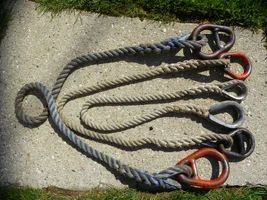
I really hate carrying a big tailblock when I don’t have to. Hey, the handle isn’t OldFart for nothing …

Anyway, here are some early thoughts for a cheap, light, easy-to-build alternative for rigging chores when a big block is overkill. I’ll probably do some tweaking with this as I try it under different conditions … and I’d appreciate your thinking.

Rigging Whoopie

If you build one, I’d especially like to hear your weight/strength experience with it.
Thanks.


OF
 
I like it too for light rigging.

But that last application for dropping a spar needs to be nixed if you intend to use those steel rings again.

Anytime I drop a spar using a rope with a steel termination, I rig it so the termination point is 180 degrees opposite the trunk side that slaps the ground with such force. This generally means I choke it on the far side, then up and over the top of the spar in the direction of pull. Sometimes I even cut little V grooves in the upper edge at 6 and 12 O'clock.

jomoco
 
hey jomoco,

I'd never drop on a biner or a pulley, but I've been doing fine on rings. But you're right and I didn't think this through. I've been lucky cuz I'm on consistant loamy sandy soil. In a more general situation, one granite cowpie wrecks the whoopie and makes you look like a genius.

Thanks for the post.

OF
 
Thanks for the comments, guys, here and on YouTube.

I think the issue of bend radius is real and I’m pushing it. But perhaps not as much as you might think…

The WM rings have a section diameter of 11.7mm. That’s considerably fatter than a normal steel arborist rigging ring. So in the hanging, 3-ring configuration the rope sees a 1.4” effective pulley diameter (2x11.7 + 1x12.0). I’m good with that.

In the 2-ring choking configuration, the effective diameter drops to 0.92”. That’s looking small, to be sure. But a good bend radius is a function of the rope being used. I chose the small arborist ring to specifically prevent loading the whoopie with a big rigging line. There’s no room for more than a 9/16" line. It’s like a micropulley stops you from threading up a big line, even if you don’t intend to load it heavily. The small ring is there to protect for bend radius.

I’ve tried the whoopie on three rigging lines:

1/2” Stable Braid
9/16” Stable Braid
1/2” Treemaster (a tri-line)

The Stable Braids both look perfectly happy. Very nice flexibility. The Treemaster, not so much. It doesn’t look completely pissed but it definitely looks annoyed.

I really don’t know what the long-term durability will be for a small bull line. Of course, two rings is perfectly fine for a climbing line, but we’re not hitting it with repeated impact loads.

I really would like some feedback on this.


If this is a major issue for you, there are two additional things you could think about:

1) If you need the choking, round turn the adjustable eye and use three rings.

whoopieroundturn.jpg


2) If you’re a traditionalist, you could be saying “If I want a light alternative to my big block, I’ll get the little CMI or something for a hundred bucks.” Fine, but you’ll need a sling for it. Hmmm …you could pull the adjustable eye through the big rings and hang the CMI on a Rigging Whoopie. Now the Whoopie can earn it’s keep with a few extra tricks other than just holding the block.


OF

 
Here's a short vid showing the Rigging Whoopie used as a vectored redirect with no impact loading. The 3-ring basket configuration delivers 60 kN MBS as a rigging pulley.

I'm using 1/2" tri-line. Works OK with the three rings, but I much prefer stable braid. I don't like "hearing" the tri-line reeve through the rings.

Rigging Whoopie Redirect


OF

 
I see where you're headed with that, and I think you've done well with that system. In that situation, wouldn't it be a bit easier and equally effective to find a suitable crotch and run the rigging line through a conduit friction saver?
 
I like your ingenuity and process of constructing products like this.
I have found that hollow braids, especially 2 end, "pick" very easily when running over rough barked trees, which will derate the strength. Although not adjustable, I use rigging friction savers made out of 1/2" and 5/8's" 3 strand rope and pear links with round stock rod welded to them, and different sized teardrop thimbles to act as the large and small ring. You can set and retrieve them from the ground with throwline string.
Image attached.
Keep up the thought process.
 

Attachments

  • 339684-100_0976-Copy.webp
    339684-100_0976-Copy.webp
    299.1 KB · Views: 171
I spliced a retriever onto one of Colin's pinto loopies. only got to use it once or twice and it worked super slick. CB, how is that thing working for you?
 
The whoopie version of a ring-and-ring is a nice idea. But the following comment left me scratching my head:

[ QUOTE ]
I think the issue of bend radius is real and I’m pushing it. But perhaps not as much as you might think…

The WM rings have a section diameter of 11.7mm. That’s considerably fatter than a normal steel arborist rigging ring. So in the hanging, 3-ring configuration the rope sees a 1.4” effective pulley diameter (2x11.7 + 1x12.0). I’m good with that.

[/ QUOTE ]

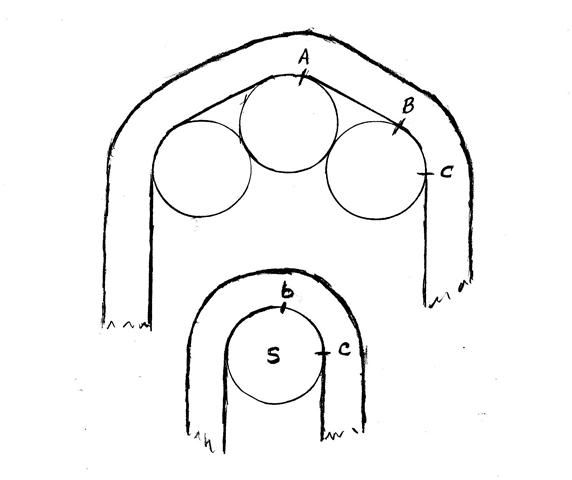
I'm wondering if this is true. In the drawing below. the 3 rings with a taut rope are shown above, and a single ring, S, with taut rope is shown below.
3Rings019Small.jpg


Wherever a rope is in contact with a ring it follows the surface of the ring and therefore has a bend radius equal to the section radius of the ring. These curved sections of rope are exactly the same for the 3-ring configuration and for the single ring. So the arc from B to C in the upper diagram is exactly the same as the arc from b to c in the lower diagram, and one would expect the weakening effect on the rope to be the same in both cases.

Now in the upper diagram the rope from A to B is perfectly straight because it is not contacting any ring. There is no bend radius and no weakening of the rope. To believe that the 3 rings are somehow better than one, one has to argue that the straight section A to B and the other one to the left are somehow helping to cancel or reduce the weakening that occurs in the arcs, such as B to C. If so, why not move the rings much further apart, say a foot between each ring, and get an "effective pulley radius" of two feet? I doubt if anyone believes that works. If lengthening the straight sections doesn't help, then reducing them shouldn't hurt, and we can reduce them to 0, ending up with the single ring, S. The rope, in other words, doesn't know the difference between 3 rings and one.

If ropes were perfect mathematical objects, this would seem like a pretty solid argument. But they aren't. Maybe there is some benefit to the rope in having a 180-degree bend subdivided into 3 bite-size chunks rather than a single uninterrupted arc, as in the lower diagram. Does anyone have any actual evidence, or a good argument, that this is true?
 
[ QUOTE ]


If ropes were perfect mathematical objects, this would seem like a pretty solid argument. But they aren't. Maybe there is some benefit to the rope in having a 180-degree bend subdivided into 3 bite-size chunks rather than a single uninterrupted arc, as in the lower diagram. Does anyone have any actual evidence, or a good argument, that this is true?

[/ QUOTE ]

To me it seems three rings would be easier on the rope because a longer section of rope is involved in the unequal stretching that causes problems in tight bends. One inch of rope stretched 1/4" presents different stresses than three inches of rope stretched 1/4".
 
Moray,

The rings would fall into a triangle with them all touching. There's no way that they would align like in your diagram consistently and continuously.

If I was going to make a rigging FC I'd use some big fat rings like Norm has in his three strand setups. Get a large thimble and a small ring.

If you want adjustable, take a look at what Nick spliced up for me a while ago.

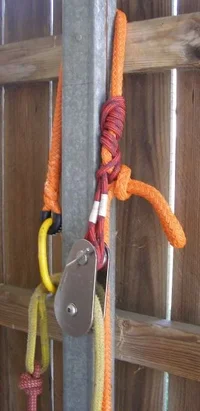
The red Fly rope tied to the eye of the doublebraid is to simulate the load. The friction hitch has a slipped half hitch to act as a stopper...just in case. This can be retrieved from the ground...but be careful, the retriever needs to be setup right and it FLIES out of the sky!

Of course this could be scaled to match the loads your rigging. Mine is for heavy duty work.
 

Attachments

  • 339813-RiggingFCcs.webp
    339813-RiggingFCcs.webp
    28.5 KB · Views: 157
Moray, thanks much for your thoughtful analysis.  If anything, I think you were being charitable.  Picture, for example,the three rings in your diagram in a horizontal straight line. Then you could argue by inspection that the two rings and the three rings would impart the same bending profile to the rope.  Wow, food for thought.

Treeco, I think the real answer is somewhere near what you wrote.  In effect, there must be some "micro" and some "macro" forces acting within the rope.  As a thought experiment, imagine not three but twenty points of deflection each one being a 1/8" dia. post of infinitely strong strong unobtainium, but they are spread nicely around a 3" semi-circle.  Intuitively I think the rope would be happy but the "micro" bend radius at each post would be awful.

This is above my pay grade.  We need a rope engineer.

Tom and Norm, thanks both for the pix.  Norm I've seen those eyes before and I absolutely like the work. I'm gonna do a couple of those babies.  But the adjustability is important to me.  I really tend to gravitate the choking the stem whenever I can.  So, Tom, I like what you and Nick did.  But somehow I'm thinking the whoopie would do a kinder job of spreading impact forces over more area than the smaller "bite" area of a prussik.  Plus, it wouldn't need to be safetied.  What do you think on that?

The downside,  Norm, is the crummy service life of the hollow braid.  I'd almost have to think of the tenex as a consumable.  Fortunately, you can build the whoopie in 5 minutes.  You don't even need to stitch either end.  Fast and pretty cheap.
 
***But somehow I'm thinking the whoopie would do a kinder job of spreading impact forces over more area than the smaller "bite" area of a prussik.

Might...I dunno. My idea was to have a heavy duty adjustable sling modeled on what I'd been climbing on for many years...just scaled up a few orders of magnitude. I don't think that there is a concern about the grabbing power of a klemheist... I rarely use a prusik after seeing how they perform compared to a klemheist in pull tests.


***Plus, it wouldn't need to be safetied.

When its so easy to add another level of safety, why not? Would it be mandatory? Without doing pull tests on my setup I would have no clue. I'm the kinda guy that puts on my lanyard when I make most of my handsaw cuts. Gives me comfort.
 
Oldfart, I really like your mind experiment with the multitude of tiny rods of unobtainium. It seems unbelievable that this wouldn't be MUCH kinder to the rope than a single 180-degree bend around a single rod. We do need a rope engineer.

Ultimately I think its going to come down to the fact that the rope is a complicated shape-shifting 3-D object, that the individual fibers can slide against each other, that they can transfer load from one to another through friction, that they are spirally woven so that a fiber that is on the inside of a sharp bend is on the outside just a short distance away, etc. Those straight sections in the 3-ring diagram are probably absorbing some of the stress generated in the curved sections. To some unknown degree the 3 rings must be better than one.
 

New threads New posts

Kask Stihl NORTHEASTERN Arborists Wesspur TreeStuff.com Teufelberger Westminster X-Rigging Teufelberger
Back
Top Bottom