









Rigging rings as snatch blocks

Shadowscape

Been here a while
Location
far north
I have worked solo for the last 15 years, so I'm not really up on what others are doing these days except for what little I have caught on the internet from time to time. I have not seen anyone using large rigging rings as snatch blocks. I find myself using them more for that than as lowering rings. As a matter of fact I have more of them spliced onto dead eye slings and what seems to be a reinvention of a once highly used sling you now call ultra slings (We just made them with knots) through the holes rather than around the outside. At any rate, is there anyone besides me out there using the rings as snatch blocks? Or am I a weird duck? About a month ago I pulled a large Aspen blowdown out of a standing Spruce with three of these and a small 4 wheeler. Oh, and about 300 feet of 5/8 rope. But it was easy and much safer than trying to cut it out of there.
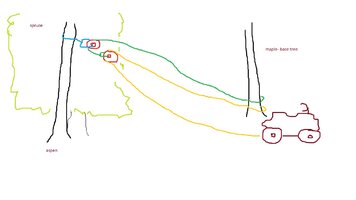
aspen out of spruce.jpg
Not good at drawing. Sorry. One more set in there I forgot to draw.
 
Last edited:
I have worked solo for the last 15 years, so I'm not really up on what others are doing these days except for what little I have caught on the internet from time to time. I have not seen anyone using large rigging rings as snatch blocks. I find myself using them more for that than as lowering rings. As a matter of fact I have more of them spliced onto dead eye slings and what seems to be a reinvention of a once highly used sling you now call ultra slings (We just made them with knots) through the holes rather than around the outside. At any rate, is there anyone besides me out there using the rings as snatch blocks? Or am I a weird duck? About a month ago I pulled a large Aspen blowdown out of a standing Spruce with three of these and a small 4 wheeler. Oh, and about 300 feet of 5/8 rope. But it was easy and much safer than trying to cut it out of there.
View attachment 86462
Not good at drawing. Sorry.
Best hardware for a snatch block would seem to me a pulley, no brainer, avoiding friction in the system. Why do you prefer the ring?
 
They can be good in place of a pulley if you expect it to take a beating when it comes down and you don't want your pulley or block to take the hit. Rings are very low friction, I've used them as snatch blocks and even in place of redirect pulleys. Blocks/pulleys are more efficient of course
 
I just have not seen anyone using rings for snatch blocks and wondered if I was the only one. Working alone for so long makes one paranoid that way. I feel better now that I know other people are doing what I do.
I use blocks a lot as well, but I don't like trees falling on them. Rings are cheap and sturdy. And I have them spliced into ropes just for that reason. I have a 200' 5/8" Polydine with a large ring spliced on the eye just for this. That is the only thing it gets used for.
 
Last edited:
I do not like using rings as snatch blocks because they put too much unnecessary friction in the system. That friction can potentially allow (necessitate) too much friction in the system, particularly on the leg where you are pulling with your machine, in order to put the needed pull on the object you’re pulling.

My guess, without actually testing it, is that a 5:1 system using rings instead of pulleys would probably give you closer to 3:1 or 4:1 in actual advantage.
 
I've had rings as top anchor point pin ropes against stem wood with heavy logs in a dynamic negative rigging situation when used on the spar. It just whooped up my expensive rigging lines more than needed, shredding covers on some softer lines, like polydyne . I rig with rings as much as possible when it mostly top down rigging, even if you have to lift a few limbs even by hand ring works very well in 3to 1, as other said theyre smooth,, we almost exclusively double whip or span or belly rig whatever you wanna call it and when we're in heavy negative rigs now we use a block as the side plates protect the rig line better from the spar crush and run, but the ring can be attached to deadeye on the log were lowering and that combo for big heavy wood keeps the rig line a bit safer from my observations of thousands of log tips on ropes. On another note the terminal end should be anchored over block or ring as I've seen people folks on the gram look like the want to cut the rig line with block as big log comes over and rips right across the bowline they whip under the block sling..
 
I do not like using rings as snatch blocks because they put too much unnecessary friction in the system. That friction can potentially allow (necessitate) too much friction in the system, particularly on the leg where you are pulling with your machine, in order to put the needed pull on the object you’re pulling.

My guess, without actually testing it, is that a 5:1 system using rings instead of pulleys would probably give you closer to 3:1 or 4:1 in actual advantage.
Could be I know sailing yachts use them in lieu of pulleys now so maybein that realm they have figures on friction coefficients
 
Best hardware for a snatch block would seem to me a pulley, no brainer, avoiding friction in the system. Why do you prefer the ring?
They are cheap. I can set up about eight snatch block rings for what one good block costs. And if I drop a tree on them... they most likely will get dug out of the dirt in good shape. If I'm doing one, and there is not a good chance a tree is going to land on it, I will use a block or pulley.
 
I do not like using rings as snatch blocks because they put too much unnecessary friction in the system. That friction can potentially allow (necessitate) too much friction in the system, particularly on the leg where you are pulling with your machine, in order to put the needed pull on the object you’re pulling.

My guess, without actually testing it, is that a 5:1 system using rings instead of pulleys would probably give you closer to 3:1 or 4:1 in actual advantage.
Actually that leg has very little forces on it. All the dead ends in this system are tied to a tree. If I am applying 3,000 lb force on the Aspen I am only putting about 600 lb force on the 4 wheeler. Plus loss for friction. If those rings and that 5/8" Polydyne can't handle the forces involved here, I want my money back.
Actually I had three ring snatch block going on that set up. So a 600 lb pull with the 4 wheeler would have been more like 4800 lbs, minus the friction loss. And I don't think the friction loss is all as much as you think it is.
 
Last edited:
I have been using the rings like this for several years now and I have not had a need to cut off an eye splice where the rings rub and splice a new eye due to wear. Not like you are winching miles of rope, or dropping chuncks down from a stem. Short pulls that are slow.
Just thought I would see what the rest of you guys are doing with rings other than redirects, and dropping / lowering.
 
Oh wow, I haven't seen these snatch rings before, that's super interesting... I thought you meant rigging rings this whole time.....
The large rigging rings work just the same. Rub just a bit more, but not much, and it is not like you are running them around at 150 RPM. But those like in the video are dirt cheap at around $15. dollars and up. The 150 dollar ones are no better that the 20 dollar ones as far as I have noticed.
I'm a fan of

RENO Winch Snatch Recovery Ring 66,000 lbs​

for about $32 dollars, and they handle 5/8" rope. You can find them on Amazon.
 

New threads New posts

Kask Stihl NORTHEASTERN Arborists Wesspur TreeStuff.com Teufelberger Westminster X-Rigging Teufelberger
Back
Top Bottom












