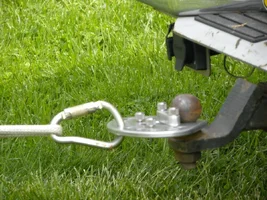
rigging plate

I like the cocept of the plate and the main prpose for it. Another thought would to be use it on a skidsteer or mini loader with a ball hook attachment for those tricky spots.
 
[ QUOTE ]
here are a few more pics
Tomorrow I will put some pics up with easter eggs on it just for you Banjo!!

[/ QUOTE ]

Thank you. I like the blue ones.
 
Tom, it is a good point that you have brought up. I have been down this road of discustion with what stress a ball will be under when being used as a tow point. With the infomation that you have brought to light it is good to note where the stress is being forced onto the ball. In the pic with the strap on the ball: if you look at how the strap is on the ball you can see it wraps high up onto the ball. This cause a pressure that acts with levrage high on the ball. Plus when using a car or any other mechanical device you have no feel or way of knowing how much force is being applied ( unless dynometer is in place).

With the plate you will not have the levrage factor due to it being placed low, and in every rope class I have sat in it has been highly stressed to only use man power to have a span of control. Plus im not sure if I have said it before, sorry if I had not, this is for light to medium rigging. Well that is unless when it comes back from testing they tell me diffrent ( not holding my breath).

Again Tom does bring a great point about hitchs and what to keep in mind when working with them. I would have to place in writing that this plate is not to be used as a toeing tool.

If you figure in that if you are staying within the guidlines of rigging the average max loading strength of a line if 6,800lbs. This is also in the same strength area of a toe hitch ( well one that will be used with a work truck). I dont mention bull line strength due to they should not be used with this plate on a ball hitch. If they are being used you know that you will be going over the safe working limit or stand the chance.

Thanks for all the possitive responses.
 
Even so...lets turn the tables, and we have LOTS of times...

The tow truck driver wants to take down a tree. How do we react? That's OUR domain, stay out, we know the best, do you want to get killed...on and on...

Shouldn't the opposite work? Go ahead...google for yourself. Let me know if you find any towing authority that says that using the tow ball for a pulling point is a good idea.

It would be too easy to configure a receiver hitch unit with a proper cross pin to use as a rigging point.

In any of the search/rescue books that I've read they have prohibitions in place to deny the use of hitches as anchors. Using webbing straps wrapped around frames is the way that I've read. In one text they would not allow a pull in the front to rear position.

But, like my friend Michelle says,

Go ahead, do what you want, you would anyways.
 
I'm sure that toe truck drivers would when asked if a ball hitch was made for pulling would say yes... I'm only guessing not sure but do belive that you hich things to a ball hitch lock them on an pull them down the road. Even then you have shock loads when you hit a bump and you feel the jerk caused from the trailer. Eather way playing it safe here as well anyone should, I am having it sent out for testing for these reasons.

Rescue classes warn of using a front or back anchor on a vehical due to the temptation to move the truck to move the load. I would hate to think someone would do that but I can see it happening. Training hard with your equipment and crew is a good way to prevent suck things.
 
Also looking to see if there is interest in people wanting one. PM me if you would like to purchace one. Again I have to have the paper work back from testing and will post hopefully with the video also (pass or fail).
 
[ QUOTE ]
My original thought of making this plate was for a first responder say pulling up to a car over an embankment or bridge, can deploye this plate fast and have a rescuer with the victim in a short amount of time ( no fussing around with tieing an anchor to anything). Also I know that once a truck is used as an anchor on a rescue scene it is not to be moved. So now because of the plate being there, there is also a place to rig a MA for hauling.

[/ QUOTE ]

Are you saying that you are considering using this experimental plate in a rescue scenario??? That can't possibly be legal.
 
Well I can see there being issues if I was to use it prior to testing, but in no way would I do that. If the plate meets the G rating by the NFPA then I would have no problem using it in the manner state above. Now that doesnt mea that I would see fit to use it as an anchor for a high line operation or to anchor a car from moving. As long as the user is keeping within the saftey factors regarding lbs placed on a system then there is no problem. I have a every bit of faith that this plate will meet at least a safe working limit of 13,000 lbs. That is well over the limit of any prussik ( tandem) used as a brake or saftey on a rescue hauling system. Not to mention the limit for the hitch.

The biggest problem I have taken notice to when it comes to a high/low angle rescue by the rescue companies, is the delay in time betwwen the first in crew and the moment the first rescuer meets the vic. That in my expereance has come to be due to taking to long to find an anchor and tie into it. It is my hope with this plate that time can be brought down. Also I am not intending or trying to say that this on a truck is the end all be all to having an anchor. There still can be cause for eather backing it up or having a second anchor. When all is said and done when it comes to a rescue, having medical personal with a vic could be the diffrence between a body recovery and a save.

sorry for ranting a little just want to make sure my intentions are clear.
 
Did some of my own practice/test work with the plate the other day. Things that I wanted to have a close look at durring and agter loads.

* plate reaction when loaded
* any damage and where on plate/bar
* reaction of ball hitch
* damage if any to ball hitch (mainly at base of neck)

The plate at the end had no damage to its self or to the ball hitch. The plate never had a hard load where it wanted to jerk slaming up into the under side of the ball. My educated guess on heavyist load was in the area of 80-90 lbs droping onto a sloping zip line. cuts where made about 10 inches above anchor. Good day of testing, more to be done and other test plate is to have its pull test done today or tomorrow.

In one of the pics it looks as if the guy in the red shirt is right in the path. It is an optical allution. All persons on the ground were out of path of anchor to tree line in case of any flying objects. Also plate and hitch where checked prior to removing anything of the zipline.
 

Attachments

  • 225478-ziplinewithplate.webp
    225478-ziplinewithplate.webp
    198.2 KB · Views: 83
Just got the offical test results back from the test company!!! After reaching 22,755 lbs of pull force they stoped the test due to the inabilty to pull any harded!!! I am sure that blows all other rigging plates out of the water. Also there was no damage done to the plate.
 

New threads New posts

Back
Top Bottom