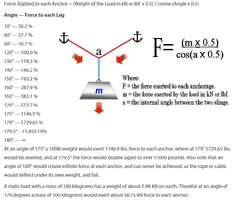
Rigging off two trees.

beastmaster

New member
Location
Calavaras co.
I have a couple questions I hope someone can help me with. If I set up a single rope through a pulley on a tree opposite the one I'm rigging. Run it to the tree being rigged and secured with a bowline under my face cut. Tieing a short line to the piece im dropping and clipping it to the rope so when it falls it'll be supported by both trees. Each tree taking half the force, compared to negitive rigging from a single spare.
Am I correct in that assumption?
Now what if I uses two ropes, the one from the opposite tree attracted to the piece above the cut, closer to the top, then a pulley set up for negative rigging from the tree being. When the piece fell it would also be supported by both tree.
I have some really dead tops I have to rig out. I don't feel safe negative rigging them. Wires and obstacles under them so I can't let them run much. I can zip line out 8 ft pieces after the tops are out. Zip lining out the tops would side load em to much. Can someone give me a physics lesson.
 
I have never done it they way you described with a single rope. Might be worth a try, just remember you will be creating a 2:1 where the piece is requiring 2x rope from the rigging point and 1\2 force to hold it up. I have used 2 lines and rigging points as you described and it works ok. A little more set up time than conventional and really nice to have a ratcheting bollard on the high point. The bottom line ends up being more of a hold back line so you don't smash the adjacent tree.
Without seeing the tree I like the zip line idea. Just go with smaller pieces or more vertical with the line to reduce the stress seen by the tree. With the right guy on the rope and enough straps zip lines are great.
 
My concern with the span rig (single line) is the side loading of your compromised stems. You won't be able to let it run as quickly to dissipate forces. With two ropes you can, as Flyingsquirrel said, use the one on the spar you're climbing as a brake line to control the pendulum to the adjacent tree. I would recommend this technique as it greatly reduces the forces to the stem you're climbing.
 
If you really want to split the weight use 2 ropes normal rig a bottom and gin tie a top and use 2 separate halves to make 1 system.

BTW when I read this thread I agree about the angles, side load, watch the dive to catch it, watch the drift and it would runs at half speed watch your ankles.

But being given all these points I wonder why not just rig it down singly if you're worried about the tree taking those forces I'd be hesitant to side load. If the tree stability is in question I'd just rig gently into the second tree tied into a separate tree if possible so the stem in question has next to no shock or wiggle forces(ish) there's always some
 
Double block rig it to itself? It would take a LOT of rope to do the top of a large grand fir but i reckon would be safer than splitting between the two trees/spars. Also less side loading
 
What's the problem with just using two ropes as in your latter scenario???
There is no upside to the first scenario, and possible down side in that you could create a force multiplier similar to speed lining if you keep the rope tight. Also, that "short line" you are planning on using could end up creating a little more drop which can create significant forces on bigger pieces. ANy concerns about side loading costing you your life, just back guy the stem..
Good luck and take pics
 
I never thought about back guying to prevent or minimize side loading a stick. But on some of these dead and brittle trees applying any new stresses can have bad consequences.
 
Your situation sounds complex, with the wire clearance involved.

Are you able to incorporate a safebloc, or double safebloc rigging system? That would reduce the 2:1 on the negative rigging point.

Can you work off two climbing lines, perhaps with one in a bag to avoid power lines?

Can you look again for narrow slots to @CutHighnLetFly ?

Can you strap a pole with a pulley to the tree, to avoid negative rigging? (time consuming...)

Can you take the top before taking the other branches, to distribute shock absorption?

Can you inform the client that you encountered different conditions than expected, and either renegotiate for a lift, or let the client put it back out to bid?

Can you bring a power line rep to the site and ask what a person in this situation might do?

Can you take a small top with a pole saw and remote anchor?

Can you negative rig with two lines, one set high and one set low, let it run a bit in small wood and let the bigger wood take the shock loading?

Can you set a belay for yourself, above the halfway point?

Prepare a pendulum swing into the other tree, with breakaway lanyard (using 500lbs-test pot metal biner)?
 
I have and use several of those techniques. But could you explan how you would set up two points to neg. Rig a top. Two ropes right. You'd need a skilled ropeman.
I've giving a lot of thought to using a safblock,, how do you mean using doubles safe blocs rigging?
 
Im guessing he means this but with safeblocs instead of the impact blocks. Just be aware that you are creating a 2:1 and that the safeblocs add friction as well so the basal friction needed will be minimal
 
Yeah, two blocks at different heights needs two guys, unless you've practiced somehow... you just set one high and sketchy with no friction device and have the ground guy provide minimal friction. When it falls far enough to get caught by a pulley/porty, you do that. I've done it once, on a sketchy oak removal where I would have taken a 40 ft. drop to a soft atc belay if the worst had happened. I'm a former rock climber. Turned out it just looked bad, but I prepared for it... Needs a breakaway lanyard or no-lanyard ANSI exception for the climber. I did it with no lanyard, sitting on a horizontal section of the 10" branch. I didn't want to fall 40 ft. with a few hundred pound of branch attached because you get close to that 7000lbs climbing rope load...

I feel like I've seen (on Instagram) a video of safeblocs used in the double block negative rigging configuration. I still do not explicitly understand the physics and logistics of double-block negative rigging, but I appreciate the value of it as expressed by others. It may have been Samurai Joe who had the video. I still have not dropped $ for a single safebloc, but I really want one or two...
 
Thank you guys. It makes perfect sense now I've seen it. Its close to what I was thinking with using two trees to share the load, except this does share the load minimizing force at the top.
Any reason a steel biner couldn't be used in place of the 2ed pulley or better yet a x-ring? Other then friction? So long as the weight was minimized?
 
I think it would be fine with a double ring for a better bend radius. I would rather use the rings on the piece being rigged out because I cant shake the thought of a block smashing back into the spar repeatedly. Thats also a good thing about the safeblocs is no moving parts. This is of course foe the DBR scenario.
The other scenario with two blocks, one being lower in the tree, and two seperate ropes, you would be safe to use a double ring again for the top rigging point. I would be skeptical to apply that much force to the rings in a negative rigging scenario for the lower rigging point. It would also depend how big of a top you're taking and how good your ground guys are at running the ropes.
Hope that makes sense
 
I think it would be fine with a double ring for a better bend radius. I would rather use the rings on the piece being rigged out because I cant shake the thought of a block smashing back into the spar repeatedly. Thats also a good thing about the safeblocs is no moving parts. This is of course foe the DBR scenario.
The other scenario with two blocks, one being lower in the tree, and two seperate ropes, you would be safe to use a double ring again for the top rigging point. I would be skeptical to apply that much force to the rings in a negative rigging scenario for the lower rigging point. It would also depend how big of a top you're taking and how good your ground guys are at running the ropes.
Hope that makes sense
As far as smashing back into the stem can anyone explain the gain/loss for us.

The higher you are the smaller diameter the piece but the more wiggle the stem has has due to length (height) vs lower down the pieces are bigger dia so heavier but less wiggle from less stem length (shorter).

If you have a less than perfect condition stem do you prefer less wiggle or more for energy dissipation purposes?
 
As far as smashing back into the stem can anyone explain the gain/loss for us.

The higher you are the smaller diameter the piece but the more wiggle the stem has has due to length (height) vs lower down the pieces are bigger dia so heavier but less wiggle from less stem length (shorter).

If you have a less than perfect condition stem do you prefer less wiggle or more for energy dissipation purposes?

If the double block rigging is done correctly and the ropeman is practiced in estimating the reduced friction needed at the rigging device wobble, wiggle and shimmy are no more than normal rigging. The benefit comes when looking at the forces exerted on the tree parts and equipment. You essentially reduce force on the main rigging block (remains on the stem) and the POW by half, but double the force on piece being removed (due to the 2:1 in the set up). As long as the rigging on the falling piece is strong enough it doesn't matter how much force is exerted on it. The downfall is you gotta have a really good ropeman. It's difficult to get the right friction and speed to reduce the loads further.

As for rings or safeblocs, I haven't had a chance to try the rings on this technique but think a ring on an ultra sling would work for the falling piece. I wouldn't add extra friction (safebloc) at the top until the ropeman could effectively manage the pieces with the already reduced force.
 

New threads New posts

Kask Stihl NORTHEASTERN Arborists Wesspur TreeStuff.com Teufelberger Westminster X-Rigging Teufelberger
Back
Top Bottom