Retreivable false crotch for rigging

rfwoodvt

New member
Hey All!

Been a while since I've been online...was good to run into so many of you at TCI Expo.

Anyhoo, I've been trying to revist the topic of setting a false crotch from the ground. Basically setting a throw line over a suitable crotch then running a pully up to the crotch.

The dilemma of course being that if we hang the pully and tie it off down below is a mulitplicaiton of forces on the crotch.

I thought there had been a thread on board here with diagrams of how to do it but I can't seem to find the right search words.

Does anyone remember thos threads and can point me in the right direction?

ThanX!
 
The concern is correct; for a load in a suspended pulley that is looped over the branch and anchored at ground is 2 (pulley) X 2 (loop over branch) less friction. Or ~4x forces.

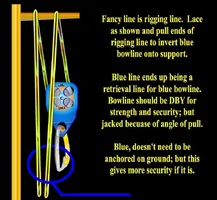
The pulley anchored in tree is 'only' 2x forces (less pulley friction). So blue should be stronger than rigging line; as blue takes more force.

62515-retrievablebowlineinverse.jpg


This retrieveable system is inverting a bowline over an upper branch; so that the bowline ends up choked like a sling that holds the pulley; but with a retrieving line. This takes about 4x as much rig line as drop; unless ya get fancy. DBY preffered; for strength and security; especially when making many runs with system, and it is up where it can't be inspected without being removed and reset. The pull on bowline is not inline; but spreading apart on bowline. So, bowline strategy should change to jacked DBY to address the errant angle of pull. Circumferamce is Diameter x Pi; so bowline should be about branch diameter X 4+. Need to be patient sometimes and flirt it; especially when removing, may take 2 people at differnt angles; but it works!
 

Attachments

  • 62515-retrievablebowlineinverse.webp
    62515-retrievablebowlineinverse.webp
    69 KB · Views: 223
Spydie;

I agree with your concern about capsizing the bowline. I simply tie a separate retrieval line to a (Tuflex) loop-sling. The sling is sized for the limb and for the load, the retrieval line (since it will be used just for retrieval) can be a light 1/2 inch line.
 
i've gone with that; virtually the same strategy(hence the comparison to sling in last paragraph). But i'll tie a 'wide' knot on sling with line. To keep it open and not flattening out/closed to work pulley thru both ways; both to install and remove. Otherwise the non-load retrieval line can be about any old piece. This more mimics the bowline strategy; whereby the bowline adds extra stiffness and spread to the loop for installation/removal; like the 'wide' knot strategy.
 
I don't know who created the technique, but Robert Phillips wrote about it in Arbor Age magazine and Bob Weber showed it in a video shot in conjunction with Lamphear Supply. Both of these (the article and the video) appeared in the early/mid 90's.

Robert told me that the knot (not the bowline, but the setup--threading an endline loop around an object and then back through itself) is called a 'Stirrup Hitch'. Robert said that the 'Stirrup Hitch' was originally shown by Davey Tree as a means of providing a foot support for use in aerial rescue.
 
Thanks Mahk - interesting.

The retrievable girth hitched sling is something I expect many to have used for decades.

I got the impression from Bob that while he was relaxing in the bath one night (I know, not a nice thought!), he came up with the idea of setting and retrieving the pulley from the ground with nothing more than one rescue pulley, karabiner and rope.

WARNING: post no longer person specific - Sense of humour now required.


But these issues, like knots, are never clear cut; like minds think alike, come up with the same ideas, but call it something different. How far back into world history do we have to go to find who thought of something first? I expect much of the rigging ideas we use were thought of centuries ago for monuments, military and seige purposes.

Unless aliens erected the pyramids. Maybe they had the first rigging ideas and passed them down to mankind, calling them something different in each corner of the world, so we could drive each other nuts pondering who thought of what first and what it should be called. I'm thinking the type of alien that showed up in the documentary 'The Life of Brian'. Probably still having great laughs at our expense!
grin.gif
 
Thanks Mark; i thought i'd seen it on the Weber vid; that totally changed how i looked at stuff. i had never seen gear etc. used as properly until then!

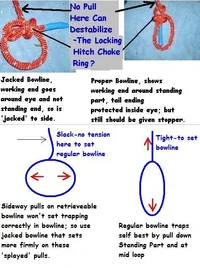
i think because of the force direction change to across the loop/eye instead of a more down the loop from the line; that the 'trap' of the bowline's hitch won't set properly and this 'jacked' to the side version is best. Because of the flow of force empowering the self trapping has changed; we should also change the direction of the self trapping mechanics appropriately IMLHO.

If you look hard at a bowline you will see it wants to be set tightest/ most securely from the straight line pull and the 'bottom' of the loop. If the tail/straight line is slack, it is not the same trapping and also the horizontal spread on loop trys to unseat it more.

This jacked version i believe capitalizes on the sidewards pull to set self trapping. And will lay flatter on support, to further stabilize this critical part of the lacing. What once was the Bitter End is now the Standing Part, but inside the loop. What once was the Standing Part that you'd pull line/bowline with is now the slack Bitters. i think the slack, long end of line doesn't need anchored at ground; but is even better if it is anchored at ground under tension.

62796-JackedversusStraightBowlineinretrieveablebowline_2.JPG
 

Attachments

  • 62796-JackedversusStraightBowlineinretrieveablebowline_2.webp
    62796-JackedversusStraightBowlineinretrieveablebowline_2.webp
    63.7 KB · Views: 196
Interesting stuff Spydy.

I'll stick to a Yosemite Bowlin'. Just checked it again in the configuration, and it tends to tighten rather than loosen in this configuration.

I've used this trick quite a bit in the past, normally at the end of the job to lift big pieces over a fence to the roadside truck. I've never once seen the Yosemite come loose at all.

The jacked bowline is too much of an unknown quantity strength wise, especially stiffer ropes.

My Yosemite tie off isn't the same as illustrated in 'On Rope'; this way seems less secure to me, the tail being easily loosened. In a climbing situation, this also creates a loop that can be miss clipped (as happened to a colleague of mine with 30 years experience, resulting in horrific injuries).

Mine is finished like this:

http://en.wikipedia.org/wiki/Image:Yosemitebowline.jpg
 
i'll see what i can do...

But, in short; to me a bowline is a sheetbend to itself to form eye. In a regular bowline; the bight goes around the 'long end' of the line as Standing Part. In this jacked version; the bight goes around 1 side of the loop is the only differance to me.

i'd think the same strength as regular bowline; same construction, only the bight is turned to sideways as the expected force is turned from down the loop to across.

That is just the base, then i make it a double with Y-tie off (jacked).
 
I think I can see how you tie it Spydy; the starting loop is reversed, so it should be the same strength when pulled the way we want it. Looks like a Yosemite tie off to it shouldn't be too much trouble either (extra security)?

Looks like the version that is demonstrated in 'On Rope', to finish of the 'Helical Hitch' (Ascender knot).
 
Oh no now; you asked fer it!!
grin.gif


This be-quest mixes well with a long time target to build modular library of knot animation components; complete with multi color line and translucent shadowing! And compacted into 11k. With a right click on the stage; you can zoom in and inspect closer; also show how the vector artwork color and shadowing grows more intense (instead of losing detail/quality like .bmp, .jpg, .gif etc.).


Animated Jacked Bowline
 

New threads New posts

Kask Stihl NORTHEASTERN Arborists Wesspur TreeStuff.com Teufelberger Westminster X-Rigging Teufelberger
Back
Top Bottom