- Location
- Oakland, CA
HI,
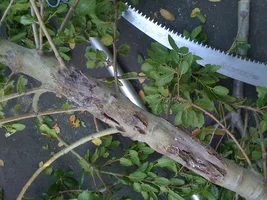
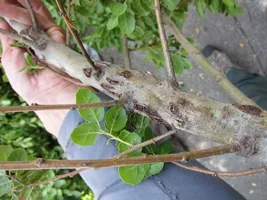
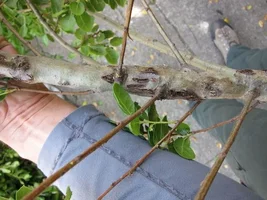
I have seen this in a couple of coast live oaks i do things for in Oakland, CA. This one tree in particular has quite a bit of this sort of thing. Lesions (?) on smaller branches, only some of which have this webby growth on it. Most don't. The branches seems fine and keep on growing out and out, but I have seen it around and wonder what it is. I haven't seen anything like this in the oak diseases handbook i have. I hope to bring my hand lens to bear on it the next time i see it.
This tree is a vigorous grower and otherwise appears quite happy. It has probably gotten too much summer water and we are cutting back on that. It has a fair amount of beneficial wasp galls on smaller twigs, but i mostly leave them on for, you know, the Nature and its Mysterious Ways. It was lollipopped long before i starting working on it and I work to get it back into shape (as much as possible for the twisted tree it is!) as it attempts to swallow the house and shade out a very lovely garden of native plants.
the photo was taken in mid-June.
Any thoughts? seen this before?
thanks,
pete
I have seen this in a couple of coast live oaks i do things for in Oakland, CA. This one tree in particular has quite a bit of this sort of thing. Lesions (?) on smaller branches, only some of which have this webby growth on it. Most don't. The branches seems fine and keep on growing out and out, but I have seen it around and wonder what it is. I haven't seen anything like this in the oak diseases handbook i have. I hope to bring my hand lens to bear on it the next time i see it.
This tree is a vigorous grower and otherwise appears quite happy. It has probably gotten too much summer water and we are cutting back on that. It has a fair amount of beneficial wasp galls on smaller twigs, but i mostly leave them on for, you know, the Nature and its Mysterious Ways. It was lollipopped long before i starting working on it and I work to get it back into shape (as much as possible for the twisted tree it is!) as it attempts to swallow the house and shade out a very lovely garden of native plants.
the photo was taken in mid-June.
Any thoughts? seen this before?
thanks,
pete