









Pull Testing Trees, risk assessment

Nish

Branched out member
Location
North Carolina
Does anyone know of guidelines or have advice about pull testing large trees for lower trunk strength? How much of a load should one put on a 50 foot tall 42" dbh oak with a hollow and thin-walled lower trunk, with the pull line installed, say, at 30'? I'd be interested in learning of published guidelines, studies, useful (and hopefully affordable) instruments, or of an expert with all the fancy equipment who perform these tests in central NC. In the direction of pull, targets can be moved (it's just a parking lot).
 
Does anyone know of guidelines or have advice about pull testing large trees for lower trunk strength? How much of a load should one put on a 50 foot tall 42" dbh oak with a hollow and thin-walled lower trunk, with the pull line installed, say, at 30'? I'd be interested in learning of published guidelines, studies, useful (and hopefully affordable) instruments, or of an expert with all the fancy equipment who perform these tests in central NC. In the direction of pull, targets can be moved (it's just a parking lot).
Nature has been conducting these tests for eons.

Screenshot_20190411-065407_Google.webp
 
Does anyone know of guidelines or have advice about pull testing large trees for lower trunk strength? How much of a load should one put on a 50 foot tall 42" dbh oak with a hollow and thin-walled lower trunk, with the pull line installed, say, at 30'? I'd be interested in learning of published guidelines, studies, useful (and hopefully affordable) instruments, or of an expert with all the fancy equipment who perform these tests in central NC. In the direction of pull, targets can be moved (it's just a parking lot).

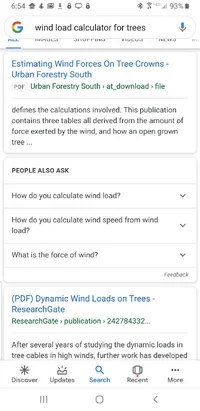
As above!

If you want « concrete » data ... you also have to corroborate that with the relevant area. A protected sapling in a large grove won’t have to withstand the same forces as Big Lonely Doug

A pull test can be used to obtain subjective information about a tree, such as the bending moment along the trunk, an unnatural “stiff” bend, or reveal weird noises or creaking ...

With that being said ... there are static pull tests where root plate movement is measured, as well as a variation where they actually measure fiber strain using extremely expensive tools

There is no golden rule but as far as climbing goes, a good sidepull of your TIP (from the ground) can be reassuring
 
Everything you want to know is in your own backyard/landscape/park and forest.
Make your own observations, soils, tree health, species, specific tree defecencies, characteristics, moisture content etc there is alot of shit to consider.
Make note and study of trees recently failed and in the past and future predictions
Now go to your local/regional weather channel and look at the history of weather/winds/moisture/season etc.
Do your homework end of story in few yrs of observations and solid science you can safely predict what needs removing and what can safely be saved.
Any studies I have looked at are riddled with flaws. How can I say this? Look at what I just said no study or pull test can give you all the information, It is your responsibility to save trees that need saving and remove trees that threaten valuable targets.
Pull test is one small part. I like to see zero movement in the bottom third in high winds or if your pulling, it can't be static it must mimic natural wind/snow ice loading with one line pilling in one direction and better if in two but you should be able to get it swaying enough get it to move or deflect or roll( xyz )
 

New threads New posts

Kask Stihl NORTHEASTERN Arborists Wesspur TreeStuff.com Teufelberger Westminster X-Rigging Teufelberger
Back
Top Bottom












