Portland Paradox Walnut Update (major bummer alert)

treewill

Participating member
Hey all,

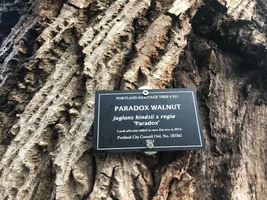
As many of you probably remember, back in 2014 there was a large uproar in Portland, Oregon about a massive Juglans hinsii X regia that was slated to be cut down to make way for condos. After an Earth Day protest where a large group of arborists climbed the tree, the developer bowed to community pressure and eliminated 2 units in ordered to keep the tree. The tree was submitted and accepted as a Portland heritage tree, which grants extensive protections to the tree regardless of who owns the land it's on.

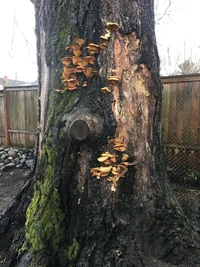
I visited the tree today along with Brian French and Kevin Hillary, and it's almost unbelievable what has happened since then. The tree has 70-80% cambium loss around the circumference of the trunk, just within the last 2 years. Oyster mushrooms and saprophytic borers are going to town on the trunk, but the real cause of this is a mystery.

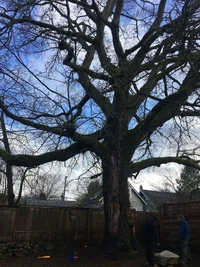
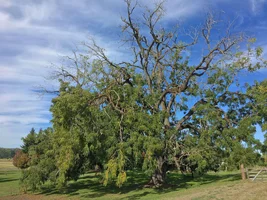
No major roots were severed during construction, compaction and root loss only occurred >50ft from the trunk and only in <25% of the root zone. The crown is full and healthy-looking, with no signs of tip die-back or other issues. Of course, everyone is eager to see if it leafs out in the spring.

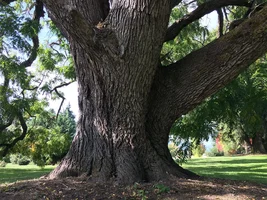
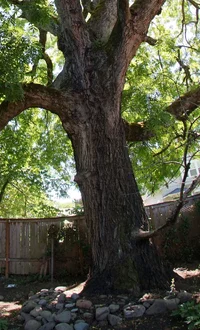
I am curious if any of you have thoughts on what might have happened. I have my theories, but am curious to hear yours with me prejudicing them. Below are some photos of the tree in summer of 2015, and some others from today.
 
1. The crown in June 2015
2. Trunk closeup in June 2015
3. Trunk in January 2018
4. Crown in January 2018
5. Salt in the wound!
 

Attachments

  • DSC04663.JPG
    DSC04663.JPG
    19.8 MB · Views: 52
  • paradox.webp
    paradox.webp
    649.7 KB · Views: 114
  • IMG_7305.webp
    IMG_7305.webp
    868.5 KB · Views: 115
  • IMG_7302.webp
    IMG_7302.webp
    968.5 KB · Views: 106
  • IMG_7304.webp
    IMG_7304.webp
    812.8 KB · Views: 117
Last edited:
Root severence and disruption absolutely occured but a change in the hydrology pattern and major compaction probably did the old dude in. Construction debris and spills may also have worked their way in as well.

Trunk damaged by equipment as well?
Is 1000 Cankers in your area now?
 
Last edited:
Possibly the turning over of the material on the ground (decomposing wood and leaf material) encouraged the moving in of opportunistic pests as well as spores released from decaying material on the ground to up into the air during site work, and spreading tree parts still attached?
 
Root severence and disruption absolutely occured but a change in the hydrology pattern and major compaction probably did the old dude in. Construction debris and spills may also have worked their way in as well.

Definitely not root severance or disruption; compaction and disturbance was minimal and happened very far from the trunk. No significant changes to hydrology.

Damage from construction debris seems possible, but I reckon it would have to be a lot to cause such immediate and extensive damage. This tree had a quality tree protection plan during construction and many people paying attention to it; I don't find this plausible.
 
I believe 1000 cankers is here

Thousand cankers was first identified on the west coast; we've had it here for a while and lost a lot of trees to it. But this doesn't look like thousand cankers to me.

IME thousand cankers always starts in the crown and causes extensive die-back before the trunk becomes cankered. The photos below are of the national champion black walnut, which shows the classic thousand canker profile of dieback starting on the tops and then moving down into the rest of tree over several years.

I've never seen thousand cankers where the trunk cankers come first. Also we didn't find any of the characteristic stains around beetle holes in the sapwood.

IMG_6675.webp IMG_6667.webp
 
What was around the tree in 2014 before construction? Was this a lone tree in a field being developed or was it a member of a forest community? Was the land around the tree (even at the considerable distance) raised or lowered creating differences in water flow and run off? It is well known that young and vigorous trees can take a considerable amount of abuse, but large mature trees, sometimes, can’t even take the slightest disturbance.
My only other question is how salty was the developer about loosing 2 units? Could he have had “the last laugh”? If it lost all that cambium was there a midnight mission with methal-ethal-death?
 
That is considerable damage to occur in such short time.
Lightning, mechanical, toxins, salts etc.
Tree that size will take up to 7 yrs to die back like that to the ground from construction impact.
Whatever it was it was hard and fast.
 
Tree that size will take up to 7 yrs to die back like that to the ground from construction impact.
Whatever it was it was hard and fast.

I agree.

Just to reiterate, mechanical damage from construction on this site must have been very minimal. <25% of the root zone and starting >50ft from the trunk. There's no way that explains the massive trunk cankering we're seeing. No way.

 
Do a soil sample. Do a sample on the trunk material. They will identify the problem

This is strange advice; it's only really helpful to have a sample tested if you know what you're looking for. Unless you have an idea that you're not sharing?

Many tree diseases need to be cultured to be positively ID'ed. So the lab can do the culture and then tell you either yes or no, but they won't be able to tell you what the disease is if you just bring them a sample.
 
My only other question is how salty was the developer about loosing 2 units? Could he have had “the last laugh”? If it lost all that cambium was there a midnight mission with methal-ethal-death?

This is an interesting question. My first reaction was that this looked like other trees I have seen that have been poisoned with glyphosate.


That said, after the developer decided to retain the tree he has a HUGE financial incentive for the tree to live. They even named the development the Paradox condos after the trees! So now they have a bunch of new condos under a dying tree that will likely cost at least $15k to remove, plus even if they do decide to add the 2 additional units, they will have to do it around the occupied condos, which will be much less (or maybe not at all) profitable. This is definitely bad news for them.
 
Was the live foliage showing any symptoms that herbicide could be suspected? Needle leaf, rosetting, distortion, etc
 
This is strange advice; it's only really helpful to have a sample tested if you know what you're looking for. Unless you have an idea that you're not sharing?

Many tree diseases need to be cultured to be positively ID'ed. So the lab can do the culture and then tell you either yes or no, but they won't be able to tell you what the disease is if you just bring them a sample.

Tell them to test for herbicides.


Sent from my iPhone using Tapatalk
 

New threads New posts

Kask Stihl NORTHEASTERN Arborists Wesspur TreeStuff.com Teufelberger Westminster X-Rigging Teufelberger
Back
Top Bottom