Pins on rigging bollards

X,

YOu got it right. Most of the friction that I've needed is on tube with a suitable number of wraps. Then, I'll bend the tail to put myself in a good position or to add just a tiny bit, compared to what I have on the bollard, of the load using the pins.

I can't think of a time when any rigger I've seen didn't do the same.
 
I'm so sick of f***ing rules boxing peoples minds in and keeping them from thinking about what is really going on. How many other threads have gone to crap while I've not had time to read them?

yeah I'm back, you won't like me probably, but I'll tell you the truth, friend or foe and I won't EVER follow the crowd, just because it is a crowd.
 
Tom, even if you were an idiot and had WAY too few of wraps, you are NEVER going to bend that pin OR cut that rope, or even fatigue that rope with your strength or anyone's strength holding that rope.
 
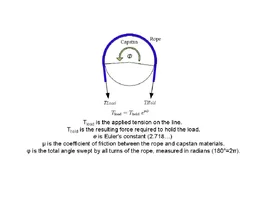
The physics of bollard friction is not generally understood. The load reduction between input and output ends is dependent on two factors alone: friction coefficient of nylon on metal (~0.7 static, but only 0.2 dynamic with moving rope) and the total degrees of turn in the rope. The diameter of the bollard makes no difference in terms of EXTERNAL friction between rope and metal, as the more surface contact the more the load is dispersed over a greater area and the less force exerted per unit area.

But the reason that all rope manufacturers specify minimum bollard or sheave sizes is to minimize the INTERNAL friction of a nylon rope, which is what destroys the fibers over time and can result in catastrophic failure under the right conditions (that's why dynamic rock-climbing ropes are rated in total number of falls, with the rope bending over a small carabiner radius).

So, while it's true that the load force will be reduced by the initial wrap or two on the main bollard, the remaining load will cause both external and internal friction at the pin, depending only on the angle of the rope around the pin. In other words, you'll get just as much external friction by a 180° turn around a pin as with a 180° turn around a bollard, but much greater internal friction (which also reduces the load at the control end, and is dissipated as heat, both on the outside and on the inside of the rope).Capstan Formula.webp

Example:
Lowering a one ton chunk with two full wraps (720°) on a bollard will reduce the dynamic load to 162 lbs. A 120° turn around a fairlead pin or hook will reduce the holding tension to a little less than 107 lbs (which can be resisted by two gloved hands), but will put 269 lbs of force on the pin (input + output).
 
Last edited:
I believe Greg Good had to beef up the pig tail (fairlead) from the earlier generation GRCS, because they were getting bent from whats being described here. I could be wrong, but Im sure he told me that in person. He didnt have to do it, but did so because people have a great tendency to do their own thing.

Chewbaca, yes you can easily loose half wrap dynamic loading, when the slack gets induced into the line as the log tips. The deeper the facecut, the more slack youre going to get. If youre using a device that is standing upright, its possible to pull some of that slack out as the logs fall over. Thats a good reason to hang up a PAW at the small D....so the whole thing doesn't dip down each time the line goes slack. Whatever, its important to keep positive pressure on the line.

David, manufactures aren't going to encourage using the pins as a significant source of friction, even though we know it goes on. If all tree workers could be relied upon to work responsibly then instructions might be written differently.....but they cant.

Your X rings make great friction savers for climbing by the way. Never going to break.
 
"will put 269 lbs of force on the pin "

Thanks rescue. If that is true, how is 269 lbs going to break or fatigue a rigging rope?

How much can a man handle? Probably not much more, right?

What I'm saying is, how can a human holding a rope cause a rigging rope to fail at a pin?

It doesn't seem possible that a human could ever hold the rope tight enough.

I might like to do some"testing".

Various sized pins. Big to thin. Then a knife blade welded to it. Then a chipper blade as the pin.

Maybe, just maybe a new chipper blade and complete redirect around it with a slammimg weight could cut it
 
During a week of skiing with Pete Donzelli we talked a lot about climbing , rigging and telemark skiing!

Pete was trying to figure out a way to braid in or attach load cells along a rope. That way we could find out where the loads are concentrated or dissipated. This discussion would be a perfect place to use this technology. Would the measured numbers match the math?


I understand that the load on the end of the rope decreases with the amount of rope on bollard contact. I trust the numbers that Robert is sharing. That seems to match up with my seat of the pants, or hands on rope, research.

To me, the right amount of holding power that's needed for lowering is a firm grip without using any body-bracing against the load. That way the load can quickly be locked off or let run with super control. If I ever needed to apply 200# to the tail I would say that I should have had more wraps.

On the other hand, if it took another half wrap so that I had no load on the pin I think there would be too much friction and the load would be hard to lowers smoothly. Split the difference is what I'm doing.
 
"What I'm saying is, how can a human holding a rope cause a rigging rope to fail at a pin?

That 269 lbs is the load on the pin with a smooth dynamic lower. If you catch the initial bounce, it could easily double that load instantaneously. I was thinking more about bending the pin than breaking the rope, but then only if it's a weak pin.
 

New threads New posts

Back
Top Bottom