Oil type coating aiding reduction of rot during long duration heal time.

Willber

New member
Location
Milford, NH
Is there a safe oil for coating branch cuts, that have a large cross section, where the cut surface area is large and will take a long time to heal over?
The oil will not need to have a fungicide, just an inert safe oil for the tree, that will keep water off/out the of cut surface to reduce rot, until it heals over.
Not that I unnecessarily cut large leaders/branches. It's just sometimes there is a large dead leader/branch that needs to be cut with a slight or abrupt upward cut, as to have a full live perimeter, and now it will rot faster than if it was vertical or overhanging.
 
Shellac in a spray can has been recommended for Oak trees that were damaged during the summer.
 
For years now I've used Lac Balsam, not everywhere, but on larger cuts - for example on birch that have been topped in the past and haven't coped well with the cut and now have rot further down the stem - some of these I've reduced in height with a sloped cut lower down and then Lac Balsam to seal and drain water. It does seem to have slowed down more rot a bit and on other cuts I've used it to try and seal a larger pruning cut up a bit if it's in the sun on say the south side of a tree (we've been dryer than skunk over the last couple of summers). There's a paper on it available as a pdf file: Hudler G.W. and Jensen-Tracy S. LAC BALSAM® as a Treatment To Hasten Wound Closure and Minimize Discoloration and Decay Journal of Arboriculture 28(6) 2002 pp 264-269. Just google the title. Cheers
 
@southsoundtree I thought full was synonymous to complete. I cut the the large leader, then there was enough exposed live cambium on the bottom, and up to about 2 o'clock and 10 o'clock, but no visible cambium on 11 o'clock and 1 o'clock.
So, I cut a bit more of the whole face of the cut, to expose just enough live cambium on the top perimeter that was not visible before, meanwhile trying to keep the full cut one plane, to keep the same angle of the original cut, that was an ideal balance of a proper cut but, also allowed ok water runoff.

@ghostice It would seem, to put a coating of solidity (immobile), like shellac, or a paint like substance, might, allow and cause moisture to be trapped behind it, giving life to fungus.

Isn't shellac kinda like a stain, in that it will eventually completely dry, to an effectively solid substance?
An oil that is applied periodically, would seem to seep into the "non-live" wood of the cut, to keeping it more "subcutaneously actively sealed" from rain water.

Though maybe an oil might cause issue with the regrowth adherence, keeping the new bark from "adhering", "unioning naturally" well to the cut surface, if oil is periodically applied.

I could post a picture, though it's time consuming to post even one picture on this forum, as my connection is still incredibly slow, and randomly cuts out completely.

Edit: Applying a shellac vs. an oil or permanently viscous type substance. Is akin to the reason not to undercoat a road vehicle with a rubberize surface coating, but rather Fluid Film or simply an oily substance, that will seep into the surface, actively displacing water that otherwise, will inhabit the porous surface.
As salt water will ingress under the edges, and inevitably be kept more wet behind this non breathable membrane, harboring a moist environment for corrosion to more rapidly occur.
 
Last edited:
Shellac in a spray can has been recommended for Oak trees that were damaged during the summer.
For any reason besides masking volatiles? That's the main reason to treat oak wounds during growing season...so the beetles attracted to fresh wounds (who also carry oak wilt fungus) are less likely to find the tree.

As for treatment of wounds:
exposure to oxygen triggers the tree's response.

Trichoderma is a fungus that behave as an antagonist against several decay fungi...
 
@southsoundtree I thought full was synonymous to complete. I cut the the large leader, then there was enough exposed live cambium on the bottom, and up to about 2 o'clock and 10 o'clock, but no visible cambium on 11 o'clock and 1 o'clock.
So, I cut a bit more of the whole face of the cut, to expose just enough live cambium on the top perimeter that was not visible before, meanwhile trying to keep the full cut one plane, to keep the same angle of the original cut, that was an ideal balance of a proper cut but, also allowed ok water runoff.

@ghostice It would seem, to put a coating of solidity (immobile), like shellac, or a paint like substance, might, allow and cause moisture to be trapped behind it, giving life to fungus.

Isn't shellac kinda like a stain, in that it will eventually completely dry, to an effectively solid substance?
An oil that is applied periodically, would seem to seep into the "non-live" wood of the cut, to keeping it more "subcutaneously actively sealed" from rain water.

Though maybe an oil might cause issue with the regrowth adherence, keeping the new bark from "adhering", "unioning naturally" well to the cut surface, if oil is periodically applied.

I could post a picture, though it's time consuming to post even one picture on this forum, as my connection is still incredibly slow, and randomly cuts out completely.

Edit: Applying a shellac vs. an oil or permanently viscous type substance. Is akin to the reason not to undercoat a road vehicle with a rubberize surface coating, but rather Fluid Film or simply an oily substance, that will seep into the surface, actively displacing water that otherwise, will inhabit the porous surface.
As salt water will ingress under the edges, and inevitably be kept more wet behind this non breathable membrane, harboring a moist environment for corrosion to more rapidly occur.
Why are you concerned about one plane?


Are you suggesting that you helped by cutting into the tree past the dead, into live tissue?
 
Why are you concerned about one plane?


Are you suggesting that you helped by cutting into the tree past the dead, into live tissue?
One plane would decrease surface area, and also, decrease water travel redirect to, reduce water ingress into the substrate.

Yes, I thought it is ideal to cut just enough into live cambium, sufficiently, to have a live full perimeter, because then the bark regrowth will occur evenly, and proficiently to, ideally heal/seal the cut surface.
 
Yes, I thought it is ideal to cut just enough into live cambium, sufficiently, to have a live full perimeter, because then the bark regrowth will occur evenly, and proficiently to, ideally heal/seal the cut surface.


Wrong.

This idea hasn't been followed since early '80s.

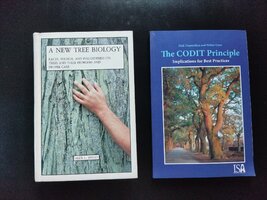
Are you familiar with the CODIT model of tree growth? Your idea wounds a wound. BAD BAD BAD

I;ve seen examples where a flush cut closes faster than a collar cut. BUT!!! There is MUCH more decay from a flush cut. Wound closure is less important.

Never worry about water pooling. Make a proper cut.
 
Wrong.

This idea hasn't been followed since early '80s.

Are you familiar with the CODIT model of tree growth? Your idea wounds a wound. BAD BAD BAD

I;ve seen examples where a flush cut closes faster than a collar cut. BUT!!! There is MUCH more decay from a flush cut. Wound closure is less important.

Never worry about water pooling. Make a proper cut.
I understand. I have seen first hand on an ornamental cherry that a closer to proper collar cut, healed over much sooner than the other closer to flush cut. But, yea, it probably might have natural variables, that a flush cut, can, in some cases heal over faster.
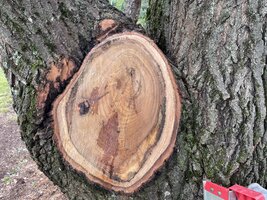
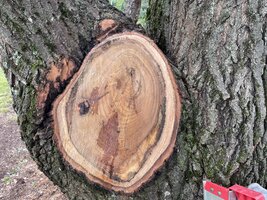
This dead branch was more like a leader than a branch, surprisingly it was not that rotten at the base, and had a full live perimeter, even though 3feet out on this leader, the cambium was complete dead, and the bark could be picked off.

I did use compressed air to thoroughly blowout any debris in the few rotten areas of the cut surface, and the crevasses around the leader union to the tree and the other leader, before I applied the oil.
Then saturated the cut surface in an oil, to reduce water ingress, and bug attraction.
The multiple chainsaw wood shavings on the cut, fell from above, where the tree was pruned.

I did kinda leave a collar on the base of this dead leader.

It took 2 long failed uploads to finally upload this photo, just saying. I haven't been told why my connection to this site is severely slow.


IMG_3620.JPG
 

Attachments

  • IMG_3620.JPG
    IMG_3620.JPG
    1.3 MB · Views: 4
Last edited:
The light colored ring of wood is the only part of the limb that is live. The cut you made isn't proper. You should have just cut off the dead stub and not cut the live wood.

Whatever oil you used is not likely to have any affect on decay.When I started in arborculture in the early 70's the idea was to paint, etc. By early 80's things changed. Your ideas are 40+ years out of date. You should be studying modern arborculture. There are plenty of good information sites on the Net.
 
@Tom Dunlap
I searched online and couldn't find a similar instance where a cut like this was described, diagramed or pictured.
I will monitor this cut, as I do the trees and other low cuts I've made.
And, make future cuts according to how you have described.

Does anyone on this forum, have diagrams or pictures showing a similar situation, on how to cut this?
And, a picture showing how it has started to seal, or has completely sealed?
 
Alex Shigo took pictures of the "after" results from a pretty wide variety of cuts.

He laid a very strong foundation for the work we do today. Every now and then someone will say 'this just seems like a better way to make such and such cut'. My advise is to look up Shigo's work, see if he documented that cut and what the results were. If he didn't, take pics, monitor then remove and saw it in half are we can all learn from it.
 

New threads New posts

Kask Stihl NORTHEASTERN Arborists Wesspur TreeStuff.com Teufelberger Westminster X-Rigging Teufelberger
Back
Top Bottom