My scary black cherry removal

Woodwork

Participating member
Location
Tidewater
Hey, guys,

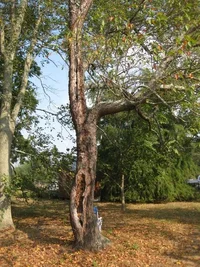
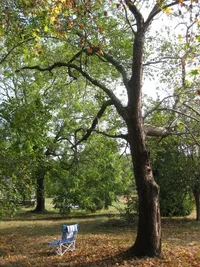
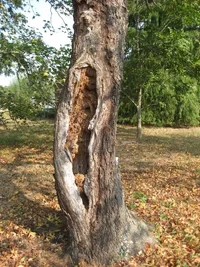
I have a diseased and lightning-wrecked 20" DBH black cherry I need to take down in the yard, as it has some dead limbs and a massive canker going most of the way through. It's becoming a hazard. I'm not an arborist but plan to take it down myself.

I want to fall it toward the south, meaning I would need to cut a wedge out of the side with the canker.

My initial plan is to climb it with lanyard and srt to remove a couple of overhead limbs (so they don't fall on me while I'm falling the tree), then tie on a pulling rope up high, and have a friend pull on the rope when I want it to go down when I'm falling it.

Does this sound like a reasonable plan to you guys?

Alternately, would you suggest removing most of the limbs and then blocking most of it down to help prevent chairing / other chaos if I fall it largely intact? (Either way, I was planning to remove the dead limbs first.)

Pics below...TIA for any advice.

Jeff
south 1.jpg

south 2.jpg

east.jpg
west.jpg
 
It's difficult to tell how much lean this tree has but it doesn't look excessive. If the lean is something that can be overcome by pulling with a rope, there is no need to complicate matters by climbing to remove a few dead limbs. Install the pull line using a throw line and you should be good to go. You do not need to isolate the pull line at the top of the tree. You can basal tie it and still gain the benefit of a high leverage point. The only reason to climb this tree might be to reduce weight so it is possible to pull it over with a rope. Keep in mind, your hinge will be highly compromised pretty much anywhere you decide to make the notch. This will affect how much lean you can overcome with confidence.
 
The pics may not be showing the entire picture, but it looks like the COG is on the side of the tree where the chair is. I would fell that way, just to the right of the chair and that little small tree in front of the chair. I wouldn't climb it. If you're scared those limbs will fall when your cutting and pulling, then just throw a rope over them first and try to pull them down first. If they are solid, then you should be able to fell without them coming down. Cut your notch low where there's maybe more wood all around. Cut notch without going to deep so you can have as much hinge wood as possible without a big gap in the middle of the hinge. When you make your back cut, do a bore cut, set up your hinge, allow for more hinge material due to possible hole in hinge and the weakened wood, wedge each side, then have your guy pull steady while you finish out the back of the cut. Let me add, on bore cuts on good wood, you can leave a tiny strap. On this tree, I would leave a little more strap wood just to be safe, then cut the strap like normal.
 
Last edited:
Thanks, guys, this all sounds like great advice.

The main dead limb I'm concerned about is up high and directly overhead from where I'll be cutting but maybe it's not that much of a hazard yet. (I'll try to add a pic of it tomorrow.) Good idea on trying to pull the dead limbs down with a rope, I hadn't thought of that.

I sure see a lot of old cherry snags in the woods around here and they look like they've been there forever, so maybe these cherries last longer than I realize before they start falling down.

Been hoping for 20 years this tree would straighten up and fly right but I think it's a lost cause. Will transplant a nice pecan I have all ready to go in its place...

I appreciate your help and will let you know how it goes.
 
Last edited:
The pics may not be showing the entire picture, but it looks like the COG is on the side of the tree where the chair is. I would fell that way, just to the right of the chair and that little small tree in front of the chair. I wouldn't climb it. If you're scared those limbs will fall when your cutting and pulling, then just throw a rope over them first and try to pull them down first. If they are solid, then you should be able to fell without them coming down. Cut your notch low where there's maybe more wood all around. Cut notch without going to deep so you can have as much hinge wood as possible without a big gap in the middle of the hinge. When you make your back cut, do a bore cut, set up your hinge, allow for more hinge material due to possible hole in hinge and the weakened wood, wedge each side, then have your guy pull steady while you finish out the back of the cut. Let me add, on bore cuts on good wood, you can leave a tiny strap. On this tree, I would leave a little more strap wood just to be safe, then cut the strap like normal.

Can also step cut the strap (lower than bore cut) like when release cutting a forward leaner, then walk around to pull rope to pull tree over so aren’t any where near it if hinge wood compromised, or risk of limbs dropping
 
Last edited:
I'd probably just climb it beca
Thanks, guys, this all sounds like great advice.

The main dead limb I'm concerned about is up high and directly overhead from where I'll be cutting but maybe it's not that much of a hazard yet. (I'll try to add a pic of it tomorrow.) Good idea on trying to pull the dead limbs down with a rope, I hadn't thought of that.

I sure see a lot of old cherry snags in the woods around here and they look like they've been there forever, so maybe these cherries last longer than I realize before they start falling down.

Been hoping for 20 years this tree would straighten up and fly right but I think it's a lost cause. Will transplant a nice pecan I have all ready to go in its place...

I appreciate your help and will let you know how it goes.
I have wasted a lot of time trying to break dead out of cherry trees with a throwline.
They can really hold some of it.
 

New threads New posts

Kask Stihl NORTHEASTERN Arborists Wesspur TreeStuff.com Teufelberger Westminster X-Rigging Teufelberger
Back
Top Bottom