TheTreeSpyder
Branched out member
- Location
- Florida>>> USA
HNY to all !
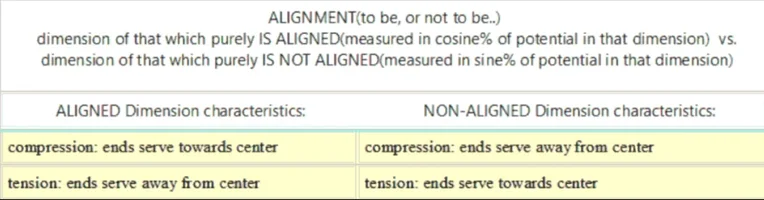
All the examples shown in drawings and real life are this same principle of when within the same system: If in the same UNIQUE Dimension or not; to cover all possibilities. Mostly, each is a mix of the 2 extremes of purely in the SAME UNIQUE Dimension, or purely NOT (as parent extremes). cos:sin ratio shows how much length, force is expressed in Same Dimension vs not. The chart of ALIGNED and NON-ALIGNED shows this goes beyond cos:sin definitions.
Really all this is as 'simple' and (yet) complete as a Zen riddle..
pic: same chart as above post#18
Either something of the same system/space is :
•in the same unique benchmark dimension(cos force and of cos patterns in left column of above chart)
or
•it is not(sin force and of sin patterns in right column of above chart)
To Be or NOT To Be is the question( yin/yang) and then the sum total of both's expressions in a system!
For rigids/non flexibles another slice of the that same previous chart focuses another category of forces in:
•the unique aligned dimension of force in the system/space(left side effects of chart at cos value)
or
•the not aligned parts(right side of chart effects at sin value)
(from: same chart referenced as from above post#18)

Again the cos/aligned dimension carries 1 force and force pattern;
while the sin /not aligned Dimension carries the other force(s) and pattern.
Failure happens when either Dimension forces are greater than that dimension's support capacity(usually from cross dimension effects). The crossing dimension forces can not be carried by the inline capacity NOR pattern(and vice versa). This makes all the difference..
Notice in the simple models we have only 3 types of how linear input forces can be expressed:
•tension only (so is of the aligned Dimension in the system)
•compression only (so is of the aligned Dimension in the system)
•both at once (so is of the crossing Dimension in the system)
So even these force patterns are per Dimension, like cos:sin ratio; and the leveraged length clip of chart shown above. Everything is about if in the same Unique Dimension of the system or not (and how much so of each for cos:sin) as key factors. This defines how knots, rigging, hinging, leveraging, reaching etc. etc. plays out.
Relating to things by Dimension , it’s attributes including cos:sin value pair of how much of Same vs. Not Dimensions; has made me a better rigger, driver, knottier, worker etc. as i do things more purposefully to these powers, L-earn from that, and can see reflections of the same common principle into the other skills. For they are all facets/examples of this same lesson to me. So the knowledge, familiarity in one can be reflected into others; as they each re-affirm as echo each other’s same root functions in this model. To the point of seeing how could it be any different in rope, when even stars and microbes follow this pattern.
All the examples shown in drawings and real life are this same principle of when within the same system: If in the same UNIQUE Dimension or not; to cover all possibilities. Mostly, each is a mix of the 2 extremes of purely in the SAME UNIQUE Dimension, or purely NOT (as parent extremes). cos:sin ratio shows how much length, force is expressed in Same Dimension vs not. The chart of ALIGNED and NON-ALIGNED shows this goes beyond cos:sin definitions.
Really all this is as 'simple' and (yet) complete as a Zen riddle..
pic: same chart as above post#18
Either something of the same system/space is :
•in the same unique benchmark dimension(cos force and of cos patterns in left column of above chart)
or
•it is not(sin force and of sin patterns in right column of above chart)
To Be or NOT To Be is the question( yin/yang) and then the sum total of both's expressions in a system!
For rigids/non flexibles another slice of the that same previous chart focuses another category of forces in:
•the unique aligned dimension of force in the system/space(left side effects of chart at cos value)
or
•the not aligned parts(right side of chart effects at sin value)
(from: same chart referenced as from above post#18)
Again the cos/aligned dimension carries 1 force and force pattern;
while the sin /not aligned Dimension carries the other force(s) and pattern.
Failure happens when either Dimension forces are greater than that dimension's support capacity(usually from cross dimension effects). The crossing dimension forces can not be carried by the inline capacity NOR pattern(and vice versa). This makes all the difference..
Notice in the simple models we have only 3 types of how linear input forces can be expressed:
•tension only (so is of the aligned Dimension in the system)
•compression only (so is of the aligned Dimension in the system)
•both at once (so is of the crossing Dimension in the system)
So even these force patterns are per Dimension, like cos:sin ratio; and the leveraged length clip of chart shown above. Everything is about if in the same Unique Dimension of the system or not (and how much so of each for cos:sin) as key factors. This defines how knots, rigging, hinging, leveraging, reaching etc. etc. plays out.
Relating to things by Dimension , it’s attributes including cos:sin value pair of how much of Same vs. Not Dimensions; has made me a better rigger, driver, knottier, worker etc. as i do things more purposefully to these powers, L-earn from that, and can see reflections of the same common principle into the other skills. For they are all facets/examples of this same lesson to me. So the knowledge, familiarity in one can be reflected into others; as they each re-affirm as echo each other’s same root functions in this model. To the point of seeing how could it be any different in rope, when even stars and microbes follow this pattern.