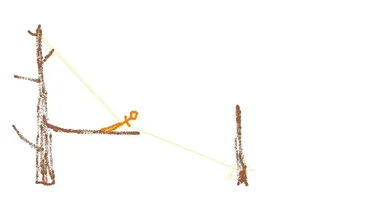
Limb walking and limb loading...

First, this isn't coming from an experienced limb walker - well, I have done limb walks and seen them done, but this is more of a statement/inquiry based on some of my observations from the limb walks I've done and seen others do.

I had been under the impression that the 'proper' limb walk kept your weight on a climbing line tied high in the tree and perhaps shared with a 'balance' line on another limb. But, my observations indicate that isn't true at all.

I've seen pics of limb walks with slack in the rope(s). That means the entire weight of the climber is supported fully by the limb. Further, even if we attempt to keep our weight supported by the rope(s) as much as possible, all it takes is one motion, say a lean, a position adjustment, a step, to pretty much relief all tension in the rope(s) which in turn applies full weight to the limb.

If we accept that can happen, what we are conceding is that if we limb walk, there will very likely be times that the limb has to support our full weight. Now, compare that to attaching a climbing rope to the same point on the limb we've walked to on the limb, but instead we are going to climb up to that point on the limb. Would anyone climb on a rope attached that far out on a limb?

But wouldn't it be every bit as sensible as walking out on a limb to the same point? Granted, when we walk we have rope backup if the limb breaks, but who has ever walked out on a limb knowing it was likely break? Nobody! So when we walk out the limb we do so expecting it not to fail. But when we think about climbing up a rope attached to the same point on the limb, we tend not to do that at all.

What's the difference?

I guess what I'm asking is, when we limb walk are we relying on the limb to support our full weight or are we thinking we can keep our rope(s) so tight that they support our weight all the time?
 
[ QUOTE ]

I guess what I'm asking is, when we limb walk are we relying on the limb to support our full weight or are we thinking we can keep our rope(s) so tight that they support our weight all the time?

[/ QUOTE ]

Too many variables to reduce to a binary equation, but the simple answer is that TIP should be high enough to share load with the limb.

Your other question something to the effect of "Why not just climb up on the outer limb if you can walk on it?" brings to mind the rec climber who broke his back (the climber has recovered) when he tied into the outer third approximately of a red oak limb that looked strong enough and that he had previously limb walked on (that was his "proof" that it was safe enough). The problem besides that he shouldn't have tied that far out on the branch under any circumstances was that there was a flaw (rot) in the limb that he didn't recognize. The advantage when you're limb walking is that if you have the assessment skills you're examining the limb closely as you're going out. The disadvantage of climbing up on an outer limb TIP from the ground is you're not going to be able to see structural flaws from the ground.
-moss
 
moss,
True, but misses the point. The point I'm after is do we actually fully load the limb with our weight at times?

Granted that if a limb broke we were climbing on we could be seriously injured, but the same is true if the limb we are way out on walking breaks. Because of all the variables, it'd be difficult to say which might produce the more serious injury. E.g. if the limb broke and left a sharp 'spear', being swung back into the tree and gored by the stub might be as serious as falling some distance to the ground. Or just slamming into a solid tree could be just as damaging as falling.

For clarity, I wasn't suggesting we should/could climb on a limb at the same point we walk on it - that was just a comparison of how we may be trusting the limb in one situation to hold our entire weight and not in another.

What I'm actually asking, can we guarantee that every second we are on a limb walk that our rope(s) support most of our weight, or are there times where motion/manipulation inadvertantly applies our full weight to the limb?
 
Your TIP point must be able to withstand a shock load. Say the limb your walking on breaks out from underneath you while you have slack on you line. You are going to put an immense load on your tie in point Like in the 1000 lbs + range. when your walking on a limb all its got to take is however much percentage of your weight you think its going to take. For me, im pretty light so I can stand on little bitty stuff. but I wouldnt want to fall or jump on it.
 
treebing,

Shock loading the TIP aside, when you say, "when your walking on a limb all its got to take is however much percentage of your weight you think its going to take.", how does one control the amount of weight on the limb? Is there ever a time/situation where you cannot maintain tension in the rope(s)? The instant tension is relieved from the rope(s), your full weight goes on the limb.

What I'm asking, in a limb walk, what are we trusting exactly - that the limb will hold our entire weight if we should happen to get slack in the rope(s)? Or, that we will not under any circumstances, ever allow slack to get in our ropes?
 
I think the goal is, don't hurt the limb.

If you accidentally put too much weight on it, you screwed up or misjudged. You can be extremely light by staying on the life line and working your rope and body angle. If you slack your rope you compensate by falling off to one side and staying on the rope... sometimes, they break.

On a big limbs you're trusting the limb, on small ones, your rope and your ability to dance around lightly.
 
I think part of your question revolves around the discrepancies of the highly publicized and filmed competitions as opposed to the almost never seen everyday work scenario.

In a comp there is almost always a section or route designed to display agility and balance with a predetermined margin of safety.

In tree trimming scenarios, if there is any doubt that the limb you are walking can survive the weight you take measures to protect that limb. The homeowner quickly becomes disillusioned when you start tearing off portions of their tree from body weight.

Dave
 
[ QUOTE ]
I think the goal is, don't hurt the limb....

[/ QUOTE ]
Or hurt yourself!

[ QUOTE ]
...If you accidentally put too much weight on it, you screwed up or misjudged...

[/ QUOTE ]That's what scares me and directly addresses the issue that concerns me.

This implies if we are less than perfect we can break the limb and I think it would be reasonable to conclude that we also jeopordize ourself. This would mean that if a shoe lace has come untied and we step on it and have to compensate, we could momentarily load the limb.

[ QUOTE ]
...You can be extremely light by staying on the life line and working your rope and body angle. If you slack your rope you compensate by falling off to one side and staying on the rope... sometimes, they break.

On a big limbs you're trusting the limb, on small ones, your rope and your ability to dance around lightly.

[/ QUOTE ]
That makes sense - I wish I had your confidence.

I'm having problems with how we really know how much weight is on our rope and how much is on the limb. I realize in some situations it is obvious, but in others it may not be.

E.g. I think we would all agree that to keep tension in our life line while limb walking, we must lean hard against the rope. So how much weight does the lean put in our rope and how much must be supported by the limb? How do we know?

I think most, go by experience; probably starting out on big limbs and developing a feel as walks are done on smaller and smaller limbs.

The last time I did a limb walk, I leaned hard against my rope until a foot slipped. I realized I had lost the tension in my rope so most of my weight was on the limb. Nothing happened, but it did get me thinking as evident from this thread.

I suppose the work-around answer is to simply work on large limbs and work down to the smaller ones. Of course, that doesn't mean we aren't loading a limb more than we think.
 
Ron,

This will depend on the situation. I limbwalk on Douglas-fir limbs at times with most of my weight on the climbline. I've also limbwalked on a 1.5' thick branch (at the trunk) on a huge walnut. The limb extended about 50'. I was able to just walk around on it without concern of it breaking (for the most part) as I deadwooded it. As you go farther and farther out on the limb, you are gradually loading it more and more. In the case of a removal, where you don't have to worry about the limb breaking (from a tree protection viewpoint), you will get noise-cues that the limb is creaking under strain. Whereas with the extended-out-the-limb TIP, you are committed. You will tend to bounce a little as you climb, subjecting the limb to greater forces, with all your eggs in one basket.

When limbwalking with overhead support, you lean away from the limb, pushing the limb toward the trunk somewhat, compressing the limb down the length, whereas with the extended TIP the force will be more perpendicular to the limb.

I think that the answer is, IT DEPENDS.

If you need to rest your whole weight onto the limb, ease off of the climbline support onto the branch, listening without your hearing protection in place for any noise that could precede cracking of the limb.

As for worrying about the pendulum swing back into a spear-stub or the trunk itself, I have had the groundman take my running end/ tail of the rope and walk it out farther from the trunk and be ready to do a quick trunk wrap on another tree to keep me from going for the full swing toward the potential broken branch/ trunk.
 

Attachments

  • 199643-limbwalkwithfall-arrestprotect-ish.webp
    199643-limbwalkwithfall-arrestprotect-ish.webp
    26.4 KB · Views: 99
southsoundtree,

I think that's pretty much what I was looking for. Your comments about 'clues' i.e. the sounds of stress, is right on - I hadn't thought about that. It's funny in a way, in all my handgun training we were taught to LISTEN for clues. I should have connected those two.

The groundman controlling the down line to protect you is another excellent thought.
 
One thing to think about is that if you are using a friction hitch, the climber would have to grab both lines above him/ her so that the hitch doesn't get tended by the micropulley. If you are in this situation, you can also just have a tagline attached to a solid point on your harness, which would go to the ground. I've used this tagline to pull me into an adjacent tree when I've needed to transfer to work on another tree.

I've used a GriGri on SRT or DdRT for the limbwalk with the groundman-standing end safety, as the downward pull on the GG locks it off, instead of tending it.
 
Also it's a good idea to know which spieces of tree can take certain weights,on live oaks,i'll slack my line until i get out till the end just ask Scotty olson,unless its really rotten because they can take it usually,however sycamores and maples in my area are not to be trusted like oaks,niether are certain pines,it all comes down to good judgement and listening to those with more experiance.
 
The way i keep my weight off the limb when limb walking is by trying to get horizontal or flat. i'll pull the limb up to me, more than putting weight on them, and pull myself out the limb. Then to work i lanyard in keeping the limb pulled towards me. For most limbs i walk out to the tips first and then do my thinning or deadwooding on the way back in. That way i keep all those footholds to help with the limb walk.

You really learn and can see how well you do at keeping your weight off a limb during competition. Competition in my opinion is underrated by many, i know personally i have learned a lot from the little i've competed.

Here is a good example of a climber at competition getting horizontal or flat.

7835_728125743129_11802250_41191012_1103927_n.jpg
 
I was limb walking on a 4 " maple branch. the limb was rotten inside, and I didnt notice. it snapped, and I swung towards the stub, narrowly avoiding it and the tree. how can this be prevented? is it just a matter of knowing whether it can hold you or not?
 
the answer to this will be found in the art of climbing.

Climbers should have been taught to do assessments as they move through the tree. Start at the ground and continue during the ascent. By looking at the bottoms of limbs more information can be gathered about the strength of the limb.

Unless a climber jumps or runs out onto a limb their weight is gradually applied. Step by step the assessment changes. If the limb flexes, or doesn't, in an expected way the climber will change their approach...or retreat.

In dicey exposures it's imperative to consider 'what if' at each step. Slip, breakage, fall...where does the climber swing?

I'll do bounce tests in the tree at times. Secure myself on my rope, maybe add a lanyard, then give the limb a bounce...or lean out and bounce with one foot before committing.

Growing up in Minnesota taught me how to test thin ice. We did the same thing. The ice was generally thicker along shore. As we skated/walked out from shore we would stomp a bit and see if the ice cracked. We had a pretty good idea when we were going to punch through and get a wet foot :)
 
It's all about positioning, like countryboypa said.

Remember, you can negatively load a limb that you go out on by getting the right triangulation going on between climbline/TIP and flipline/lanyard attachment.

This technique can get you out to prune 1" tips.

Also demonstrated in the plumb bob station at a work climb in competition.
 
I've worked on some limbs I knew couldn't hold me. Dead rotten maple no way it was safe to limb walk so I put in a redirect above that limb not quite half way out its length. Then between me pushing off and a couple grounds guys pulling i could swing out parallel to the limb and lanyard or put in a sling for a foot hold. If your sketched out about a limb stop and take a minute to think out side the box there's always a plan B.

Another time i had a split ash section i had to limb walk to tip tie just about ready to tear off. I but ma on a butt line snuged it up an repeated that as i went out i use 3 lines on a 20' limb then when i got back to the tree used the tip support line as a pull line to steer and let it down on the butt line. Being slow and tedious doesn't make you a bad climber if nothing is broke and everyone walks away using a little extra rigging is ok.

Have fun and be safe
 
I am a rec climber. Have not done much limb walking. Recently I took a nasty swing on a limb walk (with experienced supervision.) Now I am hyper aware of the high stakes. This thread has been super helpful.


Sent from my iPhone using Tapatalk
 
moss,
True, but misses the point. The point I'm after is do we actually fully load the limb with our weight at times?
I think @moss was very on point considering the real world aspects of the question. Because of the nature of the question, he probably did not want to give a simple "yes" answer. Think of this, if he answered "yes we weight the limb fully at times", and you interpret that as you can throw a rope over the limb and start ascending because you think it's the same thing, then that would be very dangerous for you. @moss was just being thorough and trying to head off a potentially deadly mistake because he's been doing this a long time and knows how climber's minds work. ;)

Here are some points to consider:
- Limbs have defects. Some you can't see from ground, so it's impossible to assess whether I'd weight it there unless I've gone up from another TIP, then walked out the limb and looked at it.
- Ascending puts dynamic loads on limb that can significantly exceed those generated by a careful limbwalker.
- A limb breaking is not an "all or none" "instantaneous" thing. It is a process, which means a series a minute steps that don't all take place at once, and can be halted before the final cascade of events. If your truly interested, your state engineering school teaches courses in material properties, material dynamics, and organic chemistry, all of which will provide a good foundation for understanding this process.
- Yes, I will walk on a limb that could knowingly fail - one that I would NEVER throw a line over and ascend on - but I do it carefully, and only stay there long enough to get a rigging line on, or get a cut made.
 
Interesting history. I tangled with original poster Ron quite a bit on a rec climbing forum back in the day. He was not likely going to hear my answer no matter what I said. I never knew what was behind his attitude, might have been a "I'm a smart engineer, I can figure anything out" sort of guy vs. fairly logical/analytical but more intuitive and less math credentialed me.

For the climber who recently fell off a limb walk there are simple ways to mitigate. As Derrick "CountryBoy" mentioned, getting low and more horizontal can be key especially when you're out on the tips which absolutely will not hold you otherwise. I rarely walk on top of a limb unless it's a big live oak or white oak horizontal fatty. I'm mostly feet on the side or upper third of a limb, opposing the direction of load from the TIP. It's rare for a TIP to be directly inline with your limbwalk, conifers more likely. Even so you can find the subtle directional angle to the side and work it to advantage. For inclined limbs I make sling runner girthed footholds to capture progress or help maintain strong positioning running a saw or using a hand saw. Another good strategy is to choke my lanyard ahead of me as I go to prevent swing back as I progress. It's possible to choke safely, any of you can figure out a way that meets your safety requirements. This situation is what led me to see the value of choking my lanyard SRS mode and has led me to using it in many other advancing and positioning situations horizontal, vertical and in-between canopy movement.
-AJ
 

New threads New posts

Back
Top Bottom