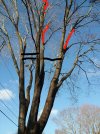
large split in Maple, is it appropriate for support?

dspacio

Branched out member
Location
Narragansett Bay
Greeting folks,

I was called about a maple tree that is splitting, 20220119_150100.jpg
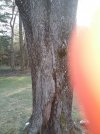
This just opened up recently, and gotten worse in a few windy storms. The bark at the bottom just released too.
They called asking my opinion and whether I can cable it.
The left side of this photo aims toward the house. I told them it certainly wants to be reduced, and I feel a support system would work. I am thinking to remove the entire limb from the lowest right of this picture (the one departing about the middle of the picture vertically) (this photo is from other side of tree). 20220119_150802.jpg
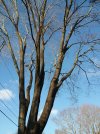
Then I would support the two leads shown on the right here, back to the lead on the left. I used the Tree Guard system from Wesspur before, with rope, that is what I am thinking of.

My question is:
Looking at the length of that crack, is cabling and weight reduction an appropriate exercise?

I know this is speculative territory, I really appreciate any insight from those of you with more experience. I have helped install cables back in the day, but never got to follow up. And I have cut out snapped cables with bolt cutters (funny enough, I did that yesterday), but it's still a bit of mystery what really works when it comes to cabling.

Thank you, this tree is in the center of their front yard, so it's a tree they are definitely hoping to do the best for.
 
As long as there is good solid wood in there, I would be comfortable cabling that tree. However, I would use at least one or two steel cables myself, and I would suggest a couple bracing rods through the trunk as well. The rods may even add enough support to allow that wound wood to knit itself together, adding even more support over time.

Reducing some of those leaders is definitely a good thing to do as well.
 
Ditto on bracing rods for this tree, plus cabling. Seems like it may be worth keeping, but it depends on targets and clients for sure.

My understanding of the mechanics of leverage is that reducing height at the very top of a lead has an outsized effect on the reduction of leverage on the overall lead. So I would probably not choose to remove that lower limb that begins in the middle of the frame but rather dance at the very top and make some tip weight reduction cuts.
 
Thank you ~
Question : @Reach , why would you lean toward steel cable over the rope system? We are coastal here, and my experience is whenever I find cables, they are falling apart with salty air corrosion. However, I recognize that this is a tried and true method, maybe I am just not seeing rope systems falling apart because they aren't out there! I am curious.
I am planning on two ropes, 9000 pounds each.
I really like the concept of non-invasive cabling, for obvious reasons.

Anyone know where to find a 36" drill bit? I have some research to do. Thanks for the input around through-bolting it. I haven't helped do that on a tree of this size, only seen that on smaller fruit trees.

great point @Stumpsprouts , from a side view, that branch is very long, reaching, North branch. My sense is that it's catching a lot of wind. The split is asymmetrical, and it's that side that the crack is going down. Also, if the thing does go, that whole branch is what would probably strike the house, the main trunk is aiming a bit to the side.

I totally agree with your assessment, bringing the tips back, especially those that look to be catching wind, is a definite good move.

I feel like I have seen trees with evidence of splits this size that have recovered, and the tree is definitely stout and looks healthy.

Thanks again. Glad to have your insights.
 
Bear in mind the species Norway maple is fairly weak-wooded, it's more structurally degraded by hollowing than tougher wood species like oak and hickory for example. Not to mention what looks like zero structural connection between the two sides of the tree right into the root plate. Would require a more aggressive/strategic crown reduction than you'd do for say a white oak, I think.
-AJ
 
great point @Stumpsprouts , from a side view, that branch is very long, reaching, North branch. My sense is that it's catching a lot of wind. The split is asymmetrical, and it's that side that the crack is going down. Also, if the thing does go, that whole branch is what would probably strike the house, the main trunk is aiming a bit to the side.
Copy that. Always hard to see what you can see in real life. Sounds like you have good instincts.
 
Thank you ~
Question : @Reach , why would you lean toward steel cable over the rope system? We are coastal here, and my experience is whenever I find cables, they are falling apart with salty air corrosion. However, I recognize that this is a tried and true method, maybe I am just not seeing rope systems falling apart because they aren't out there! I am curious.
I am planning on two ropes, 9000 pounds each.
I really like the concept of non-invasive cabling, for obvious reasons.
I would lean towards steel on that tree because the support it needs is major structural support, this tree is never going to grow much, if any, stronger on its own. If it would grow stronger, I would be more willing to use a dynamic system, which would not handicap it from future strengthening.

Even with being coastal, I would expect steel to still last a number of years, and any cabling system should be inspected annually, so you can watch for it to rust.

Maybe someone else knows for sure, but I would guess that UV degradation of the rope in a dynamic system would be at least as fast as rust on a steel cable.
 
Hard Advocate for Norway maple destruction imo. If they insist id do 2 cables and probably a thru rod or 2.

Do you have a 1/2" drive drill and ship Auger bits long enough? If not, the cost to buy the materials and tools would likely be about the same as removal.

Galvanized EHS cable holds up well on the coast here, I wouldn't worry about that. That Norway is a terminal patient without intervention, that makes metal hardware the better choice in My mind.
 
I'll take a stab - for conversation, not claiming to have a "final answer".

Two things that I haven't seen posted yet:
1) There is not a great place to install the cables. Ideally, you should measure from the top of the fork to the top of the tree. Put the cable 2/3 of that height. For example...if it is 60', the cables should be at 40'. However, it looks like the branches get too thin that high up? That means the cable (or rope) will be lower than ideal.
2) There are a other bad forks in that tree. Typical of Norway maple. Consider the load on those when you are pruning.

I'd at least take off the right-most red branch (all the way down to that ugly V-crotch. I wouldn't worry about the branch below that...or maybe I'd take half of that one.

I'd probably take the middle red line. Maybe down to the bottom of the red line if that branch coming off is big enough to make that a good cut. Maybe I'd change my mind seeing the tree in person?

Maybe I'd take something above the question mark if there is another co-dominate fork up there.

Probably cable where the black lines are. The lower one is from the left to right (not contacting the middle - the dotted line is supposed to represent that). Unless the wood is large enough to hold them higher up - but the left side looks sketch and Norway maple is not real strong.

+1 on bracing rods - you are looking at needing at least 3 rods with a split already there. Check the ISA BMP for cabling and bracing to see what sizes of hardware to use. You are going to need something longer than 36". There should be a rod above the "V".


20220119_150802edit.jpg
 
Last edited:
For an active split inclusion like that steel is the only ANSI acceptable option. Best practice would involve a through bolt for every 18-24" of split through the stem. Plus probably multiple cables above. Best practice would also call for reduction. $ound$ expen$ive. All that for a Norway Maple? By powerlines? How close is a significant target (house)?
 
As to cable or rope...the question is really static or dynamic.

Because we are bracing below, I think we want static system up above as well. (I see @KentuckySawyer piped in while I was typing as being the ANSI standard on that...I honestly don't recall that being in the standard - not second guessing, deferring his knowledge on that).

Because Norway maple is so brittle, I'd probably rather use a dynamic system as it would "shock load" the tree a little less in heavy storms and anything we can to reduce forces on that weak wood, the better. But probably not in this case.

I used to think rope was easier than cable. It is easier to handle (and lower investment to start using it), but cable with Preformed Lines Wedge Grips is easier to install.
 
... $ound$ expen$ive. All that for a Norway Maple? By powerlines? How close is a significant target (house)?
Curious what others would quote that at?
I'm thinking based on 2 pictures - which I would never actually quote from, but this is just for kicks:
+/-$1000 for the pruning
+/- $750 for the cables
+/- $350 for the rods
...and I think it is an all or nothing package. None of those alone will be adequate to help that tree hold together. I do think all three will.

Include in the decision-making equation, the power company may take that tree down if the client asks, so possibly $0 removal.

I don't see that it is my job to "sell" either one to the client. I give them information and let them make a decision. We can help that tree...but do you want to spend $2000+ for a tree that probably doesn't have 15 years left?
 
Thanks again for the quick replies. I am truly concerned about the tree on their house. They have a 5-month old; I mentioned they may want to sleep in a further section of the house on a windy day.

So making a plan pronto is essential and I am grateful for the input.

The tree is quite close to the house, maybe 30 feet away, @KentuckySawyer . It dropped a few fair sized branches recently.

I appreciate the point about the species, @moss , as I was looking and imagining what's going on inside, it will always be weak, and a threat. I mentioned that to them.
She hasn't been sleeping well since it cracked. I also have concerns about the ground (it's a pretty wet, swamp-type area) and root area.

Thanks for the illustration @ATH - this was another concern, available cable places 2/3 up are not robust. That good wood you draw into are maybe halfway from bad union to tips.

They are mini-homesteaders with some chickens and stuff, so encouraging them to plant a fruit tree in it's place would probably go over pretty well. The tree doesn't provide any significant shade advantage. As I sit with it now I am leaning towards this thing being gone.

I will let her know what was discussed over here. I can't say enough how much I appreciate the insights. Thank you~
 
Meh, always a tough conversation to have as a tree lover. Trees have a lifespan tho. Wouldn’t take a chance with a Norway maple unless it had real significance
 
Last edited:
Yea, thanks again for the encouragement. I am drawing up an estimate for the takedown right now.

I noticed a Mother Mary at the base of the tree, it's what I covered with my finger in the photo, an altar for her Mother. I told her I will carve the stump into a true altar;
and we are already talking about fruit trees. I just worked with a guy who cultivates figs and nursery trees.

Feeling way more confident at success with a removal. The only way to guarantee it won't land on their house some day.
 

New threads New posts

Kask Stihl NORTHEASTERN Arborists Wesspur TreeStuff.com Teufelberger Westminster X-Rigging Teufelberger
Back
Top Bottom