[ QUOTE ]
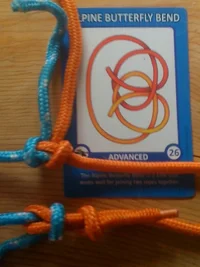
Attached is a picture of alpine butterfly it is a little tricky to tie
good on the offset aspect.
...
I think I like the ashley bend best. Easy to tie considered secure and easy to untie and both tails on same side gives the offset.
[/ QUOTE ]
Neither of these knots is **offset** --both have "collars" around their
loaded ends ("main lines") which will impede movement over a rough
surface. (Yes, tails exit roughly perpendicularly, but that isn't the key
to being offset --knotted part lying entirely to one side of the axis
of tension.)
[ QUOTE ]
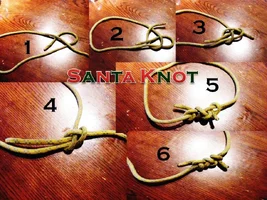
Also picture of sheetbend backed up by slipknot. The slipknot prevents the bight part of the knot pulling through as knud knoggin pointed out as its weakness.
[/ QUOTE ]
Actually, I wasn't so specific --only pointed to Richards's finding of slippage,
which, in fact, he found on both ends, in some cases.
(And, recall that Brion Toss did some testing of 5/32" 12-strand HMPE
cord (Dyneema, I think) in which a double bowline with tail stoppered
slipped by collapsing the eye, material just *flowing* out of the knot
via the double turns (!!).)
[ QUOTE ]
I saw that the overhand bend aka euro death knot that started the discussion reduces strength by 50%.
[/ QUOTE ]
And this matters, how? The indicated applications here (and esp. for the
rockclimbing use of abseil-ends joining) don't need great strength.
*kN*































 Free CEUs: February 05 & March 05 - 'Urban Forestry Today' Webcasts @ Noon (Eastern)








