Knot for joining two lines for an SRT base-tie

southsoundtree

Been here much more than a while
Location
Olympia, WA
What do you use?


In the rare likelihood of needing to use the SRT lowering system at the base of the tree, sometimes joining two lines is required, meaning there is a knot that might jam in a crotch when an emergency situation has arisen.

A lot of knots that are strong/ stable enough for joining two lines are symmetrical, meaning the knot will not roll out of the way when crossing over a limb.

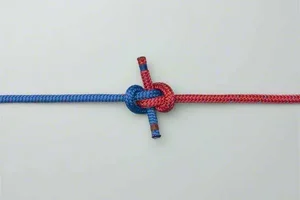
In rock climbing circles, I think the EDK (European Death Knot) is somewhat accepted as strong enough and snag-resistant due to its asymmetrical nature.

When I'm rock rappelling, I use a EDK with a second overhand snugged right up against the first. Thought this might be a winner for SRT, too.

I haven't experimented with trying to pull different knots through canopies, and it may not matter in trees as it does with rock. Dunno.

This was the first testing info I came upon, and it explains it reasonably clearly.
http://user.xmission.com/~tmoyer/testing/EDK.html


Thoughts?
 
I never heard it call the euro death knot I dont really like that name. It is what I use and it was what I was taught on the rock. I will tie another overhand in the tail for good measure, and maybe even three for the hell of it. Easy untie, goes over surfaces and through crotches easier because of its low profile.
 
Be careful of bringing things from rock climbing into trees.

Rock climbing ropes are much more supple and flexible. The EDK will function differently. The tests that I've read over the years all look good...but they are not using arbo ropes.

There are several end to end knots to use. My fav is the double fishermans.
 
It gives me a solid feeling and makes a lot of sense to me. It is true some of these static lines are very stiff. I don't like them because of that. I feel comfortable with it in my poison ivy
 
I also use the flat overhand for joining 2 ropes. I do this with my rock and tree ropes. I don't do this with my caving ropes as they are all older and VERY stiff. But you almost never have to worry about pulling a rope in a cave.
In the event that you are concerned about flat overhand rolling, you could always join the tails with something like a double fishermans, and then in the event of a lower, untie the double fishermans and lower with just the flat overhand. That also means that whoever is doing the lowering knows that this is protocol.
 
How about a sheet bend with a back up knot? it is streamlined and essentially a bowline when joining similar ropes. Common slip knot orients tail with direction of pull.Sheet bend is not usually recommended for lifeline because reverse pull can make the knot roll out and fail.
Backup seems to eliminate that as I see it. Seems preferable to an overhand knot ? (aka Euro death knot)
 
A proper sheet bend is tied with two different sized ropes. Clifford Ashley, and other knotters, have written why, I don't have the motivation to research this again.

Zepplin Bend has favor with some people
Graeme just mentioned the Hunter's bend in another thread.

If a knot requires a backup then I would think really hard about even using the knot.

From Mark Twain:

"How can you trust a man who wears both a belt and suspenders? The man can't even trust his own pants."

I trust my pants
smile.gif
 
I use the Zeppelin as well when needed.

But, since most of my lines are spliced, I really prefer the splice-splice linked by a small carabiner.

I haven't tried to run it through crotches, but the truth (for me, usually) is that most of the time the crotches are high enough up that by the time the crab would reach it, the climber would be on the ground.

It's good to be prepared with the long line, however you construct it.

However, a separate access line would probably do more good, since if the climber gets hurt, they will more than likely be lanyarded in, in which case you can't lower them unless they are still conscious.
 
[ QUOTE ]
Double Overhand (aka double fishermans) Bend.

Or:

6507515763_1762cc13ca_z.jpg


[/ QUOTE ]

Yea this is what I was planning on going to something like this for SRT. Are there ratings stamped on it? I see luke has some was going to give him a call about them.
 
[ QUOTE ]
A proper sheet bend is tied with two different sized ropes. Clifford Ashley, and other knotters, have written why, I don't have the motivation to research this again.

Zepplin Bend has favor with some people
Graeme just mentioned the Hunter's bend in another thread.

If a knot requires a backup then I would think really hard about even using the knot.

From Mark Twain:

"How can you trust a man who wears both a belt and suspenders? The man can't even trust his own pants."

I trust my pants
smile.gif


[/ QUOTE ]

i hope you weren't referring to me as graeme? my name is tiger i am an arborist from australia, currently residing in vancouver. i'm just an admirer of his work.

i prefer the hunters bend for joining ropes. its easy to tie and unties very easily when its been loaded. plus i like how it looks. haha
 

Attachments

  • 303341-huntersR6.webp
    303341-huntersR6.webp
    11.2 KB · Views: 86
I use a zeplin exclusively if I need to tie a rescuable endless loop for SRT. It unties much nicer than the double fisherman. I do put stopper knots in the tails just as a back up but I can't see it coming out. Used to use bowlines on each end until Mark showed the zeplin in a class.
 
[ QUOTE ]
In rock climbing circles, I think the EDK (European Death Knot) is somewhat accepted as strong enough and snag-resistant due to its asymmetrical nature.

When I'm rock rappelling, I use a EDK with a second overhand snugged right up against the first. Thought this might be a winner for SRT, too.
...
Thoughts?

[/ QUOTE ]

NB: Let's name this knot intelligently (too) :
"Offset Water Knot" (aka "Offset Overhand Bend").
emphasis : O F F S E T -that is the key aspect
(don't use "flat" for this, please (Moyer was supposed
to update his text, but ... ))


I think that you're right on target. Only spare the full
2nd overhand and just tie off the tail of the line
making the (initial) choke at the entry point; tie it off
w/an overhand around the other tail, snug to the knot
--for THIS line is what would need to be prised open for
the knot to "roll", and the stopper, well, stops that.

"strong enough" : right, as though we've EVER seen a knot
that is not, in the sorts of applications under discussion.
Simply, ropes aren't breaking from knots in use.

- - - - - - - - - - - - - - - - - - - - - - - - - - - -

Now, where to begin in chasing misunderstandings ... !?

[ QUOTE ]
I will tie another overhand in the tail for good measure, and maybe even three for the hell of it.


[/ QUOTE ]
Don't tie knots "for the hell of it", tie the one knot
indicated above for the particular *purpose* of that knot,
to preclude "rolling" --prevent it, not accommodate it.
[ QUOTE ]
In the event that you are concerned about [offset] overhand rolling, you could always join the tails with something like a double fishermans ...

[/ QUOTE ]
As with my remark above, give the "back-up" knot more
purpose than merely waiting for failure --make it count
to preventing that failure! Tying off the tails as you
suggest runs a risk of getting this newly formed loop
snagged on something (in addition to adding needless bulk).


[ QUOTE ]
Easy untie, goes over surfaces and through crotches easier because of its low profile.

[/ QUOTE ]
Rather, because it is **offset**, leaving one side that
runs smoothly against a surface.

[ QUOTE ]
Rock climbing ropes are much more supple and flexible.

[/ QUOTE ]
Huh? Rather, to my feel, it is the other way 'round,
but YMMV w/condition of ropes. Still, I think that
one should be able to adequately tighten the offset
water knot
in the ropes of issue. And this is
something QUITE TESTABLE ('quiTEstable') by users
with their own gear, bouncing on the knot; it's not
as though in use it will be expected to sustain greater
loads.

[ QUOTE ]
How about a sheet bend with a back up knot? it is streamlined and essentially a bowline when joining similar ropes.

[/ QUOTE ]
Eh, not so streamlined (even w/o back-up), and not so
much a bowline in mechanics, only in superficial look.

[ QUOTE ]
A proper sheet bend is tied with two different sized ropes.

[/ QUOTE ]
Nonsense! --indeed, some recommend against such use,
which grows more dubious w/size difference.

[ QUOTE ]
If a knot requires a backup then I would think really hard about even using the knot.

[/ QUOTE ]
I feel your pain. OTOH, though, some such combinations
might be just the ticket. E.g., one can read of the
so-called "square fisherman's", by which is meant a
square knot with tails tied off with strangle knots
(showing that "square grapevine." was a better guess);
turning the square knot --somewhat reliable, despite
the Ashley parroting of end-of-world scenarios-- into
the gimmicky thief knot (!) loses surety in the center,
but with the slippage inherent in the thief will better
bring the strangles to snug against this central knot
(which helps keep the tie-offs/back-ups tied),
and the thief ultimately is more easily untied.

[ QUOTE ]
i prefer the hunters bend for joining ropes. its easy to tie and unties very easily when its been loaded.

[/ QUOTE ]
SmitHunter's bend can jam when heavily loaded.
There's a version w/the tails crossing differently
which is more resistant to jamming. But, of the many
known interlocked-overhand bends, this one is on the
low end for jamming resistance. (The "zeppelin" being
one of the most jam-proof.)
[ QUOTE ]
I do put stopper knots in the tails just as a back up but I can't see it coming out.

[/ QUOTE ]
!!!? Whoa, rather than this, just take the tails around
and through a 2nd time. This knot is resistant to coming
loose, but I yet feel some caution about its integrity
if dragged through/among stuff that might snag a bight.

... and so on.


*kN*

 
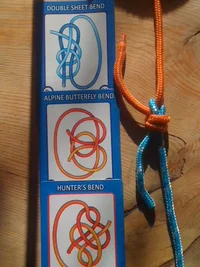
I am curious how a sheet bend is different in function than a bowline? Can someone elaborate on that? I like the similarity to bowline easy to teach and tie. Both require back up knots in critical application. The belt and suspenders idea makes sense though.Double sheet bend is very secure and clean.I have used sheet bend to lengthen tree pulling ropes, slipped double sheet bend is better and unties after loading. I am not endorsing sheet bend for climbing just some observations. Ashleys and zeppelin bend have endorsement for safety.Interestingly both are related to an overhand knot, like the EDK.
I am using SRT primarily to ascend to high TIP,leave in place for rescue access while working off 150' ddrt.I have needed to attach ropes several times. Being aware the bend could jam in a crotch while lowering injured climber is an important safety concern I hadn't really considered.My set up put the connection on the opposite side of the crotch from where I was climbing.
Passing a bend even "streamlined" or "offset" while lowering an injured climber doesn't seem like a good set up. Rope length 3x height of tip for rescue lowering = 225' rope @ 75' tip.
I will buy myself a longer rope soon!
(double sheetbend picture attached)
 

Attachments

  • 305131-bends1.webp
    305131-bends1.webp
    165.4 KB · Views: 65
[ QUOTE ]
double fish for me. if it get's stuck you can pull it out the other direction, no?

[/ QUOTE ]

Yes, Kathy, in normal circumstances, it can be, but in the unlikely scenario of a emergency lower, it can't, and a jammed knot can be a big problem.
 
[ QUOTE ]
I am curious how a sheet bend is different in function than a bowline? Can someone elaborate on that?

[/ QUOTE ]
In classical knot terms, one might regard these knots as being the marriage
of a "loop" (circular part) with a bight (u-shaped part).

Consider the loading : with the eye-knot (bowline), the loop part is loaded
on both ends of the loop (main line & a leg of the eye), and this helps it
contract around the two legs of the bight part (that "rabbit's" path);
whereas in the end-2-end knot, the loop part is unloaded on one
side (its tail). There is considerably more difference in behavior
between the two possible sheet bends (tails on same side, or opposite
--which is generally the less secure) than the corresponding bowlines.

[ QUOTE ]
Double sheet bend is very secure and clean.

[/ QUOTE ]
And yet in Dave Richards's testing of some kernmantle ropes, he found
it to slip in some, at high loads (!). (I just spent some time on the beach
struggling to untie a dbl. sheet bend to an eye, of roughly quarter-inch
braided & laid ropes (resp.); I needed the aid of a piece of driftwood's
broken branch just right-sized for marlinespike duty. (And so now I've
two more "play ropes".)

*kN*
 

New threads New posts

Kask Stihl NORTHEASTERN Arborists Wesspur TreeStuff.com Teufelberger Westminster X-Rigging Teufelberger
Back
Top Bottom