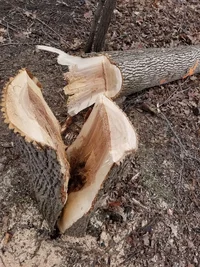
First a disclaimer! We can Armchair Sawyer this till we are blue in the face. None of us were there, a few pics online and a brief description are a start, but by no means comprehensive. Hindsight is always perfect vision and if "if and buts were candy and nuts everyday would be Christmas"
Take this discussion as just that, a discussion, not an attach or criticism of Jimbo66 or anybody else.
Furthermore, I am discussing tree felling from the ground. While the principles may be similar, aerial cuts are different for many reasons.
Lastly, there are two aspects to this conversation Concepts and Application. Concepts guide the application and are general, but relatively constant. Application varies widely for many reason from weather, to wood type, to terrain. A attempt to debate application here in this forum with such a wide audience is futile. As was recently pointed out to me, the internet is a million miles wide, but an inch deep. I respect most of your judgements, but no silver bullet exists for tree felling. There are some very definite wrong ways as there are a plethora of correct ones.
Having said all that...
The face cut (call it what you like) accomplishes 3 things. One, it establishes the front of the hinge. In this case, the apex of the notch forms the front of the hinge. In doing this it also gives the tree room to move on the hinge. Think of the face cut as the space in front of a door. Without the space the door cannot swing on the hinge. This space is the second thing a face cut provides. When the faces meet, the tree either stops (rare) or the hinge breaks (this is the plan!) Third, the face cut removes a section of support from the tree. I equate it to breaking one leg off of an empty 4 legged table. The table does not fall, but if weighted or influenced it is most likely to tip toward the missing leg. Of course there are many variables and a tree with lean will always go with lean unless influenced by something else be it gravity, mechanical advantage, or simple brute force. Suffice to say that the face cut removes a section of support or removes wood fiber so there is room for the tree to be influenced in a specified direction.
A deep face cut (defined as a cut with the apex or front of the hinge beyond the center of gravity of the tree) is akin to breaking two legs off our hypothetical 4 leg table. Break two legs and the table begins to fall, unless acted on by something. So in effect when it comes to tree felling, any face cut less than even with the center of gravity of the tree is going to meet the concept, but not all applications. There are reasons to have a shallow face cut. Small trees, leaving room to bore cut, preserving butt wood (logging), positions as much of the hinge as possible in sap wood (live trees of course) as this wood will "bend" better in most cases. There are conversely reasons to cut deeper. Influence lean, bypass defects or rot, increase hinge length.
The concept remains the same, the applications very different. Guidelines for proper face cut depth (or hinge positioning because that is what we are really discussing) can vary. Rico mentioned 1/4 . Back in the day my Father told me 1/3. Neither are wrong. For training and accuracy I refer to percentages The issue with 1/4, 1/3 or whatnot is that not all trees are round! Depending on felling direction 1/3 of the way in might be drastically different on the same tree. Giving a percentage smooths this out. 80% is an excellent starting point for the cutter to var as application dictates.
The concept of tree felling is this. The face cut, used in conjunction with a back cut crates a predictable weak point. When stressed (by whatever means, gravity, MA, wind) the tree will fail at it's weakest point. If the felling cut is not the weakest point, the tree will fail elsewhere.
In CmJ's case with the Cherry there I theorize that after it was was bored too much hold on the trigger could caused the final result. The same could be said for the hinge. If too thick the force that pulled it over was not enough to bend a think hinge, but obviously enough to cause failure at a weaker point. Rico's recommendation of a deep face may be spot on. I disagree however, seems to me the hinge thickness was excessive for the diameter/ wood characteristics and it may very well have been over tensioned with either internal (lean) or external (pull) force. Either way we all have a plan till we get smacked in the face. Seems as if taking the escape route prior to pulling paid off! I find this to always be a good idea if possible.
In Jimbo's case it is rather evident the tree was pretensioned way too much. And I mean WAY TOO much! Good job on the escape route!
As a side note: on EAB Killed ash. Be careful! they do not behave predictably. While Jimbo's seems obvious, there may have been other factors.
Thanks for the opportunity to blather on a bit.
Tony