How do we determine tree and climber limits?

August said something to me recently concerning a long career that rang very true and seemed fitting for this conversation. His basis gist was that a long career is only reached if genetics, lifestyle, grace/luck, and sound judgement are combined. For me the tough part has been teaching good judgement because it is largely developed through experience, so its a bit of a circular firing squad. I alway teach young climbers to never attempt something they are uncomfortable doing, and that there is zero shame in knowing your limitations..Bravado has no place in this line of work.
 
There is a strange median between dangerously pushing you comfort level working dangerous works it's and never advancing your abilities because you won't take on the "sketchy" trees.
Like Steve said, I also have lacked a mentor working dead or sketchy trees. I went through a period of being afraid, a period of being overly confident, and feel like I'm entering a period of caution. I feel like this is common thing for male climbers 19-30 (can't speak for female climbers as I haven't worked with many myself).
That period of over confidence is a where experience and some gained knowledge run into a lack of these things. But often times some experience and knowledge are gained and poof, the person is a lead climber on a crew. At 10 years experience there's still at of things I haven't dealt with too frequently.
In my time of being self employed I've hired more experienced help to aid me in mainly storm damaged stuff, and hsve been able to get more on the job training that way than being an employee somewhere. Figure that one out
 
Learning and mentors...hmmm...this will be multi-part

There are four faces on my Mt Rushmore. All important to me for different reasons

Dr Alex Shigo

such an influence to most of us. Be careful of the words I use. Look at the tree for lessons. Read. Read. Read. My shelves are sagging from books. Most have been read too. Some are for sale

looking at growth response to storm damage or saw work. Compare how the same species grows and reacts in different biomes

My early years included many hours in American elms. Not only doing DED work. It’s a great species to learn from. Strong and tough. I could make a wrong cut and the tree would do the save. Shigo taught me to give more. Reddit to the tree
Topping and cutting the inner canopy is what I was taught. Certainly not from Shigo. More about that later. Until I learned why, from Shigo, my work was ‘normal’
 
This is the best thread I’ve seen in quite some time.

As my career length is now starting to be as long as the ages of the newer climbers on the crews, I am feeling that role of a mentor growing more and more. One thing I always try to instill in everyone on the job site is that EVERYONE has a voice and can speak up and stop things if they see something that seems out of place. How many times have you had a near miss or even an accident when multiple people afterwards said something like “I knew that was going to happen” but in the moment nobody said anything? Sometimes it is fatigue, sometimes it is because nobody wants to change the plan once it is in place, and sometimes nobody wants to be the one to express that other alternatives should be explored. Being the one willing to back away or the one willing to say “is there another way?” should be rewarded in our trade.

I have fielded calls on numerous occasions from friends and other contract climbers who were being hard on themselves up because they backed out of a difficult or dangerous removal. I always listen and then tell them that they did the right thing. Sometimes coming back with the right crew, right equipment, or just a different head space and perspective is all it takes to turn a job from a potential disaster to a successful day. Every day we all go home is a true success even if the job itself is not financially profitable.
 
@Steve Connally holy hell I cut one bad saw-snatcher early in my climbing career, never heard of a climber-snatcher though! Great point about machines as teachers, never considered that before, and I would love to hear more of what you've learned about the nature of nasties using the grapple saw. Of the many things COVID has dashed this year, I'm really sad that Biomechanics Week didn't happen out in OH. I was hoping to go this year, and I think that event would have added an interesting dimension to this discussion, and I wonder if I would have learned anything that changed my climbing practices.

my issue early on was the first time I tackled that sketchy tree of each species.
EAB killed ash sound like difficult beasts to safely climb; so the first ascent for gaining the species specific framework is part bravado and partly “it’s my job”? The “adventure vs misadventure” Graeme references is pretty thin with some trees. Especially without a mentor as many of us have not had that privilege.
I've been ruminating about this point a lot recently, how we can proceed in the face of unknown structural integrity. There is a real element of Schrodinger's cat when it comes to finding the limits climbing dead, decayed, badly pinned, beetle killed, and all other manner of nasty trees- we won't know until we know- and I'm struggling to cohesively explain it without deferring to intuition. Even without mentors however, I think we can still stack the odds in our favor by: being self-learners (Read. Read. Read, as Tom says), doing our due-diligence on the ground (asking the tree owner about its history and the history its surroundings, doing a "pull-test," ect.), searching out compounding risk factors (conductors, soil conditions, pathogens, state of neighboring trees, ect.), making a good plan, and drawing on our own previous experiences amongst other things.

There is another element that Rico and CutHigh are getting at, and that is humility.
How many times have you had a near miss or even an accident when multiple people afterwards said something like “I knew that was going to happen” but in the moment nobody said anything?
Or even that we thought we had enough information to make a given decision? Climbing nasties requires confidence, and it's easy to over simmer confidence into bravado. Humility tempers confidence , and in my view bravado is just unfounded confidence. Socrates knew that he didn't know, and so should we. Sometimes we can tip-toe right up to the limit by taking small steps, tapping with the butt of our handsaw, turning off the SENA and taking small steps with our muffs up, having already stacked the odds in our favor as much as we can.

@Graeme McMahon can you tell us a little more about your preparation and process for the famous removal over the Tahune airwalk? Using the search here, you said you only climbed half way your first time up, and still weren't sure you'd be able to do the whole job climbing. Really interested to hear a little more in-depth about how you decided to climb it. It's the Free Solo of arboriculture.

And speaking of Free Solo and humility, I know I always have a hard time letting go, be it calling in sick for a day or backing off something I've already started up
I have fielded calls on numerous occasions from friends and other contract climbers who were being hard on themselves up because they backed out of a difficult or dangerous removal. I always listen and then tell them that they did the right thing. Sometimes coming back with the right crew, right equipment, or just a different head space and perspective is all it takes to turn a job from a potential disaster to a successful day. Every day we all go home is a true success even if the job itself is not financially profitable.

“This sucks,” he tells a cameraman who catches up with him on a ledge, still in the dark because he has started so early. “I don’t want to be here. I’m over it.” Back on the ground, Honnold walks over to Peter Croft, one of the few legendary ropeless climbers to make it to age 60.

“I failed,” Honnold says.

“Good for you,” Croft replies.

“Yep. Nope. Too many folks about.”

“You made the perfect decision.”

“Now it all has to drag on longer. I just need it to end, you know.”

“You never have to go for it.”
 
In 1999 I'd become a climber in a blink of the eye, after the climber in place got hurt, the boss just told me- gear up is your time, I had never climbed a tree before I was just the guy who drags the brush to the chipper, learned to be a climber the hard way no PPE at all, not rigging tools, I wasn't naive, I was simply stupid just thinking on the rise in my check. After some years I was fortunate to hear about an event in Tinley Park Illinois and Mark Chisholm and Todd Kramer were showing how to climb a tree and do the rigging, that was in 2006 and I realized I had been doing everything wrong for the last 7 years. Thanks to them I opened my eyes and start learning from the right guys and it is how I discover my limits and now I can mentor some of the new climbers. I guess is like the Kenny Rogers song "
You've got to know when to hold 'em
Know when to fold 'em
Know when to walk away
And know when to run
 

Attachments

  • IMG_0260.JPG
    IMG_0260.JPG
    414.3 KB · Views: 30
  • IMG_0346.JPG
    IMG_0346.JPG
    239.6 KB · Views: 29
This is a topic that has many avenues from where to start whether it’s from the bid aspect or what crew to send to complete a particular job. I think many companies have that crew or crews that they can send to the certain jobs that need to be thought out well and planned before executing. I’ve been lucky to work for a company that always puts SAFETY first with quality and production second. Knowing when to ask for advice or just to reassure what you’re thinking is in the realm of practicality to complete a job is a great confidence booster when what your thinking aligns with the one you’re running it by and asking advice from. Coming from a person that religiously second guesses himself allows me to confidently work the job. I’ve worked around many people that like to push the envelope because they think it makes them great climbers/bucket operators when in reality luck is NOT skill it’s just luck. It catches up with you at some point and I’ve far surpassed their abilities in a short amount of time and moved on to a better environment. With a great work ethic and positive attitude we can work in this industry for a long time. I’m still learning the ins and outs of using caution and reasoning to make the right call. One thing I pride myself on is I will never ask someone to do something I will not do myself. With that being said I also don’t want to be the one that walks away from a task that is able to be done. I like to make sense of a plan of attack with the whole crew because sometimes they see something I don’t or I catch something while explaining it that I didn’t realize before.
 
CJM asked:
"@Graeme McMahon can you tell us a little more about your preparation and process for the famous removal over the Tahune airwalk? Using the search here, you said you only climbed half way your first time up, and still weren't sure you'd be able to do the whole job climbing. Really interested to hear a little more in-depth about how you decided to climb it. It's the Free Solo of arboriculture."

Preparation was anchored to decades of prudent large removals, a great team, fluid quote/plan and two weeks of nil beer prior to (clear head). I made up for lost time afterwards :). Discussing the process does no justice to the options and flexability considered by the moment, minute, hour and day. So I won't put that out there.
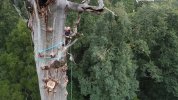
It did take me two days to reach the top of the tree. For the crew it must have been like watching paint dry. I climbed it, one foot at a time, every progression up was a futher risk to be considered.

The tree just completed which prompted my post was as challenging as Tahune, and in some ways worse. I eventually said, "no, thats it". I drew on option three that I supplied which was to winch the about 250 ton tree up hill against its lean. It was plausable because of the limbs removed. I also sourced a rotatory wing to snip 4 ton off the top but it didn't solve the trunk problems, so it stayed in the hanger.

Above the 120' mark, the last 60 feet of the shell (where it existed) was as little as 1 - 2" thick (8 -4' diameter) and I made a safe choice not to lop off the blocks. Demonstrating the "non event" of saying no and being prudent is unexpected and heathy for those who wish to pick it up.

Andrew Firth (Ascension Trees) came with his fleet of cameras and drone. Between assisting he has captured significant quality footage of the circus. In time I will work out how to edit a short with some narration.
Regards
 
CJM
To give you a scale this photo is at about 100' and applying the first of the 7 straps through the splitting and failing shell. I suggest it is larger and more fragile than Tahune at this point. Serious consideration had to be given to progress the next about 80' before cutting freeDJI_0039.JPG the large limbs.

Graeme
 
That is truly inspiring Graeme, can't wait to see the video. I can't believe what can stand up in the air supported by only an inch or two in thickness. Were you worried about breaking a section out or crushing the shell when winching it over?
 
There is Mr. McMahon, then there is the rest of us.
CJM
To give you a scale this photo is at about 100' and applying the first of the 7 straps through the splitting and failing shell. I suggest it is larger and more fragile than Tahune at this point. Serious consideration had to be given to progress the next about 80' before cutting freeView attachment 70852 the large limbs.

Graeme
Dealing with mass like that at 100ft is something very few on earth will ever experience.. Dealing with it when it is as compromised and rotten as that is mind blowing..

True next level stuff Graeme!..
 
Last edited:
This is a topic that has many avenues from where to start whether it’s from the bid aspect or what crew to send to complete a particular job. I think many companies have that crew or crews that they can send to the certain jobs that need to be thought out well and planned before executing. I’ve been lucky to work for a company that always puts SAFETY first with quality and production second. Knowing when to ask for advice or just to reassure what you’re thinking is in the realm of practicality to complete a job is a great confidence booster when what your thinking aligns with the one you’re running it by and asking advice from. Coming from a person that religiously second guesses himself allows me to confidently work the job. I’ve worked around many people that like to push the envelope because they think it makes them great climbers/bucket operators when in reality luck is NOT skill it’s just luck. It catches up with you at some point and I’ve far surpassed their abilities in a short amount of time and moved on to a better environment. With a great work ethic and positive attitude we can work in this industry for a long time. I’m still learning the ins and outs of using caution and reasoning to make the right call. One thing I pride myself on is I will never ask someone to do something I will not do myself.
 
That is truly inspiring Graeme, can't wait to see the video. I can't believe what can stand up in the air supported by only an inch or two in thickness. Were you worried about breaking a section out or crushing the shell when winching it over?
These tasks can be impressive however shouldn't blur our focus of how we determine tree and climber limits. The reason I described the recent removal was because it caused me again, to consider this issue for myself and others.

Despite climbers and tree fallers here being qualified for tasking there have been ongoing accidents in private and utility work. One reactive solution has been to write more checklists and directives for a tasks however this approach appears like a "band aid" to me. The core issue of qualifications not matching tasking and not coupled with experience is glaring and in some ways confirmed by those additional checklists.

How we obtain the experience to recognise the limits of both is important. Employers cannot afford to send employees away to obtain that experience. Additional regulation/ advisory lists are onerous if they fail to address the problem. I could not write a checklist for many of the trees we remove that would ensure climber safety. It seems that mentoring on site and developing an awareness is appropriate. Should the learner have gaps in skills or knowledge it can be topped up or addressed with the training organisation. I am interested in the thoughts of others.

If I were to offer a system that works for me as a contract faller with the hope it is found useful. The paper work is not with me for the 10 hours of work in the forest nor is it of value. I am continually scrolling my mental lists of hazards and looking for them during my work. I can be half way through a scarf and spot a bridged log that needs cutting or whatever. If the saw needs attention I fix it. I have the same system when climbing.

Developing this mechanism in all staff not just climbers may assist.

The thickness did vary however I felled the tree with a standard 24" bar and was never in doubt to cut all wood.

Regards
 
It seems that mentoring on site and developing an awareness is appropriate.

That is the simplest answer of all in my opinion. The hard part is finding the "qualified" mentor. I was lucky to grow up in a business where my father was my trainer and mentor. And I believe that this helps qualify me as such. (Just my opinion) Outside of luck, how do we search out or recommend a true mentor?
 
Mark, how did you get to the level of teaching you're at? I'm sure you've met many folks around the world who are in teachers and mentors at their companies around the world, anything stand out these folks that make them good mentors in the tree world?
 
Definitely a big topic.

Few thoughts.

Anyone who pushes the limits is an easy target in a court room up against, say, a safety trainer/organization. I could certainly imagine an organization like NATS heaping criticism on someone like Graeme for his techniques. Maybe they wouldn't call Graeme out because of his reputation, but say a similarly skilled unknown professional. Would probably get thrown off of a contract. I've seen this on a few occasions. (

Any large organization is going to discourage pushing the limits. Thus, the "limits" are defined in such a way that frees the organization and it's leaders from liability in the event that an accident occurs beyond their "limits".
^Much could be said about this topic.....

More limits are being pushed/experimented with in small companies, which rarely fall under the critical eye of safety institutions. Thus, their techniques, ideas, experience of what can and can't be done is often/easily discredited as unsafe. "Your honor, I knew it was safe because a seasoned tree guy I used to work for showed me." vs. "Your honor, TCIA says yada yada"..... and they get an expert in and make the skilled unknown look like an ignorant, foolish, hack tree guy/criminal.

Perhaps a private open minded organization that grades professionals based on years of experience/skill exhibited in normal-extreme situations. Someone like Graeme wouldn't be a bad person to head it.....

Cheers to you for your inspirational work!
 

New threads New posts

Kask Stihl NORTHEASTERN Arborists Wesspur TreeStuff.com Teufelberger Westminster X-Rigging Teufelberger
Back
Top Bottom