Hinge hold video, close ups

Colin

Administrator
Administrator
I've had this a while. I cut wide gobbed scarfs (notches), and have the video camera set up close and see what happens in slow motion.

I'll have to do some chronic tapered hinges the same again to prove the point that tapered hinges dont influence fall direction, but you have to have symetrical trees or palms with no wind or leans. I've done these before but have to get a real close up of the hinge breaking.

Anyway, this is a start.

Around 2mins and 10mb WMV

http://www.palmtreeservices.com.au/video/hingehold.wmv
 
Sir Rat

I didn't plunge cut any ... and yes wife working with me.

I dont take the plunge too often.
smile.gif


What you have to try and avoid is blocking the shot or spraying the camera with sawdust.
 
I guess I'm a bit confused about all this.

What are you saying, Erik? That a full-width tapered hinge is supposed to but does not make the tree fall differently from the notch direction? If so, what would give you the notion it would supposed to do that?

In my experience, the tree always falls toward the direction of the notch in the case of a side-leaner with a tapered hinge to give strength to the "high" side. When I speak of adjusting the gun I mean to fell it in the direction which will provide for the top to land where I want it, even if that's to the side of where the main stem goes. I do not ever try to second-guess when a straight hinge will break, thus allowing the tree to fall differently from the direction of the notch. Furthermore, I cannot possibly fathom anyone espousing such an action. The entire purpose of a tapered hinge in my use is to preclude such an occurrence.

And I would call that a textbook open-face cut.
 
I would prefer to see that done with a dicotolydenous tree known for good holding wood. I do not think that palms work well for demonstrating this sort of thing as their hinging characteristics are different from real wood. I do use tapered hinges in wood, but on palms I think they are fairly worthless.

I'm not trying to say that anyone is right or wrong about the tapered hinge/adjusted gun thing, just saying that it would be more instructive to see it demonstrated in a more reliable medium. Seeing this done in palms just doesn't mean much to me.
 
These were all straight hinges, the objective was to see how they break and how long they hang on ... they held on till the face closed.

I had pines with tapered hinges and they stay true to notch direction not the tapered hinge in another video but I didn't have the camera close up like this so you could see the hingewood breaking.

That's what I say, they fall true to the notch not the angle of the tapered hinge wood. But some say otherwise, so got to get evidence.

Leon, you have to find trees that are straight and symmetrical to fell like norfolks etc ... give some a tapered hinge and see if they fall true to notch or tapered hinge. Gotta make sure no external influencing factors like wind or canopy weighting.

I know, I know a guy who wants to clear his farm of pines ... I'll go see him, maybe I can pick out one or two to fell before the dozer gets there. Maybe bomb one down tomorrow on a radical tapered hinge.
 
In my imagery, a given tree with a given hinge position; all have the same hinge strength against the forward pull, no matter what the backcut/shape. Going even further, as long as the compression part of hinge(as real pivot) is in the same place, the hinges of same tree all have the same strength on forward axis at folding.

Because, the tree and pivot position don't change in the scenario, then the hinge must have same strength at first folding, for hinge strength is just a response/reflection to the sum of pulls/pushes (if using wedge) on it. So, same weight, length, angle on same pivot; all put the same forward force on the hinge hold/tension/stretch fibers that form strength. So pushing or pulling forward by outside forces of wedge and line strengthen hinge more; by placing more pressure on hinge; that the hinge responds to with an earlier folding/ more holding fiber/ more strength in response.

The tree folds forward because the narrow part of hinge is on forward/bakcward axis and has less leverage than the length across of the hinge. The the CG has to be on the right side of that axis. Cuz tree don't care which way it folds on narrow axis; so never walk behind one! It is how we arrange those chosen fibers at first folding, that controls the rest of the ride, and side to side leverage. But all the same forward strength/resistance; side to side resistance is by the arriangemeant/shape/positions of these chosen amount of fibers.

The tapered hinge chooses to reapportion the fiber distribution of this hinge so that the reach to farthest, tension fiber is longer leveraged distance from compressed pivot, places more fibers in these positions and 3rdly places these positions more inline behind the lean(so adjusts leveraged angle too). These fibers will have to stretch farther than the other fibers, and is why the high fiber on one side is on the front of Dent's bible on the subject.

Nature will take the most powerful route, so we can in hinge forensics note the most stretched fiber positions and predict the lean direction post mortem. A lot of times we will see the extreme outer corner of tapered hinge with most fiber pull showng this. Sometimes, the most stretched fiber will be jsut inside of this position, cuz Nature calculates that mixture of leveraged distance and angle(now more inline behind lean) to be greater power than the farther away fibers, but at less inline of an angle.

A tapered hinge will take a horizontal limb and get limb to slide sideways from over roof/obstachle; so works at most extreme leveraged position in this model. But an adjusted gun with face on top of horizontal limb will not make the limb travel sideways on a fairly horizontal plateau. So, doesn't show itself to work at all angles.

Adjusted gun works well on ground, but in air especially, i like tapered hinges and side dutchmans; so have explored them more! Because more cuts in air, and can reflect on the strategy at so many more different angles to get different glimpses of what is going on. like changing pivot of compressed fiber slightly is very powerful; for that can take away some length/angle from lean and give more length/angle to hinge(or the exact opposite); 2 adjsutmeants at once for a bigger/ compounding change. Thus the expression of a "pivotal change' meaning one of so strong/intense potential.

Palms aren't regular trees, more like "grass on steroids" (Gilman and Borschat). The face is very soft to count on the solid push of side kerf dutchamn for one thing; and the fibers pull out fairly easily IMLHO compred to 'real trees'. So, without the total resistance of the tension fiber; aren't going to shine as brightly in tapered hinge arena; but i still have gotten some of it from them. Now, a Live Oak; that is a completely different story...

So, in my book it is all mechanics; a hinge is a miniarature machine; and a tapered hinge properly done can give more length/angle multiplier to same generic fibers; that is more power by position, with all equal fibers IMLHO. Great effort but ya need sidelean to empower the the tapered fully; without that the results will be marginal/ not needed/ not used.

 
[ QUOTE ]
Great effort but ya need sidelean to empower the the tapered fully; without that the results will be marginal/ not needed/ not used.


[/ QUOTE ]

Excellent point Spydie. I agree completely.
 
But there was no one sentence conclusion as to whether or not a tapered hinge on a straight tree has any effect. Will the tree go down true to notch or tapered hinge?

There are only 2 answers here ... yes or no. some say yes it changes the fall direction some say no. Some-one mentioned that the hinge breaks from the back first so the thicker side just starts to break sooner.

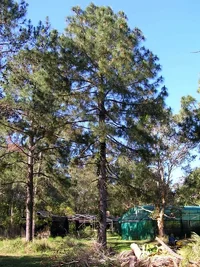
Anyway, this puppies going down tomorrow morning. Nice and straight, symmetrical. I'll cut a standard notch and have a tapered hinge. I'll have to set a pull rope high to get it going ... the camera will be zoomed right in on that hinge.
 

Attachments

  • 62935-PB180001-2.webp
    62935-PB180001-2.webp
    171.8 KB · Views: 125
I've seen straight trees fall almost 90o to the face using a tapered hinge.
I've split stumps lengthwise with the holding wood in a tapered hinge turning the tree.
I know they work .
I'll be back in a week.
 
I don't count on the tapered hinge to turn a tree. My observation is that the direction of the face cut determines the falling direction of the tree.

Nice video Ekka.
 
i was going to say i've gotten some performance out of a tapered without side lean; when instead i had good head lean and real weight as force to work with; and on a good diameter stump for leveraged distance; but never juiced a full 90 from it; great going Kev!. And see if that is what Kevin was referring to; but guess i need to take a brake instead.
 

New threads New posts

Kask Stihl NORTHEASTERN Arborists Wesspur TreeStuff.com Teufelberger Westminster X-Rigging Teufelberger
Back
Top Bottom