









Help Comparing Two Chains

Birdyman88

Branched out member
Location
Arlington
So I was cutting a large oak log today and something happened that got me scratching my head. The log was a downed 20 ft trunk about 30" diameter at end, and about 48" diameter at the last cut near stump. It was too risky to get on top of log, so I had bars long enough to cut in each piece in one pass. Everything was done with a 661, stock, with muffler mod. The two b/c setups were as follows.

Used Stihl ES 36" bar, used Stihl 3/8 .050" RS full chisel full complement chain, sharpened to stihl specs, rakers at .025".

New Forester Pro 52" bar, new Forester 3/8 .063" full chisel full skip chain, rakers factory at .025"

I have a lot of time with the 36" setup so I know how it cuts. I was expecting slow cut times with the 52". Well, I was totally surprised when the cut times of 52" totally blew away the 36". Not by a little, but by a lot. The times for the 52" in 48" wood were easily 2/3 of what 36" was in 33" wood. Plus that 661 purred like happy cat as long as didn't try to stand on it too hard. Chips were better defined on the 52" as well. The 52" had much more noticeable grab and I got to experience what a 661 REALLY feels like when it pulls in.

I sat out in the shop tonight making some measurements on the two chains, and I swear everything is almost identical, EXCEPT for tooth height - the 52" is taller. I looked at sharpening angles, depth gauges, distance from raker peak to tooth, angle of raker, gullet, and so on. Any thoughts?

The 36" chain is on top
The 52" chain on bottom
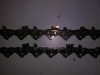
0904202158.jpg
 
Last edited:
Full comp has more to drag through the cut - maybe twice the drag.
That thought was on my mind, but to the best of my recollection, the 36" did not have any rpm drop or anything seeming like drag. In fact, the saw was spinning so good it would 4-stroke even if I let up the pressure just a little. With the 52, there seemed to be a little drag and the rpms were down some, but the saw kept pulling and hit a sweet spot with almost no 4 stroking.
 
My thoughts would be that the difference is twofold. First part being the skip chain would naturally tend to cut faster in big wood, as there are fewer teeth to drag through so much wood. Second being the new chain versus used chain, no matter how good you are a sharpening a chain, the precision grinders at the factory are always better.
 
I have run full skip for almost 30 year's except when I have had to purchase full comp. Full Skip cuts faster- it is a bit more aggressive and it will react in that upper 1/4 of the bar tip faster. Having said that it is excellent as long as it is sharp- I mean every tank sharp. It only takes about 2 minutes per side to touch up the teeth and worth 10-15 minutes per tank in labor savings. Cut true, cut sharp and stay in your kerf.
 
So I was cutting a large oak log today and something happened that got me scratching my head. The log was a downed 20 ft trunk about 30" diameter at end, and about 48" diameter at the last cut near stump. It was too risky to get on top of log, so I had bars long enough to cut in each piece in one pass. Everything was done with a 661, stock, with muffler mod. The two b/c setups were as follows.

Used Stihl ES 36" bar, used Stihl 3/8 .050" RS full chisel full complement chain, sharpened to stihl specs, rakers at .025".

New Forester Pro 52" bar, new Forester 3/8 .063" full chisel full skip chain, rakers factory at .025"

I have a lot of time with the 36" setup so I know how it cuts. I was expecting slow cut times with the 52". Well, I was totally surprised when the cut times of 52" totally blew away the 36". Not by a little, but by a lot. The times for the 52" in 48" wood were easily 2/3 of what 36" was in 33" wood. Plus that 661 purred like happy cat as long as didn't try to stand on it too hard. Chips were better defined on the 52" as well. The 52" had much more noticeable grab and I got to experience what a 661 REALLY feels like when it pulls in.

I sat out in the shop tonight making some measurements on the two chains, and I swear everything is almost identical, EXCEPT for tooth height - the 52" is taller. I looked at sharpening angles, depth gauges, distance from raker peak to tooth, angle of raker, gullet, and so on. Any thoughts?

The 36" chain is on top
The 52" chain on bottom

View attachment 70157
It’s a skip vs full comp. I run full skip on everything bigger than a 18” bar.
I don’t do many true hardwoods here in rural pnw so I can only speak from my experience.

Also careful with the 661 as the Oiler is the limiting factor for much bigger than a 36”
 
I've generally found this information from Madsens to hold true:

Our Advice
Bars 24" & Under
When running a bar length of 24" or less, full compliment is the best choice. It will always be the fastest and smoothest cutting sequence on short cutting attachments. Even those who are tempted to select a skip tooth configuration to reduce sharpening time, will find full compliment doesn't take much longer to sharpen. On short bar applications, there are are not that many more teeth.

Bars 28" - 32"
When running bar lengths of 28" to 32", the best sequence is less certain. In this range of bar lengths, the size of the cuts being made with the saw should to be taken into consideration when selecting the sequence. For example, sometimes longer bars are used to minimize bending on a job that requires a lot of limbing. In this case, the cuts are more similar to what would be done with short bars, so a full compliment chain is the best choice. On the other hand, if most cuts on the job require burying the bar in a deep cut, a skip sequence would probably be the best choice.

Bars 34" & Longer
When running bar lengths of 36" or longer, a skip sequence is usually the best choice. These bars are rarely run to eliminate bending over, and most often are used on jobs that require deep cuts. Even with these conditions, we do occasionally see full-compliment chain being run when the job also requires a fair amount of limbing. In the end, the best sequence for you requires some compromise and consideration of many factors.

As far as a factory grind being faster :ROFLMAO:

I could convert a factory round grind to a square grind and be almost 2 times as fast.
 
Wow, good info. So when my sharp 52 skip grabs much harder than the sharp 36 full comp, can I generally say that it is because the kerf is cleaner and the rakers and teeth can engage the wood better? Assuming all others things being somewhat equal.
 
Wow, good info. So when my sharp 52 skip grabs much harder than the sharp 36 full comp, can I generally say that it is because the kerf is cleaner and the rakers and teeth can engage the wood better? Assuming all others things being somewhat equal.
In wood larger than 36" I'd say that's an approximately accurate statement. I'm far from a PhD in chainsaw chain theory, but I do hang out at the opeforum with fellas who know a lot more than me.
 
One other tip when cutting big wood is to take the time to clean your kurf out.
I like my saw to have the quickest and fastest cutting capacity but I rarely use it. It’s not a race.
Think of felling a tree. You slowly cut the face in to get it perfect. Start the backcut, check that everything lines up, proper step etc. Cut a bit more until there is enough room for wedges. Cut a bit more, and double check your hinge.. cut a bit more and triple check your far corner. Nibble the hinge, pound wedges, nibble a bit more.. pound a bit more... tree starts to go, either leave it at that or blast the throttle to steer your hinge..

Bucking can go a little faster, but it’s often the same, cut/tickle tickle cut/cut..

When I have to cut balls out is for massively leaning alders. A good sawyer with a fast saw can cut past a barber chair. If I’m felling a bunch of leaning alder I’ll go for the biggest powerhead with the smallest chain and bar combo. Besides organizing this is the exact reason I run .050 3/8 full skip Stihl on all my saws.
 
It’s a skip vs full comp. I run full skip on everything bigger than a 18” bar.
I don’t do many true hardwoods here in rural pnw so I can only speak from my experience.

Also careful with the 661 as the Oiler is the limiting factor for much bigger than a 36”
Ms661 has an increased output option for oil.

Ya, full skip, more space for chips to fill and ride out of the kerf.
 
Here's a twist on it. Ever look at the teeth on the big band cut off saw at the metal store? King kong teeth. Compared to a normal bandsaw or your hacksaw. It's meant to set into big spans like 4 or 6" wide solid steel or aluminum. If you consider your hacksaw, you know it needs pressure to cut, more depending how dull the teeth are, just like a chainsaw. Point being, I'm not sure how often or if ever I have a saw that grabs into the wood of its own accord just by negligible contact. I think there's always a little feed force, even after the first few seconds cutting on the very sharpest chain. So like a hacksaw, picking your teethperinch, the applied pressure is spread over the number of teeth contacting, so if you have half as many teeth in contact each tooth gets double the feed force for the same arm/hand power applied at the handle. And then cut "better".

In a tough wood like oak required contact pressure might be a bit higher.

As to what forces and range that are ok its a bit of voodoo because there's the whole raker depth, distance from raker to tooth, the raker link not pulling in a straight line to the tooth cutting edge, angles etc and likelihood that the chain doesn't stay straight during a cut, not to mention how that could also change depending how dogged in and/or dull you're running. Dull meaning perhaps 1/4 or 3/4 the way to needing a sharpen but still working "ok".

Same limitation in metal work, coarse blade cuts great but gets squirrely if you get too few teeth in contact with the work, like cutting across a thin wall section. Like not using skip on a short bar. In passing, if you go to town on a coarse tooth blade it cuts like snot till you nuke the teeth tips - because of the running at higher contact pressure.

Just rambling. take care
 
, the applied pressure is spread over the number of teeth contacting
Hmmmmm, interesting thought. I believe you're correct on that. Never thought of it that way. So I probably have multiple factors at work here. I do believe the pressure thing is legit, add to that the increased weight of b&c.
 
I see the light, of the skip tooth..
just swapped the 24" bar I have been running for a 28" skip tooth, and the thing is RIPPING. a husky 562. bucking through oak like a champ.
had the same thoughts here, don't know if it's just the fresh chain and all, but I am a happy camper. seems to respond perfectly to the way I cut. figured less teeth would be less cut, but the saw just seems ready to fly with this combo.
 

New threads New posts

Kask Stihl NORTHEASTERN Arborists Wesspur TreeStuff.com Teufelberger Westminster X-Rigging Teufelberger
Back
Top Bottom












