rbreesems
New member
TLDR: I got into Vertical caving with no previous caving experience, and learned some interesting stuff. Skip this if you have no interest in caving or already a caving veteran (this will sound like the blathering of an excited Kindergartener after their first day at school).
I am not getting any younger, and for a long time, have had this itch to do some ‘caving’. I finally decided to scratch that itch, and here is what I learned.
Horizontal caving is a exploring a cave that requires no rope descent, Vertical caving requires rope descent (this is what I was interested in).
Caving is not a solitary activity; you need the support of experienced cavers who are willing to instruct and take you on their trips. To me, this came in the way of a ‘Grotto’, which is a local chapter of the National Speleological Society (NSS). I am lucky enough to live near Huntsville AL, which is a caving mecca and home of the NSS, and has a large, active Grotto who welcome new members. They hold one horizontal and one vertical trip each month. Huntsville is also home to the Huntsville Cave Rescue Unit, which is a volunteer organization, and they hold SRT and cave rescue training for anyone who is interested.
I found out about the Huntsville Grotto through web search. I contacted them, explained my tree climbing background and asked how could I get involved. They said I should come to their next ‘vertical climbing practice’, which I did. I naively thought that my tree climbing gear would suffice for vertical caving. However, at that practice, I was introduced to the gear and techniques they use, and realized that I needed to make some purchases! I have since been on two vertical caving trips with the Grotto.
Here is what I learned about vertical caving gear:
I have been on two vertical caving trips. The first was to Varnedoe cave (8 cavers, 7 guys, 1 gal), which is managed by the Southeastern Cave Conservancy, and which is located in the Huntsville metro area. This is a multi-drop cave with descents of 73’, 15’, 41’, 72’. At the bottom is a large horizontal cave portion which we did not explore. There were a couple of tight squeezes in the cave in the sections we went through, but nothing too bad. The second vertical trip was to War Eagle cave (southeast of Huntsville, 8 cavers on trip, all guys). This has one initial drop of 137’, and then a large ‘subway’ tunnel at the bottom with a stream which you can follow in either direction. We spent about three hours exploring the horizontal cave portion. This cave has many beautiful formations in it.
Things I learned about caving in general:
So far I have had a lot of fun on these trips and plan on more, and I am thankful to the supportive members of the Huntsville Grotto.
Below is couple of links to poorly-lit Youtube of videos of my two trips, plus some photos of my gear. On Youtube, I found that videos by ‘Derek Bristol’ were very helpful for caving-related gear/techniques, and he also has some videos of some epic trips that he has been on.
Varnedoe Cave (youtube)
War Eagle Cave (youtube)
I am not getting any younger, and for a long time, have had this itch to do some ‘caving’. I finally decided to scratch that itch, and here is what I learned.
Horizontal caving is a exploring a cave that requires no rope descent, Vertical caving requires rope descent (this is what I was interested in).
Caving is not a solitary activity; you need the support of experienced cavers who are willing to instruct and take you on their trips. To me, this came in the way of a ‘Grotto’, which is a local chapter of the National Speleological Society (NSS). I am lucky enough to live near Huntsville AL, which is a caving mecca and home of the NSS, and has a large, active Grotto who welcome new members. They hold one horizontal and one vertical trip each month. Huntsville is also home to the Huntsville Cave Rescue Unit, which is a volunteer organization, and they hold SRT and cave rescue training for anyone who is interested.
I found out about the Huntsville Grotto through web search. I contacted them, explained my tree climbing background and asked how could I get involved. They said I should come to their next ‘vertical climbing practice’, which I did. I naively thought that my tree climbing gear would suffice for vertical caving. However, at that practice, I was introduced to the gear and techniques they use, and realized that I needed to make some purchases! I have since been on two vertical caving trips with the Grotto.
Here is what I learned about vertical caving gear:
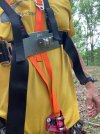
- A caving harness is different from a rock climbing harness or tree harness, in that it is mostly made out of webbing for weight purposes, and has a single ‘omni-carabiner’ that essentially serves as the bridge (everything life support attaches to this, see photo). I purchased a MTDE ‘Pico’ harness from ElevatedClimbing.com. There are other harness types, this one is relatively comfortable.
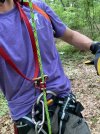
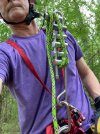
- For ascent, the Grotto members either use a frog technique, or a rope walker, but their rope walker involves offset dual ascenders with foot loops, with the bungie attaching to a chest roller plate. I eventually settled on a tree-climbing style rope walker, using a HAAS knee ascender, foot ascender, chest roller, and camp Turbo chest ascender on the omni-carabiner bridge providing a low attachment point. I added the chest roller for my second vertical trip and it reduced my arm strain to practically nothing and made ascent much easier.
- For descent, the overwhelming choice by Grotto members is a rack, either full sized or micro (less horizontal bars than a full size rack, shorter). The rack is most flexible in terms of accommodating wet/muddy rope, and different rope sizes. It is fairly straight forward to use, but still requires practice to get comfortable with it.
- The Grotto members use PMI ‘pit rope’ exclusively either, 9 mm or 11 mm. This is a really tough rope made for caving, and is stretchy on long descents. I understand why they use it, but I don’t like the rope, poor hand and its rough cover means it does not pass through your ascender gear very smoothly (true for 11 mm at least).
I have been on two vertical caving trips. The first was to Varnedoe cave (8 cavers, 7 guys, 1 gal), which is managed by the Southeastern Cave Conservancy, and which is located in the Huntsville metro area. This is a multi-drop cave with descents of 73’, 15’, 41’, 72’. At the bottom is a large horizontal cave portion which we did not explore. There were a couple of tight squeezes in the cave in the sections we went through, but nothing too bad. The second vertical trip was to War Eagle cave (southeast of Huntsville, 8 cavers on trip, all guys). This has one initial drop of 137’, and then a large ‘subway’ tunnel at the bottom with a stream which you can follow in either direction. We spent about three hours exploring the horizontal cave portion. This cave has many beautiful formations in it.
Things I learned about caving in general:
- These two caves were BIG. My mental model of caves were all tight passages, close spaces. These caves have huge spaces in them, especially in War Eagle, the stream tunnel was easily the size of a subway, if not larger in most places. There are plenty of caves in AL with tight passages, squeezes but I have not been in them yet.
- I did not realize that the vertical drops were so long, I am told the average vertical drop in Alabama is 100’.
- You are going to get wet and muddy.
- Modern LED head lamps make lighting in caves not an issue. I was a bit concerned about this being new to caving. I was surprised at how just a little bit of light makes a big difference.
- The temperature in AL caves is 58F degrees. It is perfect.
- Going over the edge on descent, and getting back over the edge on ascent, is the toughest part. If the edge is a ‘knife edge’, where you do not have a place to put your feet to help out, makes it harder. The edge in War Eagle was a knife edge, and I had a difficult time on ascent getting over it, need more practice.
- The Varnedoe cave had pre-installed bolts at the drop points to be used for rigging the descent rope. Seems that most caves the Grotto members frequent have pre-installed bolts if it is a multi-drop cave.
- Trees used at cave entrances for rigging are padded to prevent injury to the tree, since they are used so much by the cavers visiting the cave.
- Rope pads are very important at edges if the edges are sharp to prevent ropes from being damaged.
So far I have had a lot of fun on these trips and plan on more, and I am thankful to the supportive members of the Huntsville Grotto.
Below is couple of links to poorly-lit Youtube of videos of my two trips, plus some photos of my gear. On Youtube, I found that videos by ‘Derek Bristol’ were very helpful for caving-related gear/techniques, and he also has some videos of some epic trips that he has been on.
Varnedoe Cave (youtube)
War Eagle Cave (youtube)