









Fluffy Floofy Puffy Dusty...Fungus?

What is this stuff?

  • Insect eggs

    Votes: 0 0.0%
  • Foam Insulation

    Votes: 0 0.0%
  • Aerial Puffball

    Votes: 1 100.0%
  • Excrement

    Votes: 0 0.0%

  • Total voters
    1

guymayor

Branched out member
Location
East US, Earth
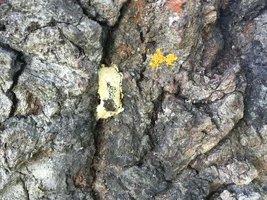
This popped up on a Q robur. Black specks (spores?) fly out when it gets poked. Had not been seen on this tree before. Observations and testimony go back a century. Europe's Tree of the Year, 2015.

Trunk is quite hollow. Vitality is medium/high. Proximal, inside of this feature, there are signs of advancing interior decay. Also new is documented (but not severe) fluxing at the flare.
IMG_0628.webp
 
The central object is the aethalium of a slime mold or myxomycete. That is the spore-containing stage. The diffuse margins makes me think of what we used to lump together as Fuligo septica, the "dog vomit" fungus. I've got a little slime mold article I wrote for the ASCA magazine linked to my FS website. Click on profile for the link.
 
Interesting. I've heard people refer to the symptoms from breathing in chip mold as dog vomit. Same thing?
 
Kevin, where do you go to for info on Myxomycetes? Other than the old Stephenson and Stempen book what resources are there? How do you ID a Myxomycete in the first place? Dog Vomit Slime Mold is pretty common and everybody has seen it but how does somebody know that is a slime mold and not something else?
 
Levi, no I don't think this is related to what you describe.

The "slimy" motile stage (not pictured) of slime molds move across their local landscape, feeding on littler, often single-celled critters. They are highly sensitive to temperature and moisture gradients. They also need to acquire enough energy to afford hunkering down. So forming the structure in the picture requires the right external environment and internal energy and element status according to the genetic program. So its's a lot like everyone else.
I'm no expert on the group...few folks are! Most of the folks who can claim expertise are more interested in regulation of molecular biology rather than their natural history. Although not a fungus, mycologists have traditionally studied slime molds and I try to keep up the tradition.

Ha, ha, I don't know what you are missing inside or outside of ASCA. A couple of years ago they asked for a couple of articles, which I supplied, and then they stopped asking. I do have my first invitation to speak at the ASCA conference in December. So we shall see.
 
Good question MrTree! You're right of course, anyone who works with trees and even lawns should know Fuligo.

I had the good fortune of graduate school programs in mycology that introduced me to primary source material and the people who actually did the research.

But materials are available. The Stephenson and Stempen Handbook is still pretty useful and valid but there are some other options:

George Barron's field guide of Mushrooms of Northeast North America has most of the ones I usually encounter.

Harold Keller has spent a career on the group and for an introduction to his work try:
http://www.fungimag.com/spring-08-articles/keller-low-res.pdf

And although a bit clunky, an NSF-supported myxo project is available at:
http://www.discoverlife.org/mp/20q and links therein.
And some of the challenges for students are described at:
http://www.ncbi.nlm.nih.gov/pmc/articles/PMC3577316/#b7-jmbe-13-2-180

Although not an expert, I have a real affection for the group.
 
Kevin I think there is a massive lack of knowledge within the the arboriculture world with regards to tree associates and ID. Most tree workers have no idea how to separate fungi from bacteria from myxos etc. yet many espouse on them. I have a school trained arborist friend who does not know a bit of fermented sap from Kretzschmaria, let alone that Diachea leucopodia is a myxo not a toadstool, in another case a consultant condemned a tree based on the presence of Aleurodiscus. The follow on is that most tree workers fell no need for identification and the help of somebody with more knowledge.
 
Nice they asked on a rare east coast swing--driving distance for you huh? I might see you there.

The cylindrical shape and the random location really baffled me this time!

mrtree is right about lack of knowledge and lack of caring about associates--they should be considered innocent until proven guilty!
 

New threads New posts

Kask Stihl NORTHEASTERN Arborists Wesspur TreeStuff.com Teufelberger Westminster X-Rigging Teufelberger
Back
Top Bottom












