pete3d
Participating member
- Location
- Hinchinbrooke
 After a winter of success with a field anchor I thought I’d pass on my experience for those of you who haven’t yet tried this rudimentary but effective device that can make tree pulling less stressful.
As previously noted I operate a “Mickey Mouse” operation which consists of me (and the Chipmunks) on foot, in the snow, felling, and occasionally climbing trees for wood lot improvement. This winter I was working down a field edge mostly felling doomed ash out into the field. The snow was deep enough that bringing the tractor-skidder was possible, but not worth the effort. We all know that trees at the edge of a clearing reach and bend out into the open - yes, but not consistently, and their branches are often entwined with their neighbours leading to frequent hang ups while the tree is still close to vertical. As a result I have sworn off wedges for felling, and unless the tree is clearly free of obstructions and leaning more or less in the desired direction, I install a rope anchored to the tree, employing a ladder (yes that’s right the anathema) about 18 feet up (on large, difficult trees I’ve climbed and installed the anchor as much as 60’ up for more control and leverage) and then direct the rope to a block anchored to something, like a tree, a fairly heavy vehicle, or as in this case, a field anchor, and redirect the rope back to my Maasdam rope puller, which I anchor to a tree in a convenient, safe spot from which I can comfortably observe the tree which I’m felling. Being alone this approach keeps me relaxed and well away from, but in a front row seat to oversee “the action” as the timber falls.
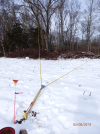
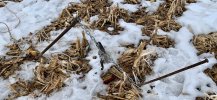
The attached photo shows how simple my field anchor is. I “made” it with odds and ends from the scrap pile and a pass or two with the welder. The first anchor element is an old 27mm drive shaft from something, but a decent crowbar would do. Where I’m using the chains (bits from my daughter’s motor block puller) I think a mid sized ratchet strap would probably be better, as it would be lighter and very easy to pre-load. The smaller anchor element is a 3/4” bar, but just about “any old thing” would do. Please note the vice grips on the smaller anchor - they are essential (and handy to rotate the bars for easier extraction) - the only time I had an anchor failure was as a result of the vice grips being hastily installed, the chain slipping up and everything upending.
Having worked through the winter with the anchor in both frost free and mildly frozen ground (there was usually no frost under the ±18” of snow I was digging through to install it) I found it reliable, easy to install (with a sledge hammer), and surprisingly easy to remove. Note that I was installing it in heavy clay soil and you would definitely have different results in other soil types. In my case, it was able to resist a load of about 4500 lbs. (the Maasdam rigged 3 to 1) handily. It’s essential to keep the anchor points as close to the ground as possible, that’s to say clear away any snow or spongy vegetation, and don’t forget those vice grips. The primary bar may get bent a bit but just install it the “other way ‘round” the next time you hammer it in.